
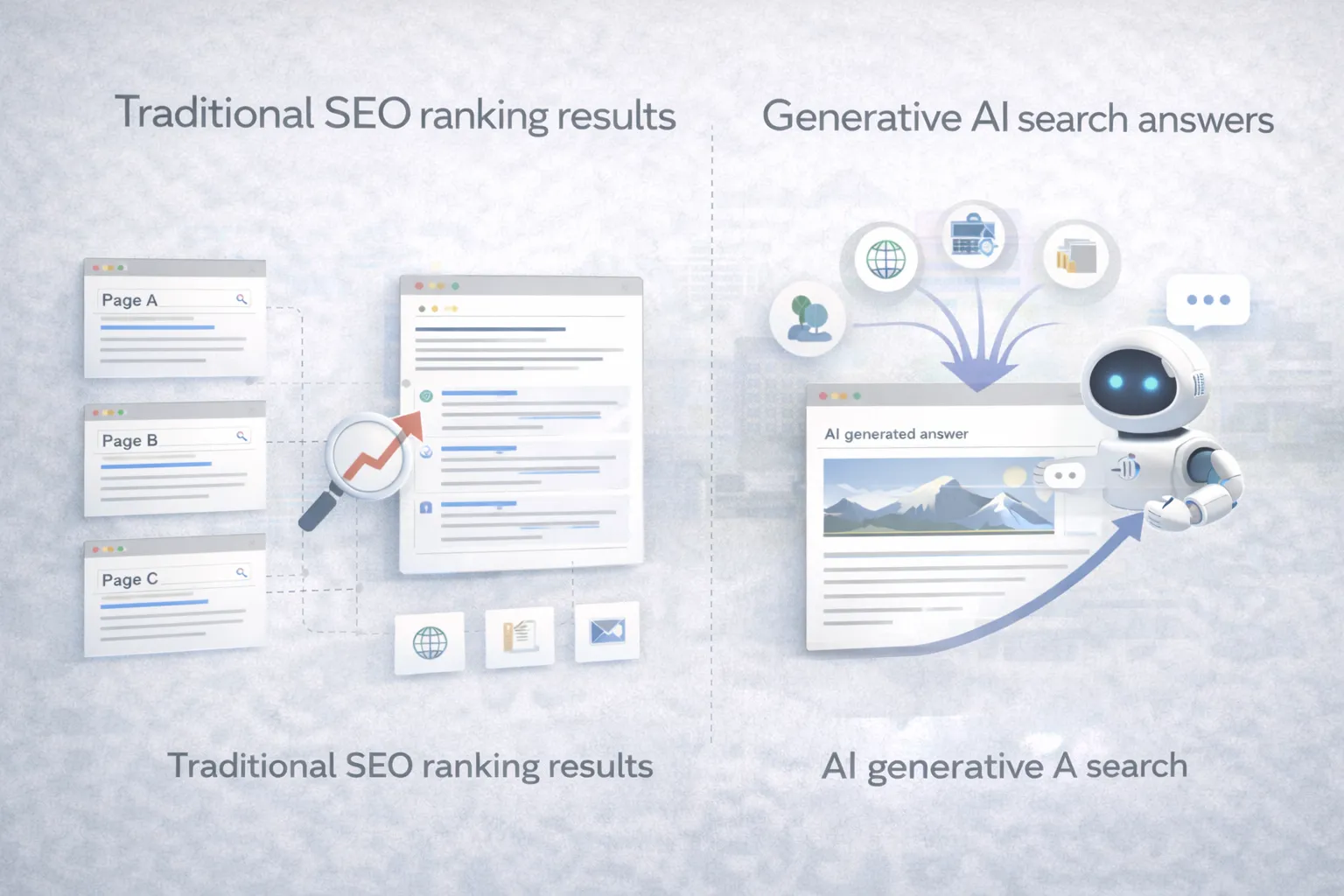
SEO vs Generative Search: What Changes in 2026?
Search is going through its biggest shift since the introduction of mobile-first indexing. Traditional SEO is no longer the only way users discover information. With AI-driven search experiences, zero-click answers, and generative engines becoming mainstream, the rules of visibility are changing.
This guide explains SEO vs generative search, what is fundamentally changing in 2026, and how businesses should adapt to stay visible in an AI-first search environment.
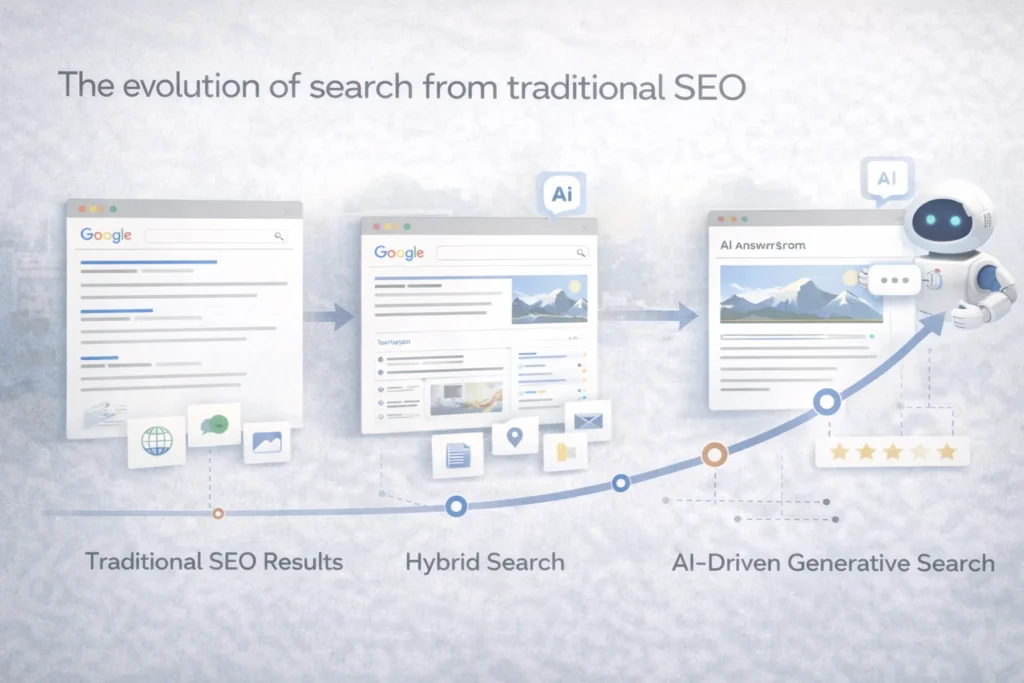
What Is Traditional SEO?
SEO (Search Engine Optimization) focuses on improving a website’s visibility in organic search results.
Traditional SEO relies on:
- Crawling and indexing
- Keyword relevance
- Content quality
- Backlinks and authority
- Technical performance
- User experience
The goal of SEO is simple: rank pages in search results and drive traffic to a website.
SEO is still essential, but it is no longer the only visibility layer that matters.
What Is Generative Search?
Generative search refers to AI-powered search systems that generate answers directly instead of showing only a list of links.
Examples include:
- AI Overviews
- Generative answers
- Conversational search responses
- Zero-click summaries
Instead of ranking pages, generative search systems synthesize information from multiple sources and present answers directly to users.
This changes how content is discovered, credited, and trusted.
SEO vs Generative Search: The Core Differences
1. Rankings vs Answers
- SEO focuses on ranking pages
- Generative search focuses on generating answers
Visibility is no longer limited to page positions.
2. Traffic vs Exposure
- SEO aims to drive clicks
- Generative search often delivers visibility without clicks
Brand presence becomes as important as traffic.
3. Keywords vs Context
- SEO relies heavily on keywords and optimization signals
- Generative search relies on context, meaning, and semantic clarity
Content must be understandable, not just optimized.
4. Pages vs Entities
- SEO optimizes pages and URLs
- Generative search evaluates entities, relationships, and authority
Clear entity signals matter more than ever.
What Is Fundamentally Changing in 2026?
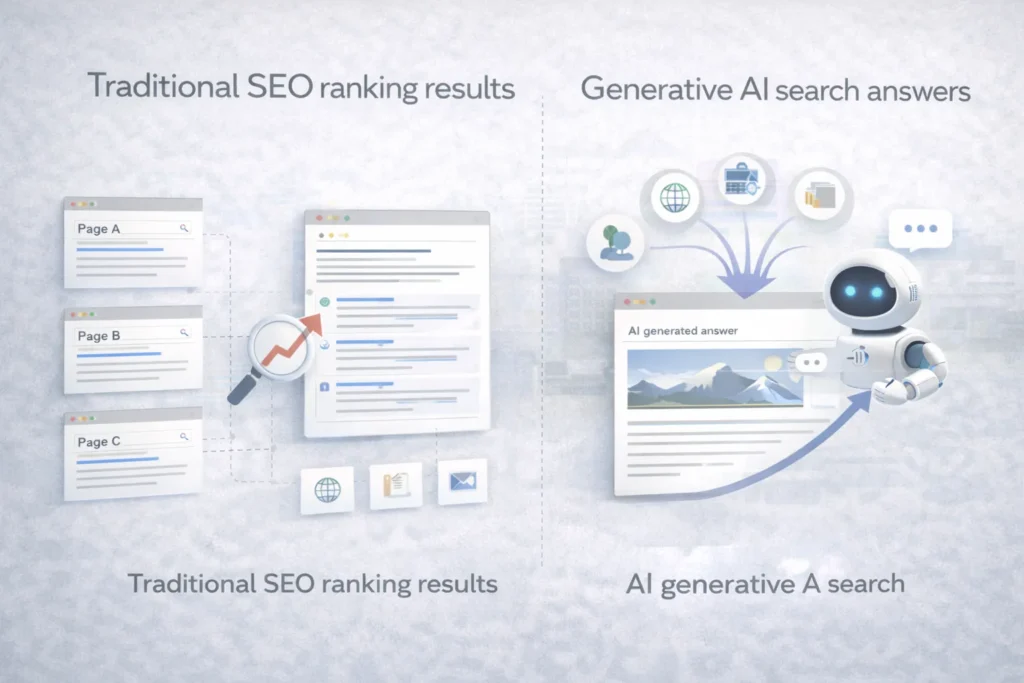
Search Is Becoming Interpretive
Search engines are no longer just matching queries. They are interpreting intent and synthesizing responses.
This means:
- Clear explanations matter more
- Ambiguous content is ignored
- Structured answers perform better
Visibility Is Fragmenting
Users may see:
- An AI answer
- A short list of sources
- No traditional blue links at all
Websites must earn inclusion, not just rankings.
Authority Is Evaluated Holistically
Generative systems assess:
- Topic depth
- Consistency across content
- Trust signals
- Author and brand credibility
One-off optimized pages are less effective.
Does Generative Search Replace SEO?
No. Generative search does not replace SEO.
SEO still provides:
- Crawlable infrastructure
- Indexable content
- Technical trust
- Commercial intent visibility
Generative search builds on top of SEO.
Without SEO, generative systems struggle to trust and understand content.
How SEO and Generative Search Work Together
Modern visibility requires integration, not replacement.
SEO ensures:
- Your content can be accessed
- Your site performs well
- Your pages are eligible
Generative optimization ensures:
- Your content is understandable
- Your answers are extractable
- Your brand is referenced
The strongest strategies combine:
- Technical SEO foundations
- Intent-driven content
- Clear answer formatting
- Consistent topical coverage
Who Needs to Care About Generative Search?
Generative search impacts:
- Service businesses
- SaaS companies
- Consultants
- Publishers
- Local businesses
- E-commerce brands
Any business relying on organic visibility should adapt.
How Businesses Should Prepare for 2026
Instead of chasing trends, focus on fundamentals that support both SEO and generative search:
- Build clear topical clusters
- Answer real questions directly
- Use structured content
- Maintain technical health
- Strengthen brand and entity signals
These practices future-proof visibility.
Final Thoughts: SEO vs Generative Search in 2026
SEO is not dying.
But SEO alone is no longer enough.
Generative search changes how visibility is earned, not whether SEO matters. Businesses that understand this shift early will gain a long-term advantage as AI-driven search becomes standard.
The future belongs to brands that combine strong SEO foundations with content designed for understanding, not just ranking.