
I’ve witnessed firsthand how the digital landscape is transforming. AI search fundamentally differs from traditional search by shifting from keyword-based to. And one-off queries that deliver lists of links to conversational, multi-turn interactions that provide synthesized, direct answers tailored to user intent. Traditional search relies on exact matches and deterministic algorithms, often leading users to click through results.
In contrast, AI search employs semantic understanding and generative models to summarize information across sources, reducing the need for navigation and emphasizing quick, accurate responses. This evolution has been propelled by the rapid rise of tools like ChatGPT, which now boasts billions of interactions, alongside Google’s Gemini (integrated into AI Overviews reaching 2 billion users), Perplexity for search-focused AI, and Claude as a strong competitor, collectively reshaping how over 50% of consumers access information in 2025.
For SEO professionals and businesses, this change signals a pivot toward optimizing for AI visibility—potentially impacting $750 billion in revenue by 2028—where traditional rankings may decline (with organic CTR dropping up to 61% due to AI Overviews). Still, opportunities arise in creating E-E-A-T-rich content that fuels AI responses, demanding adaptation to maintain traffic and conversions in an era where AI could overtake traditional search by 2028.
How AI Search Works Behind the Scenes
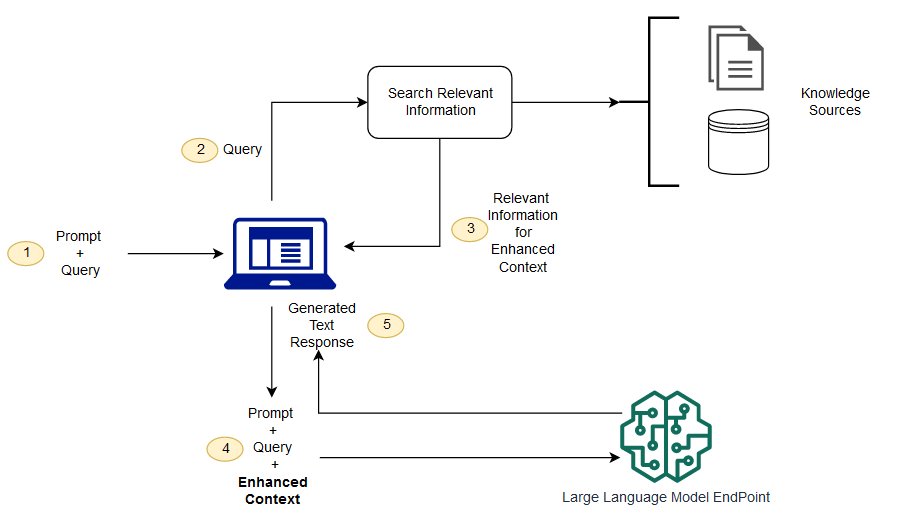
AI search engines, such as Google’s AI Overviews, ChatGPT, Gemini, and Perplexity, operate through a sophisticated process known as Retrieval-Augmented Generation (RAG), where they first retrieve relevant information from vast indexes and then generate coherent answers.
In the retrieval phase, the system breaks down the user’s query into semantic components, searches its knowledge base or external sources for matching documents, and ranks them based on relevance, often using vector embeddings to measure similarity rather than exact keywords.
Once retrieved, these “chunks” of data are augmented into a prompt fed to a large language model (LLM), which generates a natural-language response by synthesizing the information, ensuring it’s concise and accurate while citing sources to maintain transparency. This hybrid approach minimizes hallucinations by grounding outputs in real data, differing from pure generative AI.
Search indexes, crawling, and ranking signals play pivotal roles in AI search, mirroring yet extending traditional search mechanics to handle dynamic, conversational queries.
Crawling involves
Crawling involves bots systematically discovering and fetching web content, updated frequently to capture fresh data, which is then parsed and stored in massive indexes—structured databases that organize information for quick retrieval using techniques like inverted indexes or vector databases for semantic search.
Ranking signals, expanded in AI contexts, include traditional factors like backlinks and page authority, plus AI-specific ones such as content freshness, user engagement metrics, and E-E-A-T (Experience, Expertise, Authoritativeness, Trustworthiness), where machine learning models score documents for relevance before feeding them into the generation step. This ensures AI prioritizes high-quality sources, but inefficiencies in crawling (e.g., blocked robots.txt) can exclude content entirely.
AI search heavily depends on SEO-optimized content because it primarily draws from top-ranked web pages in traditional search results, ensuring the generated answers are based on authoritative, well-structured, and intent-aligned material that adheres to SEO best practices.
SEO elements like keyword optimization, mobile-friendliness, and schema markup make content discoverable during crawling and indexing, while E-E-A-T signals help AI rank and select reliable sources to avoid inaccuracies.
Without SEO, content may not be indexed or deemed credible, leading to exclusion from AI responses—studies show 76% of AI citations come from top-10 Google pages, underscoring that AI amplifies rather than replaces SEO efforts.
This interdependence means businesses must continue SEO to fuel AI visibility, as unoptimized sites risk invisibility in conversational search.
From Rankings to Answers: The New SEO Goal
Traditional SEO has long revolved around ranking pages high in search results to capture clicks and drive traffic, but the emergence of AI-powered search is pivoting the focus toward delivering direct answers that satisfy user queries without necessitating a visit to your site.
Ranking pages aims to secure top positions in SERPs through keyword optimization and authority building, fostering user navigation to your content for deeper engagement; in contrast, delivering direct answers prioritizes concise, accurate responses that AI can summarize and serve instantly, aligning with conversational queries where users seek immediate solutions rather than exploration.
This shift doesn’t render rankings obsolete but evolves them, as high rankings still feed AI systems with credible sources, yet the goal expands to crafting content that excels in both contexts for sustained relevance.
Zero-click searches, where users get answers without leaving the search page, have surged to over 65% of queries in 2025, largely driven by AI summaries like Google’s AI Overviews, which synthesize information from top sources and display it prominently, reducing the need for clicks by up to 61% for affected results.
These AI-driven features, now live in tools like ChatGPT and Perplexity, pull from optimized content to generate responses, meaning businesses must adapt by creating snippet-friendly material that appears in these overviews, even if it means fewer direct visits but greater brand exposure.
AEO (Answer Engine Optimization) Explained
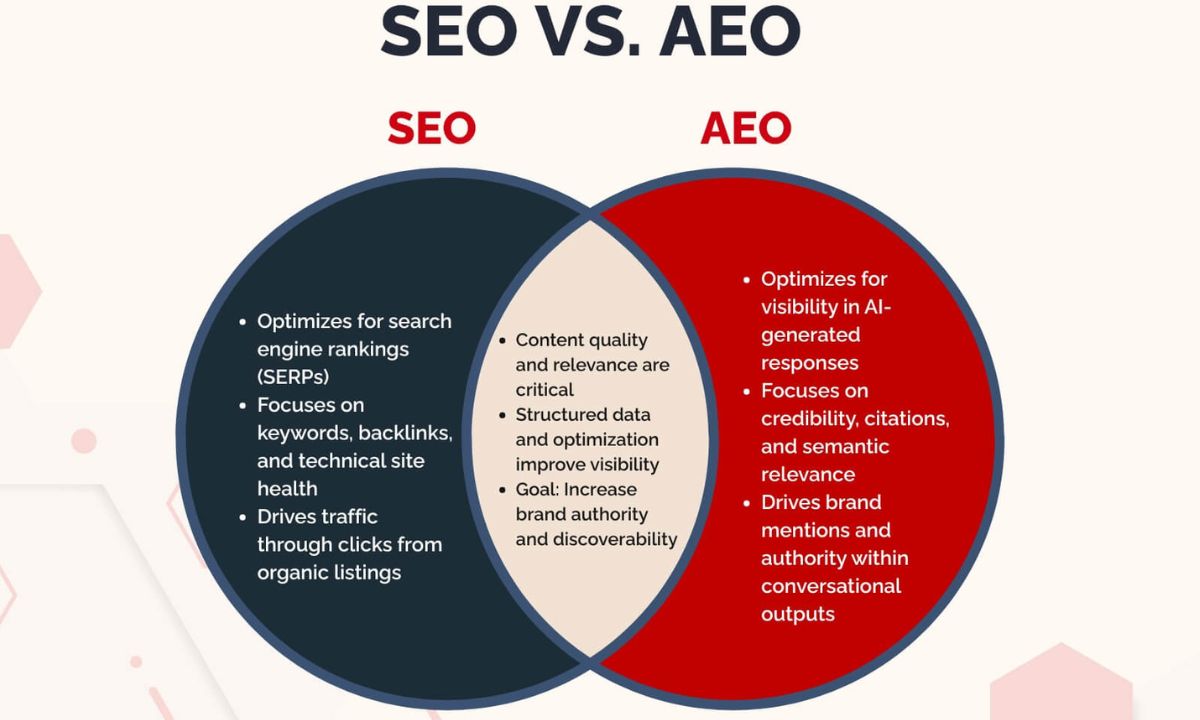
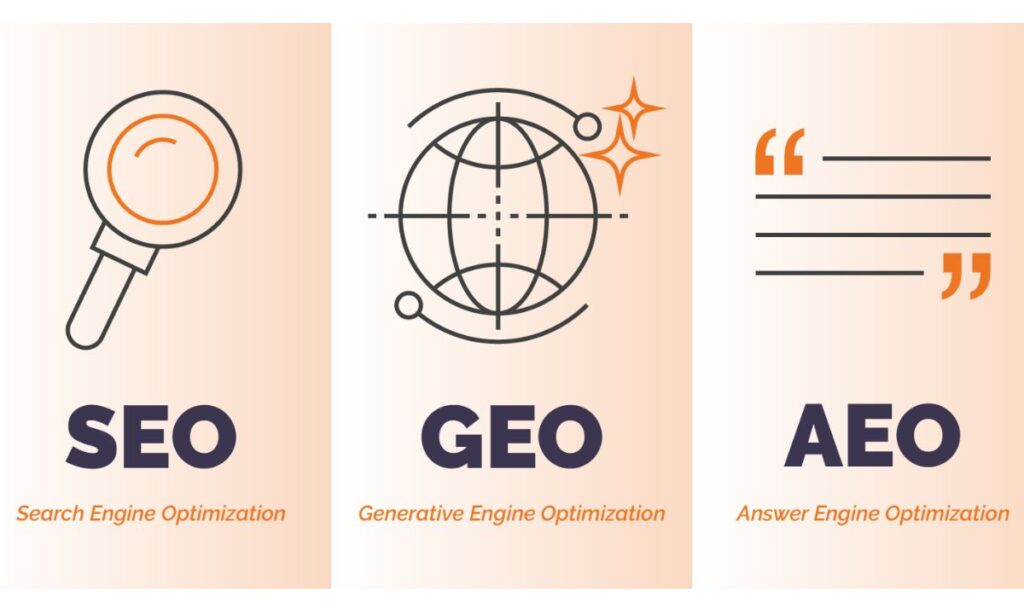
Answer Engine Optimization (AEO) is the practice of creating and formatting content to make it easily discoverable and usable by AI-driven answer engines, such as chatbots and search assistants, ensuring it appears in direct, summarized responses to user queries.
AEO overlaps significantly with Search Engine Optimization (SEO), as both aim to align content with user intent through high-quality, relevant material that emphasizes E-E-A-T (Experience, Expertise, Authoritativeness, Trustworthiness), structured data, and keyword integration to enhance visibility.
However, while SEO focuses on ranking pages in traditional search results to drive clicks, AEO prioritizes positioning content as the source for AI-generated answers, often building directly on SEO-optimized pages that rank well.
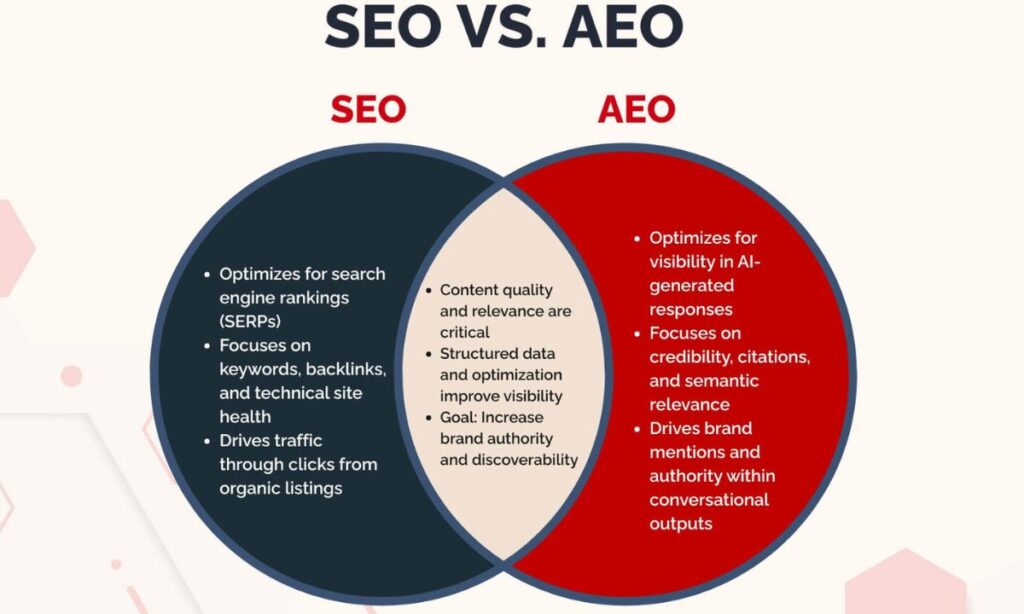
AEO enhances SEO rather than replacing it because AI engines predominantly source from SEO-optimized, high-ranking pages, meaning strong SEO practices are essential for AEO success and visibility in answer formats.
By focusing on direct answers, AEO complements SEO’s traffic-driving goals, boosting overall exposure through features like snippets while maintaining the need for comprehensive, clickable content. This synergy allows businesses to adapt to zero-click trends without abandoning proven SEO strategies, ultimately improving ROI in an AI-dominated search era.
E-E-A-T and Brand Authority in AI Search
E-E-A-T stands for Experience, Expertise, Authoritativeness, and Trustworthiness, a framework Google uses to evaluate content quality, which has become increasingly vital in AI search engines as they prioritize credible sources to generate reliable responses.
Experience refers to the creator’s hands-on knowledge in the topic, such as a doctor’s personal insights on health issues; Expertise highlights specialized skills or qualifications, like certifications in a field; Authoritativeness measures recognition from peers or industry, often through citations or awards; and Trustworthiness ensures content is accurate, transparent, and unbiased, backed by reliable sources.
AI search
In AI search contexts like Google’s AI Overviews or ChatGPT, E-E-A-T helps build brand authority by signaling to algorithms that your content is dependable, leading to higher inclusion in synthesized answers and improved visibility.
This framework encourages creators to demonstrate real-world application, depth of knowledge, respected status, and ethical practices, making it essential for standing out in 2025’s AI-driven landscape.
SEO and AEO
Combining SEO and AEO forms a robust strategy where SEO handles rankings and traffic generation, while AEO optimizes for AI inclusion in answers, creating a unified approach that captures both clicks and zero-click exposure for superior ROI.
This synergy leverages SEO’s depth for discoverability and AEO’s focus on concise, intent-matched responses, such as through FAQs and structured data, ensuring content performs across traditional SERPs and AI platforms.
In practice, blending them—like using SEO for backlinks and AEO for snippet optimization—future-proofs strategies, as most AEO tactics build on existing SEO efforts without replacement.
To future-proof your website for AI search, prioritize creating unique, E-E-A-T-aligned content that answers queries directly, incorporate schema markup for better AI parsing, and focus on brand mentions over just links to enhance visibility in generative responses.
Optimize FAQs
Optimize for conversational intent with FAQs, tables, and mobile-friendly designs, while building authority through consistent, high-quality publishing to ensure AI tools cite your site reliably. Monitor performance with tools like Search Console and adapt to trends like voice search, turning AI shifts into advantages—contact https://seoservices.com.bd/ for tailored guidance to stay ahead.
You might think about home tools. Finger brushes for toddlers. They are safe. For preschoolers, small heads. Teens use adult sizes.
Mouthwash with no alcohol. Kids swallow less. Fluoride ones strengthen. Timers make brushing fun. Two minutes pass quickly. In the clinic, they use kid mirrors. Small and curved. Easy view. X-rays with shields. Low dose for safety. Gels for numbing. No needle fear first.
Story time. A girl came crying. We showed pictures of healthy teeth. She calmed. Checked her mouth. Found no issues. Gave a sticker. She left happy. Another boy had a cavity. Filled it fast. He watched a video. No fuss. These show the care. Value in education. They teach diet. Fruits over candy. Water over soda. This prevents decay. Community talks. Free tips at schools.
Engages locals. For businesses, group plans. Employee kids get discounts. Agencies benefit.
Choose trust. Location near homes. Easy walk or drive. Public bus stops are closing. No traffic jam worry. The site has a blog. Read for advice. Social media shares tips.
Follow for updates. Modern tech. Digital records. Fast access. Laser for some work. Less noise. Kids like quiet. Hygiene top. Tools sterilized. No germ fears. Staff wear masks with smiles. All adds comfort. I recommend it for kids. See why.