
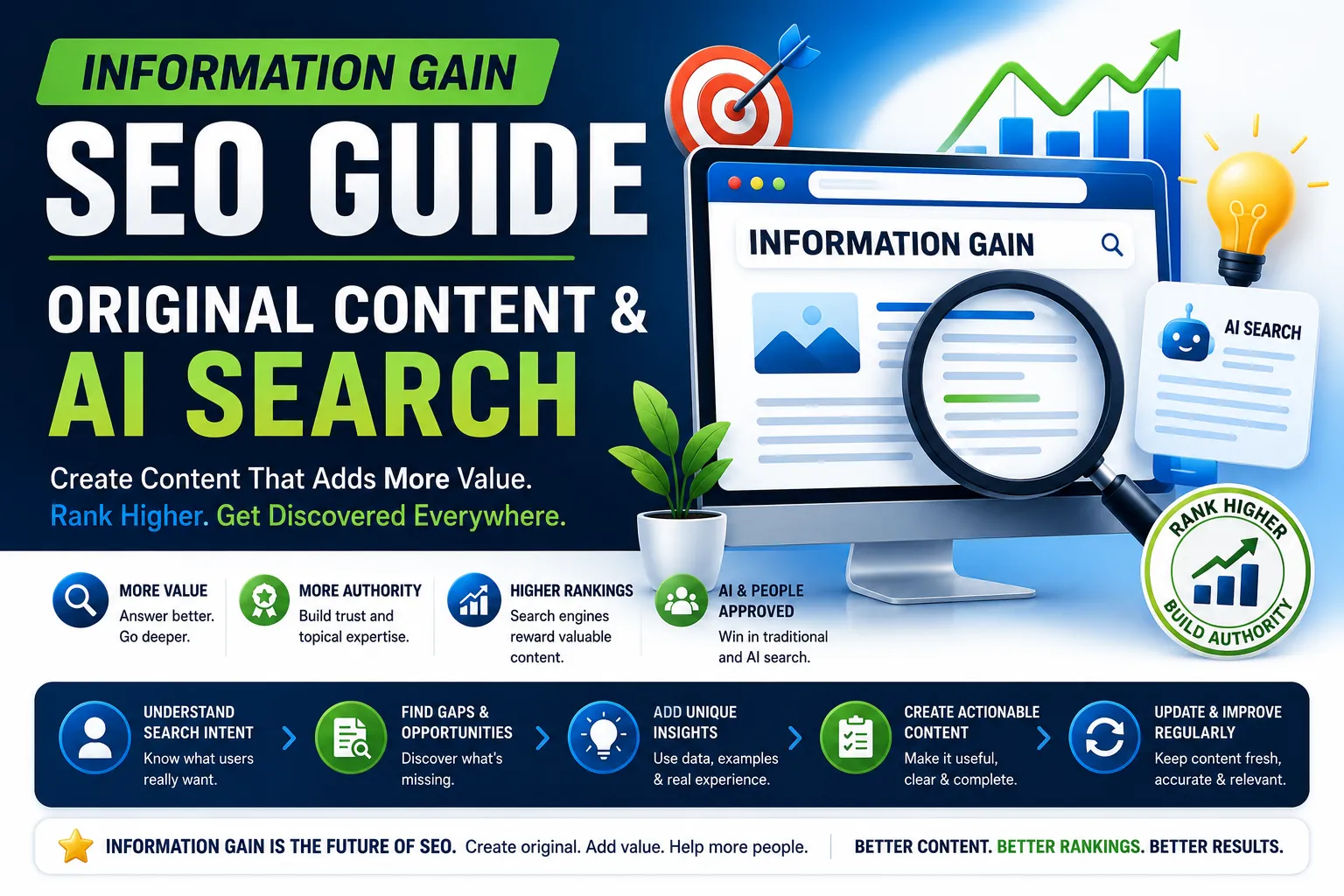
Create Content That Adds Something New, Builds Authority, and Earns Visibility Across Google and AI Search
Publishing more content does not automatically create better SEO results.
Search results in many industries are filled with articles covering the same keywords, answering the same questions, using similar headings, and repeating information already available on dozens of competing websites.
Generative AI has made producing this type of content even easier.
The result is a new SEO challenge:
Why should Google, an AI search engine, or a user choose your content when competing pages already provide essentially the same information?
This is where Information Gain SEO becomes valuable.
Information gain, as a practical SEO concept, focuses on increasing the amount of useful, distinctive information your page contributes beyond what users can already find in competing content.
That additional value might come from:
- First-hand experience
- Original research
- Proprietary data
- Expert commentary
- Case studies
- Unique examples
- Original frameworks
- New comparisons
- Better explanations
- Updated information
- Practical implementation steps
- Industry-specific insights
- Original images or demonstrations
The objective is not simply to make content different.
It is to make it more useful because of what it uniquely contributes.
Information gain therefore fits naturally alongside EEAT, Semantic SEO, Entity SEO, Topical Authority, Search Intent Optimization, Answer Engine Optimization (AEO), and Generative Engine Optimization (GEO).
In this Information Gain SEO Guide, we will explore what information gain means, how it relates to modern search optimization, and how businesses can create content that deserves visibility across Google Search and AI-powered discovery experiences.
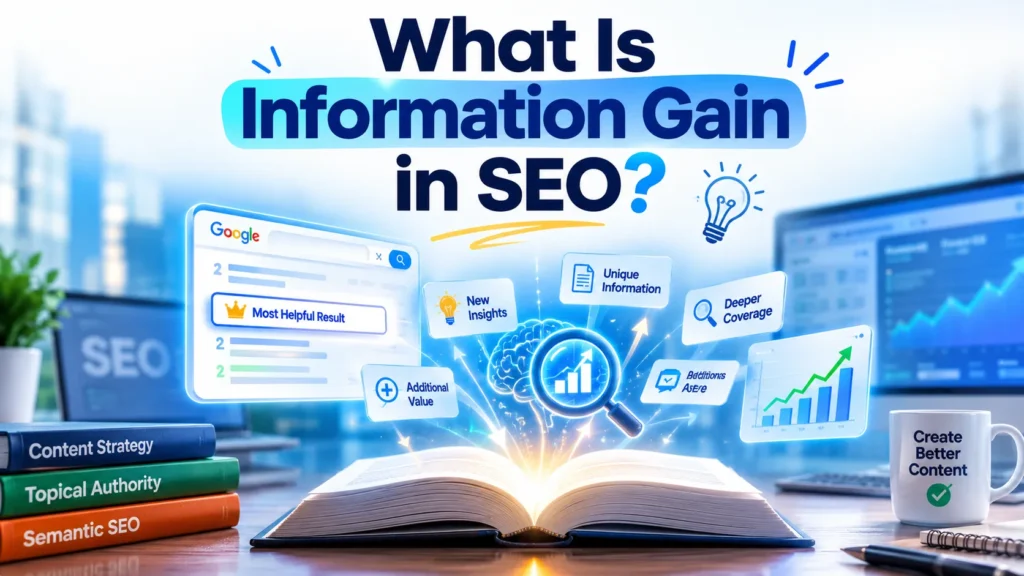
What Is Information Gain in SEO?
Information Gain SEO is a content optimization approach focused on adding useful information, perspectives, evidence, or insights that are not sufficiently covered by competing pages.
Imagine that the top-ranking pages for a query all explain the same five points.
If you publish another article covering those exact five points with slightly different wording, you may have created technically original text, but you have contributed very little new information.
A stronger page might cover those five necessary concepts and then add:
- Original survey data
- A real-world case study
- Expert observations
- A proprietary framework
- First-hand testing
- Updated statistics
- A comparison competitors missed
- Practical implementation examples
That additional contribution creates greater informational value.
In simple terms:
Information Gain = What useful knowledge does your page add beyond the existing search results?
This is fundamentally different from rewriting existing information.
How Information Gain Works
To understand information gain, think about search results as an existing body of knowledge.
Suppose ten articles ranking for “Local SEO Strategy” all discuss:
- Google Business Profile
- Local keywords
- Reviews
- Local citations
- Backlinks
These topics are important and should probably appear in a comprehensive guide.
However, publishing an eleventh article that simply repeats these five recommendations does little to advance the user’s understanding.
Your article could increase its informational contribution by adding:
- A real local SEO campaign example
- Google Business Profile performance data
- Before-and-after ranking results
- Review acquisition experiments
- Citation cleanup examples
- Local competitor analysis
- AI-generated local recommendation analysis
- A practical 90-day implementation plan
Now the page does more than summarize established advice.
It contributes additional evidence and practical insight.
Information Gain Is Not Just “Unique Content”
This distinction is critical.
SEO professionals have discussed “unique content” for years, but uniqueness and information gain are not identical.
A page can contain completely unique sentences while providing no new value.
For example:
Website A:
“Internal links help search engines discover related pages.”
Website B:
“Search engines can discover connected webpages more effectively through internal linking.”
The wording is different.
The information is essentially identical.
That is textual uniqueness, not meaningful information gain.
A stronger contribution might be:
After reducing the average crawl depth of our priority service pages from five clicks to three, we tracked changes in crawling frequency and organic visibility over the following eight weeks.
Now the content introduces experience, methodology, and potentially original evidence.
That is far more useful.
Why Information Gain Matters for Modern SEO
Modern search engines are increasingly capable of understanding meaning rather than simply matching keywords.
This makes generic content easier to identify.
If hundreds of webpages provide essentially the same information, search engines have little reason to treat every page as equally valuable.
Creating differentiated content can help strengthen several areas of SEO.
Greater Content Value
Original insights make your content more useful to readers.
Users gain information they could not obtain by simply visiting another generic result.
Stronger EEAT Signals
First-hand experience, original case studies, expert commentary, and proprietary research can demonstrate genuine expertise.
Instead of merely claiming experience, you provide evidence of it.
Better Link-Worthy Assets
Original research, statistics, frameworks, experiments, and useful data are more likely to attract citations and backlinks than generic summaries.
Stronger Brand Differentiation
When your website consistently contributes original insight, users begin associating your brand with expertise rather than commodity content.
AI Search Readiness
AI search systems need reliable source material from which to synthesize answers.
Distinctive facts, expert explanations, original research, and clearly attributable insights can make content more useful within the broader information ecosystem.
However, no single content technique guarantees citation or inclusion in an AI-generated answer.
Information Gain and Google’s Search Systems
Information gain should be discussed carefully.
Google has published patents and research related to information retrieval, document novelty, and information gain concepts. However, SEO practitioners should not assume there is a publicly confirmed, universally measurable Google metric called an “Information Gain Score” that can be calculated for every webpage.
There is no reliable public SEO formula where you can enter a page and receive Google’s official information gain score.
For practical SEO, the better question is:
Does this page provide useful information beyond what users can already obtain from the competing results?
This approach aligns with a broader principle of creating original, useful, people-first content.
Rather than attempting to manipulate an assumed score, focus on producing pages that genuinely deserve to be referenced.
Information Gain vs Unique Content
These concepts overlap but serve different purposes.
| Unique Content | Information Gain |
|---|---|
| Uses original wording | Adds original value |
| Avoids direct duplication | Expands existing knowledge |
| May paraphrase known facts | Introduces new facts or perspectives |
| Focuses on textual originality | Focuses on informational originality |
| Can still be generic | Should improve user understanding |
The strongest SEO content should ideally achieve both.
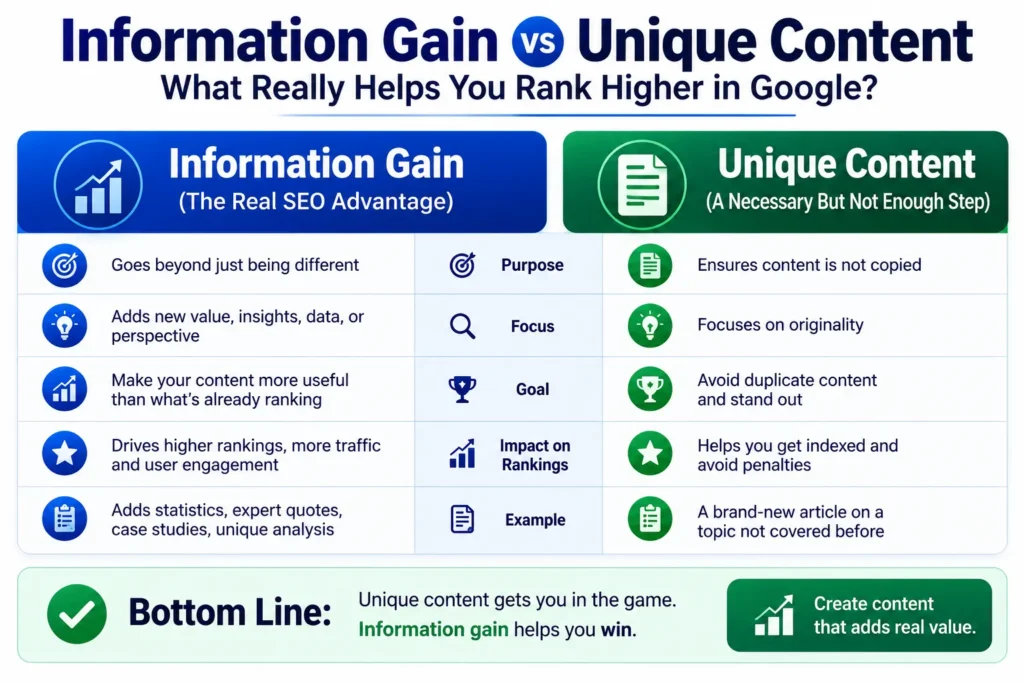
It should be original in expression and valuable in substance.
Information Gain vs Helpful Content
Helpful content answers the user’s needs effectively.
Information gain can make helpful content even stronger by introducing insights competitors have missed.
For example, a guide explaining how to conduct an SEO audit could already be helpful.
It becomes more distinctive if it also includes:
- A downloadable audit methodology
- Real crawl examples
- Screenshots of technical issues
- Before-and-after results
- Prioritization models
- Lessons from previous audits
Information gain therefore does not replace helpful content.
It enhances it.
Information Gain and Search Intent
Originality alone does not make content useful.
New information must still satisfy the user’s search intent.
Consider someone searching:
“How much does SEO cost?”
A 5,000-word history of SEO pricing might contain original research but still fail the user’s immediate need.
Higher-value information could include:
- Current pricing ranges
- Pricing by business size
- Pricing by SEO model
- Monthly retainer comparisons
- Factors affecting cost
- Examples of deliverables
- Red flags when comparing agencies
The information is valuable because it is both distinctive and aligned with the user’s goal.
This creates an important principle:
Search Intent determines what users need. Information Gain determines what additional value your page contributes while satisfying that need.
Information Gain and EEAT
Experience, Expertise, Authoritativeness, and Trustworthiness (EEAT) complement each other.
Experience
First-hand experience is one of the strongest sources of differentiated information.
Examples:
- What happened during an SEO migration
- Results from a local SEO campaign
- Lessons from recovering an indexed-page decline
- Problems discovered during a technical audit
Expertise
Subject-matter experts can provide interpretation that generic content cannot.
An expert can explain:
- Why something happened
- Which solution worked
- Which commonly recommended tactic failed
- When a strategy should or should not be used
Authoritativeness
Original research and useful frameworks can attract:
- Backlinks
- Citations
- Brand mentions
- Industry references
These signals can strengthen broader authority.
Trustworthiness
Original claims should be supported wherever possible.
Use:
- Transparent methodology
- Named authors
- Sources
- Dates
- Screenshots
- Data
- Limitations
- Clear distinctions between facts and opinions
Information gain without credibility can become speculation.
Information Gain and Semantic SEO
Semantic SEO focuses on meaning, context, related concepts, and entities.
Information gain adds another layer:
What does your page contribute to the topic that competing documents do not?
A comprehensive Semantic SEO article might cover:
- Entities
- Search intent
- NLP
- Topic clusters
- Internal linking
- Knowledge Graph
- Structured data
To increase information gain, it could additionally provide:
- A real semantic content map
- Entity mapping examples
- Internal linking experiments
- Before-and-after optimization data
- A proprietary semantic audit framework
Semantic coverage creates comprehensiveness.
Information gain creates differentiation.
The two should work together.
Information Gain and Entity SEO
Entity SEO helps search engines understand identifiable people, organizations, products, services, places, and concepts.
Information gain can strengthen entity authority by connecting original knowledge with identifiable sources.
For example, instead of publishing an anonymous claim such as:
“Semantic SEO can improve topical relevance.”
A stronger page could attribute a practical observation to an experienced author, explain the methodology used, provide the website context, and show what changed.
This creates clearer relationships between:
Author → Expertise → Organization → Topic → Evidence
Those relationships support a stronger digital identity.
Information Gain and Topical Authority
Topical authority requires comprehensive coverage of a subject.
But comprehensiveness alone can create a problem.
If you publish 100 articles that simply repeat what everyone else already says, you may have broad coverage without meaningful differentiation.
A stronger topical authority strategy combines:
Breadth + Depth + Original Value
Breadth means covering the important subtopics.
Depth means answering those topics comprehensively.
Original value means contributing useful insights beyond existing content.
For example, an AI SEO cluster could include:
- AI Search Optimization
- Google AI Overviews
- GEO
- AEO
- Semantic SEO
- Entity SEO
- Knowledge Graph SEO
- Schema Markup
- EEAT
- Information Gain
Each page should not simply define its topic.
It should contribute something distinctive to the overall knowledge ecosystem.
Information Gain vs Content Length
Longer content does not automatically provide more information.
A 4,000-word article can repeat the same ideas several times.
A focused 1,500-word article containing original research may deliver significantly greater informational value.
Avoid measuring quality primarily through word count.
Instead ask:
- What new questions does this page answer?
- What original evidence does it contain?
- What practical experience does it demonstrate?
- Which competitor gaps does it fill?
- What could someone learn here that they cannot easily find elsewhere?
This changes the goal from:
“How can we make this article longer?”
to:
“How can we make this article more valuable?”
What Creates High Information Gain?
There are many ways to contribute additional value without inventing information.
1. First-Hand Experience
Share what you have actually observed or implemented.
Examples:
- SEO campaign results
- Migration lessons
- Technical audit discoveries
- Content optimization results
- Local SEO experiments
2. Original Research
Conduct your own:
- Surveys
- Data analysis
- Experiments
- Industry studies
- SERP analysis
Original datasets can become highly valuable citation assets.
3. Proprietary Data
Businesses often possess information competitors cannot access.
Examples include anonymized:
- Customer trends
- Search performance data
- Conversion patterns
- Support questions
- Industry benchmarks
When privacy and confidentiality requirements are respected, these insights can create significant differentiation.
4. Expert Commentary
Subject-matter experts can add context to existing facts.
The value comes from interpretation, not simply repeating definitions.
5. Case Studies
Case studies demonstrate:
- The original problem
- Strategy
- Implementation
- Timeline
- Results
- Lessons learned
They combine experience, evidence, and expertise.
6. Original Frameworks
Develop useful processes that help readers apply complex ideas.
For example, an Information Gain framework could evaluate content across:
SERP Coverage → Missing Questions → Original Experience → Evidence → Expert Interpretation → Actionable Insight
A practical framework makes information easier to use.
7. Better Examples
Sometimes information gain comes from explaining an existing concept more clearly.
Industry-specific examples, comparisons, diagrams, screenshots, and workflows can make complicated topics significantly easier to understand.
The Core Principle of Information Gain SEO
The objective of Information Gain SEO is not to be different simply for the sake of being different.
It is to provide incremental useful value.
Before publishing a page, ask:
If someone has already read the top-ranking pages on this topic, what useful new knowledge will they gain from ours?
If the answer is unclear, the content probably needs additional research, experience, evidence, or differentiation.
The strongest modern SEO content combines:
Search Intent + Semantic Coverage + EEAT + Entity Authority + Topical Depth + Original Information
That combination creates content designed not merely to exist in search results, but to deserve attention from users, search engines, and AI-powered discovery systems.
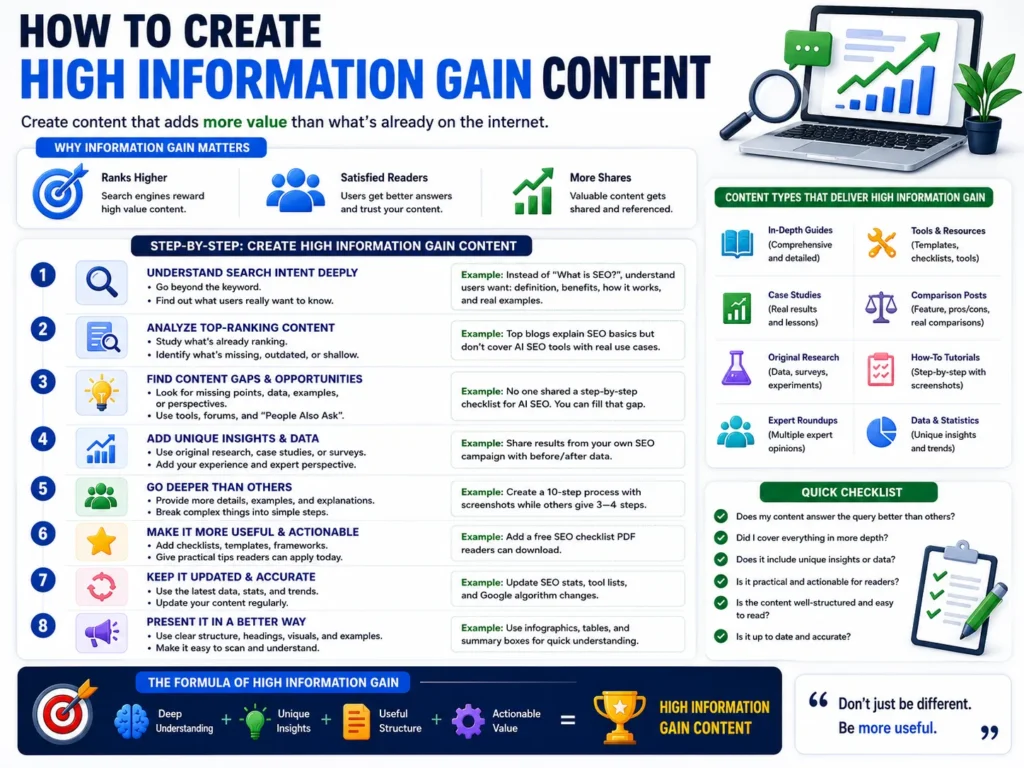
How to Create High Information Gain Content
Understanding information gain is only the first step. The real SEO opportunity comes from turning the concept into a repeatable content creation process.
The objective is not to make every article radically different from everything already published. Core facts still need to be covered when they are necessary to satisfy search intent.
The goal is to identify where existing search results stop providing value and then determine what your experience, expertise, research, data, or analysis can add.
A practical Information Gain SEO workflow can be organized into six stages:
Search Intent → SERP Analysis → Information Gap → Original Contribution → Evidence → Optimization
Let’s examine each stage.
1st Step: Identify the Primary Search Intent
Before analyzing competitors, determine what the searcher actually wants.
Search intent generally falls into four broad categories:
- Informational
- Navigational
- Commercial investigation
- Transactional
However, broad categories alone are not enough.
You should also identify the specific task behind the query.
For example:
Keyword: Information Gain SEO
The user may want to understand:
- What information gain means
- Whether Google uses it
- How it affects SEO
- How to measure it
- How to improve existing content
- How it relates to AI-generated content
Your content should satisfy these core expectations before attempting to differentiate itself.
Information gain cannot compensate for poor search intent alignment.
2nd Step: Analyze the Existing SERP
Next, study the pages already competing for the query.
Do not analyze competitors only by:
- Word count
- Keyword usage
- Number of headings
- Domain authority
- Backlinks
Analyze the information they provide.
Create a simple content inventory.
For each major competitor, record:
- Topics covered
- Questions answered
- Examples provided
- Statistics used
- Experts cited
- Case studies included
- Original research
- Visual explanations
- Tools or templates offered
- Recommendations provided
After reviewing multiple results, patterns become visible.
You might discover that almost every competitor explains what information gain is, but few demonstrate how to perform an information gain audit.
That becomes an opportunity.
3rd Step: Find the Information Gap
A content gap and an information gap are related but different.
A content gap may mean competitors have a section you do not.
An information gap is useful knowledge the existing search results do not adequately provide.
For example, competitors might all have sections titled:
How to Improve Information Gain
But if those sections repeat generic recommendations such as “add unique insights” and “create original research,” the topic is technically covered while the practical information gap remains.
You could fill it by showing:
- How to analyze the top-ranking pages
- How to create an information inventory
- How to identify repeated claims
- How to find unanswered questions
- How to determine what first-party evidence you possess
- How to prioritize improvements
That is a meaningful information gain opportunity.
4th Step: Add First-Hand Experience
First-hand experience is difficult for generic content producers to replicate.
If your team has actually performed the work being discussed, document what happened.
For SEO content, this might include:
- A website migration
- Technical SEO audit
- Indexing recovery
- Content refresh
- Internal linking campaign
- Local SEO campaign
- Schema implementation
- AI search visibility analysis
Instead of writing:
“Updating old content can improve SEO.”
You might explain:
“We reviewed pages that had lost organic visibility, compared their outdated sections with current search intent, consolidated overlapping information, added first-party examples, improved internal links, and monitored the pages after recrawling.”
This provides process-level information.
When you have reliable performance data, you can make the example even stronger by showing the actual results.
5th Step: Add Original Data
Original data is one of the strongest ways to differentiate content.
You do not necessarily need a massive industry study.
Useful first-party research can come from:
- Search Console data
- Analytics
- SEO crawls
- Customer surveys
- CRM data
- Support requests
- Search result analysis
- Conversion data
- Website experiments
For example, an SEO agency could analyze 100 local business websites and report:
- Percentage missing LocalBusiness schema
- Percentage with inconsistent NAP information
- Average number of indexed service pages
- Common technical SEO errors
- Internal linking patterns
The resulting dataset creates information competitors cannot simply reproduce without conducting their own research.
Be Transparent About Methodology
Original data becomes more trustworthy when readers know:
- Sample size
- Data source
- Collection period
- Methodology
- Limitations
Do not make small datasets sound more conclusive than they are.
Transparency strengthens trust.
6th Step: Add Expert Interpretation
Data without interpretation often has limited value.
Explain what the evidence means.
For example:
Observation: Pages receiving the most internal links were crawled more frequently in a specific website audit.
The expert contribution is explaining:
- Why this relationship may exist
- Whether other variables influenced the result
- How the finding should affect strategy
- When the recommendation might not apply
This is where genuine subject expertise creates information gain.
Use Original Case Studies
Case studies are particularly useful for EEAT and Information Gain SEO because they combine experience with evidence.
A useful SEO case study should contain:
Problem → Baseline → Analysis → Strategy → Implementation → Results → Lessons
Avoid presenting only impressive percentages without explaining what was actually done.
Readers need enough context to determine whether the strategy could apply to their situation.
Develop Original Frameworks
Original frameworks turn expertise into repeatable processes.
For Information Gain SEO, you can use a framework such as:
The GAIN Framework
G: Gap Analysis
Determine what competing pages already cover and what they miss.
A: Added Experience
Identify first-hand knowledge, customer insights, experiments, or practical observations you can contribute.
I: Independent Evidence
Support important claims with original data, reputable external sources, screenshots, examples, or documented methodology.
N: New Utility
Give readers something more useful than existing results, such as a framework, template, calculation, checklist, decision model, or practical workflow.
A framework is valuable only when it helps readers solve the problem more effectively.
Do not invent terminology merely to appear original.
Improve Existing Content with Information Gain
You do not need to create a new article every time.
Some of the best opportunities exist within pages already receiving impressions or rankings.
Start by identifying pages that:
- Have declining traffic
- Rank on page two
- Receive impressions but few clicks
- Have outdated sections
- Contain generic AI-generated content
- Overlap heavily with competitors
- Lack original evidence
Then compare each page against current search results.
Ask:
What has changed since this content was published?
Add:
- New data
- Updated examples
- New expert observations
- Recent developments
- Better comparisons
- Original screenshots
- FAQs based on real users
- New case studies
- Practical implementation steps
Content refreshes should improve informational usefulness rather than simply changing the publication date.
Information Gain and AI-Generated Content
Generative AI can produce useful drafts quickly, but it creates a major differentiation problem.
If many publishers use similar models with similar prompts to summarize the same publicly available information, their articles can become structurally and semantically similar.
This makes human contribution increasingly important.
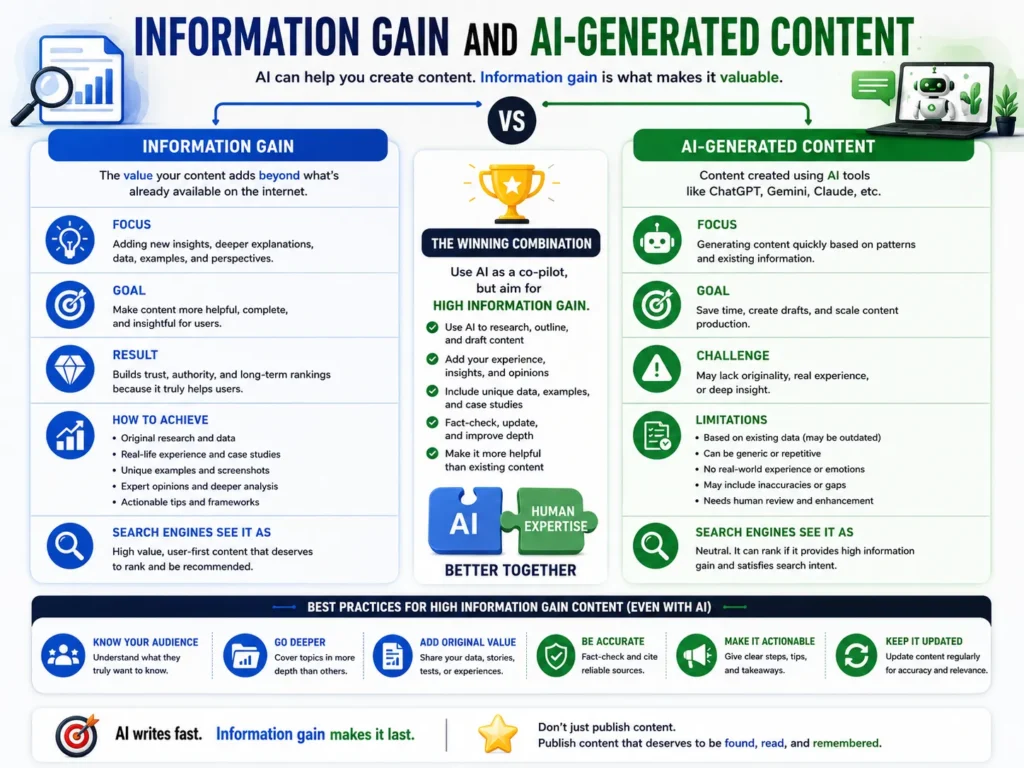
AI can assist with:
- Outlining
- Organization
- Summarization
- Brainstorming
- Editing
- Classification
But high-value content should incorporate information that does not originate solely from generic model output.
Examples include:
- Your experience
- Your client’s results
- Your data
- Your photographs
- Your tests
- Your expert opinion
- Your processes
- Your customer questions
- Your original analysis
The competitive advantage is not necessarily avoiding AI.
It is ensuring AI does not become the source of your expertise.
Information Gain for Google AI Overviews
Google AI Overviews can synthesize information from multiple web sources to answer complex queries.
This changes the competitive environment.
A page may no longer compete only for a traditional blue-link position. Its information may also compete to become useful source material within an AI-generated response.
For this environment, create content with clearly extractable, attributable information.
Useful elements include:
- Direct answers
- Clear definitions
- Original statistics
- Expert statements
- Tables
- Comparisons
- Step-by-step processes
- Named frameworks
- Case studies
- Specific examples
Do not optimize by artificially writing every paragraph as an AI snippet.
Prioritize human usefulness first.
Information Gain and Answer Engine Optimization (AEO)
AEO focuses on making information understandable and useful for systems that directly answer questions.
Information gain strengthens AEO when your page provides answers that are both clear and distinctive.
For example, rather than answering:
How do you improve topical authority?
with:
“Publish high-quality content.”
Provide a more actionable answer:
“Map the primary entity, identify its major subtopics and search intents, build dedicated pages where separate intent exists, connect them through contextual internal links, and regularly update the cluster using new first-party evidence.”
The second answer provides greater actionable information.
Information Gain and Generative Engine Optimization (GEO)
GEO focuses on improving visibility and representation within generative search environments.
Information gain supports GEO because generative systems benefit from authoritative source material containing useful facts, explanations, and evidence.
Potential GEO-friendly information includes:
- Original research
- Proprietary statistics
- Expert definitions
- Unique frameworks
- First-party observations
- Clear comparisons
- Case studies
However, GEO should not be treated as a guaranteed formula for AI citations.
Search and generative systems use many signals and may change frequently.
Focus on becoming a genuinely useful source rather than attempting to manipulate citation systems.
Information Gain for Service Pages
Information gain is not limited to blog posts.
Service pages are often extremely repetitive.
Search for almost any SEO service and you will find pages repeating:
- Customized strategy
- Experienced team
- Proven results
- Transparent reporting
- Affordable pricing
These claims provide little differentiation without evidence.
A stronger service page could include:
- Exact process
- Deliverables
- Audit methodology
- Tools used
- Reporting examples
- Team experience
- Real case studies
- Pricing methodology
- Expected timelines
- Industries served
- Common problems identified
This gives prospective customers useful information for evaluating the service.
Information Gain for Local SEO
Local businesses have excellent opportunities to create information competitors cannot easily replicate.
Examples include:
- Neighborhood-specific expertise
- Local pricing data
- Local regulations
- Service-area examples
- Customer questions
- Original photographs
- Local case studies
- Seasonal trends
A pest control company in Dhaka, for example, can provide local observations about seasonal pest activity that a generic international article may not contain.
A roofing company in Florida can discuss local storm patterns, permitting considerations, materials, and insurance-related customer questions.
Local experience itself can become informational differentiation.
Information Gain for YMYL Content
Your Money or Your Life topics require additional care because inaccurate information can affect people’s health, finances, safety, or legal decisions.
For YMYL content, originality should never come at the expense of accuracy.
Prioritize:
- Qualified expert review
- Reputable sources
- Current information
- Transparent authorship
- Clear citations
- Appropriate disclaimers
- Evidence-based recommendations
Do not create controversial or unsupported claims simply to make content different.
For YMYL, trustworthy information gain matters more than novelty.
Information Gain SEO Audit Checklist
Use this checklist before publishing or refreshing important content:
- Does the page fully satisfy the primary search intent?
- Have we analyzed the leading competing results?
- Do we know which information competitors repeatedly cover?
- Have we identified unanswered or poorly answered questions?
- Does the page contain first-hand experience?
- Can we contribute original data?
- Are expert insights included?
- Are important claims supported?
- Do we provide practical examples?
- Is there a useful case study?
- Can we create an original framework?
- Are our examples more specific than competitors?
- Is the information current?
- Does the page contain unnecessary repetition?
- Does it offer something genuinely useful that competing pages do not?
You do not need to satisfy every item on every page.
The objective is to identify the strongest opportunities for meaningful differentiation.
Common Information Gain SEO Mistakes
Rewriting Competitor Content
Changing words without adding new knowledge does not create meaningful information gain.
Making Unsupported Claims
Being different does not justify being inaccurate.
Original claims require evidence.
Adding More Words Without More Value
Content length is not information gain.
Remove unnecessary repetition.
Inventing Statistics
Never fabricate survey results, case studies, percentages, customers, or experiments.
False evidence damages trust.
Treating AI Output as Original Research
AI-generated summaries are not proprietary research simply because the wording is new.
Ignoring Search Intent
An original article can still fail if it answers the wrong question.
Creating Fake Case Studies
Only publish case studies based on real campaigns and verifiable data.
If identifying information must remain confidential, explain that results have been anonymized.
Practical Information Gain Example
Consider the keyword:
“Technical SEO Audit”
Most competing pages may cover:
- Crawlability
- Indexability
- Site speed
- Mobile optimization
- Structured data
- Broken links
- XML sitemaps
You need these topics because they satisfy search intent.
But your article could differentiate itself by adding:
Original Audit Data
Analyze 50 websites and identify the most frequent technical problems.
Real Crawl Screenshots
Show examples of canonical errors, redirect chains, orphan pages, or blocked resources.
Prioritization Framework
Classify issues as:
Critical → High → Medium → Low
Case Study
Show how a real indexing problem was diagnosed and resolved.
Decision Tree
Explain which issue should be addressed first based on its impact on crawling, indexing, rendering, or ranking.
The result is still a Technical SEO Audit guide.
But it now contributes significantly more practical information than a generic checklist.
How to Measure Information Gain
There is no public Google Information Gain score that SEOs can reliably retrieve for a webpage.
Therefore, measure information gain using practical indicators.
Track:
- Organic traffic
- Search visibility
- Ranking breadth
- Engagement
- Backlinks
- Brand mentions
- Citations
- Assisted conversions
- Search Console queries
- AI search referrals where measurable
You can also conduct a qualitative audit.
Score your content internally based on:
- Original research
- First-hand experience
- Expert contribution
- Practical examples
- Data quality
- Unique frameworks
- Competitor gap coverage
This is an internal content-quality model, not a Google ranking score.
Conclusion: Create Content Worth Discovering
SEO is becoming increasingly competitive because creating basic content is easier than ever.
Simply publishing another article targeting the same keyword, following the same headings, and summarizing the same information is unlikely to create a durable competitive advantage.
The better question is:
What can we contribute that makes this page more useful than the information already available?
The answer may come from:
- Experience
- Expertise
- Original research
- Proprietary data
- Better examples
- Case studies
- Unique frameworks
- Updated information
- Expert interpretation
Information Gain SEO works best when combined with Search Intent Optimization, EEAT, Semantic SEO, Entity SEO, Topical Authority, Internal Linking, AEO, and GEO.
Search intent ensures you answer the right question.
Semantic SEO provides contextual depth.
Entity SEO establishes who and what the content represents.
EEAT strengthens credibility.
Topical authority demonstrates subject depth.
Information gain gives users a reason to choose your content over another source.
Together, these principles create a more defensible content strategy for both traditional search and AI-powered discovery.
Build Content That Adds Real Value
If your website is publishing content but struggling to differentiate itself from competitors, simply producing more articles may not solve the problem.
SEO Services BD helps businesses build search strategies around competitor research, Semantic SEO, Entity SEO, topical authority, content optimization, AEO, GEO, and AI search visibility.
Our approach focuses on identifying what users need, what competitors already provide, and where your business can contribute meaningful additional value.
Build content that does more than target keywords.
Build content worth finding, referencing, and trusting.
Frequently Asked Questions About Information Gain SEO
What is Information Gain SEO?
Information Gain SEO is an approach to content optimization that focuses on adding useful information, evidence, experience, or perspectives beyond what competing search results already provide.
Is information gain a Google ranking factor?
Google has explored information gain and related information retrieval concepts, but SEOs should not assume there is a publicly confirmed, directly measurable “Information Gain Score” used as a standalone ranking factor. Focus on creating original and useful content rather than attempting to optimize an unknown score.
How do you increase information gain?
Add first-hand experience, original research, proprietary data, expert insights, case studies, practical examples, unique frameworks, updated information, and answers competitors have missed.
Is information gain the same as unique content?
No. Unique wording can communicate the same information as competitors. Information gain focuses on contributing additional useful knowledge.
Does longer content have higher information gain?
Not necessarily. A shorter article with original research and expert insights can provide more informational value than a long article that repeats established information.
How does information gain relate to EEAT?
First-hand experience, expert analysis, transparent methodology, and original evidence can strengthen EEAT while simultaneously increasing informational value.
Can AI-generated content provide information gain?
AI can help organize and develop content, but generic AI summaries often rely on existing information. Stronger differentiation comes from combining AI assistance with original experience, data, research, expert analysis, and proprietary insights.
Is information gain important for Google AI Overviews?
Distinctive, trustworthy information can make a page more useful as source material for search and AI systems. However, information gain alone does not guarantee inclusion in Google AI Overviews.
What is the difference between information gain and topical authority?
Topical authority concerns the depth and breadth of expertise demonstrated across a subject. Information gain concerns the additional useful value individual pages or resources contribute beyond existing information.
How does Semantic SEO relate to information gain?
Semantic SEO helps comprehensively cover entities, concepts, relationships, and context. Information gain adds differentiation by contributing insights or evidence that competitors do not adequately provide.
Can information gain improve backlinks?
Original statistics, research, frameworks, case studies, and expert insights can create stronger reasons for other websites to reference and link to your content.
Should every article contain original research?
No. Original research is one method of increasing information gain. First-hand experience, expert explanations, better examples, new comparisons, and useful frameworks can also contribute substantial value.
Can service pages use Information Gain SEO?
Yes. Service pages can differentiate themselves through detailed processes, deliverables, pricing information, real case studies, timelines, methodologies, FAQs, and evidence of expertise.
How often should information gain be audited?
Review important content during scheduled content audits and whenever search intent, competitors, technology, regulations, products, or industry knowledge materially changes.
What is the biggest mistake with Information Gain SEO?
The biggest mistake is confusing different wording with different information. Rewriting what competitors already say may create unique text without creating meaningful new value.