
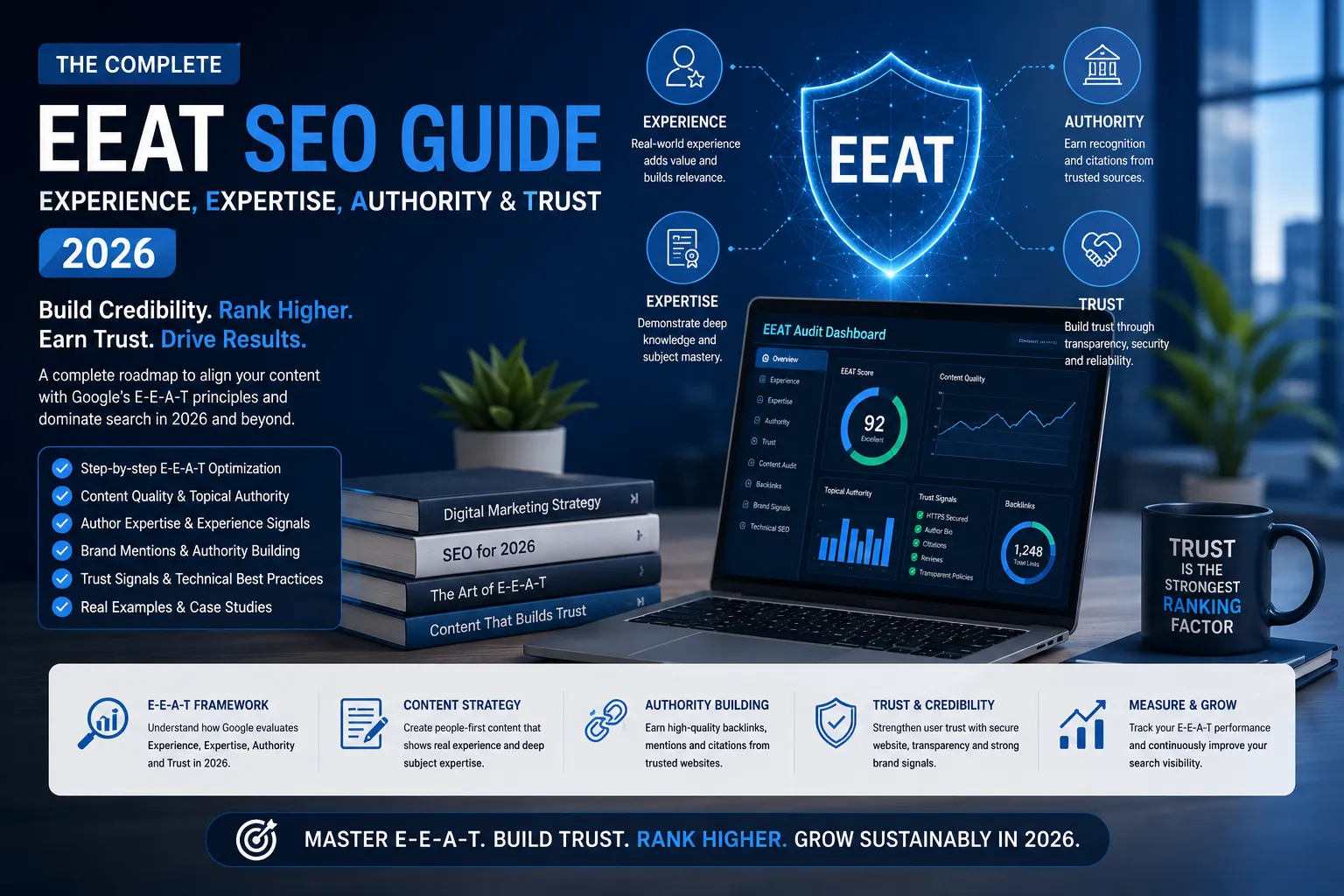
EEAT SEO Guide: The Complete Guide to Experience, Expertise, Authority & Trust
If you’ve spent any time researching how Google ranks websites in 2026, you’ve run into the acronym EEAT. Most articles that cover it stop at the definition: Experience, Expertise, Authoritativeness, Trustworthiness. That’s not wrong, but it’s not useful either. Knowing what the letters stand for doesn’t tell you how to build EEAT into a website, an author profile, or a piece of content that Google’s systems — and increasingly, AI systems like Google AI Overviews and ChatGPT Search — will trust enough to surface.
This guide goes further. It connects EEAT to the concepts that actually determine whether a site earns visibility today: entity SEO, semantic SEO, knowledge graphs, structured data, and the quality signals AI search engines use to decide who to cite. Whether you run a healthcare site, a local service business, an eCommerce store, or a SaaS product, the same underlying framework applies — just with different emphasis depending on how much risk your content carries.
What Is EEAT?
EEAT stands for Experience, Expertise, Authoritativeness, and Trustworthiness. It originates from Google’s Search Quality Rater Guidelines — the internal document Google gives to thousands of human quality raters who evaluate search results and provide feedback that helps train and validate Google’s ranking systems.
EEAT itself is not a single ranking factor you can “turn on.” It’s a framework — a set of signals Google’s algorithms and human raters use to judge whether content and the people or organizations behind it deserve to rank, especially for topics where bad information could cause real harm.
The “E” for Experience was added in December 2022, expanding the older EAT model (Expertise, Authoritativeness, Trustworthiness) that had been part of the guidelines since 2014. Its addition reflected a shift in how Google thinks about quality: it’s no longer enough to be a credentialed expert on paper. Google also wants to see evidence that the content creator has actually done, used, or lived through the thing they’re writing about.
Google’s Quality Rater Guidelines
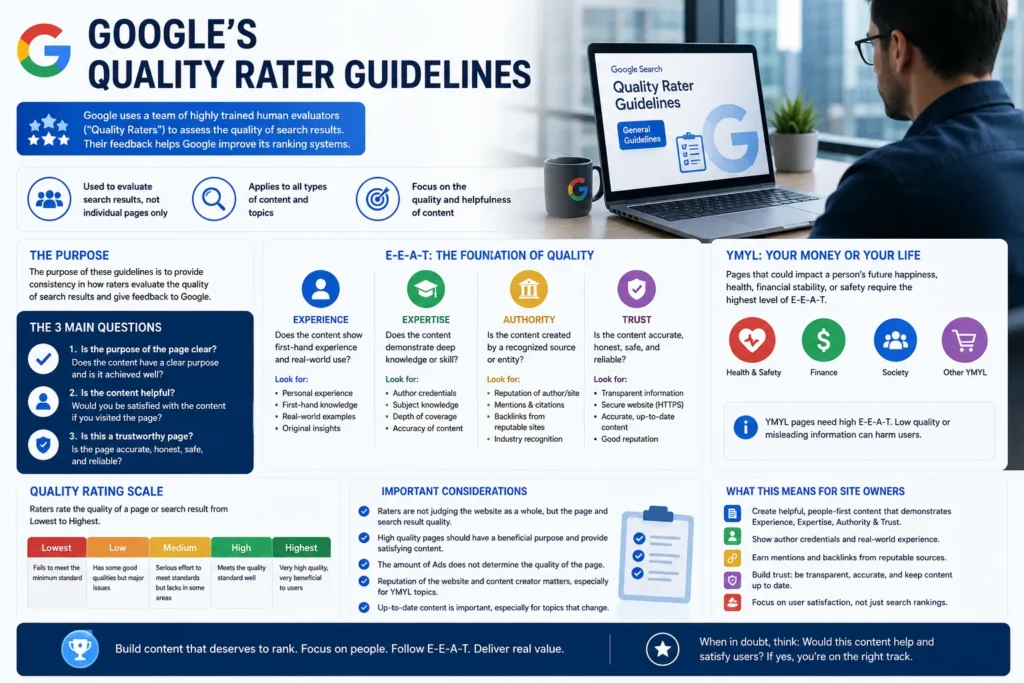
The Quality Rater Guidelines (QRG) are a lengthy public document Google uses to train human raters. Raters don’t directly change rankings — but their assessments feed into Google’s evaluation of search quality and help validate algorithm changes. Understanding the QRG matters because it’s the closest thing to a primary source explaining what “quality” means to Google.
Key concepts from the QRG that every SEO should understand:
- Page Quality (PQ) rating: Raters assign quality scores to individual pages based on the purpose of the page, the expertise behind it, and the reputation of the site and author.
- Needs Met rating: A separate scale measuring how well a page satisfies the actual intent behind a search query, regardless of its quality.
- YMYL (Your Money or Your Life): A classification for topics that could significantly impact a person’s health, financial stability, safety, or wellbeing. YMYL pages are held to a dramatically higher EEAT standard.
- Lowest quality signals: Deceptive design, harmful content, lack of expertise on YMYL topics, and thin or unoriginal content are all flagged as reasons for the lowest possible ratings.
The practical takeaway: EEAT isn’t evenly applied. A recipe blog and a page about chemotherapy side effects are not judged by the same bar, even though both could theoretically demonstrate “experience.”
Experience
Experience refers to firsthand, lived involvement with the topic. Google wants to know: has this content creator actually done the thing they’re describing?
This is different from expertise. A tax attorney has expertise in tax law. Someone who has personally gone through an IRS audit has experience with what that process actually feels like. Both are valuable, and the best YMYL content often combines them.
Ways to demonstrate experience in content:
- First-person narrative details (“When I tested this roofing material through two hail seasons…”)
- Original photos, videos, or screen recordings rather than stock imagery
- Specific, non-generic details that couldn’t be pulled from a competitor’s article
- Before-and-after results, timestamps, or outcome data from real use
Experience is also the hardest signal to fake credibly, which is part of why Google weighted it so heavily as AI-generated content flooded the web after 2022.
Expertise
Expertise is about subject-matter knowledge and skill. It can come from formal credentials (a medical degree, a CPA license, a law degree) or from demonstrated informal expertise built over years of hands-on work.
Google’s guidelines are explicit that expertise should be evaluated relative to the topic. A forum post from an experienced home cook about a family recipe can carry legitimate “everyday expertise,” while a forum post about medication dosing should not carry the same weight — even if both are equally sincere.
To reinforce expertise on a site:
- Attach named, credentialed authors to content, not generic “Admin” or “Staff” bylines
- Build detailed author bio pages listing credentials, certifications, and experience
- Have genuine subject-matter experts write or review YMYL content
- Cite primary sources, studies, and data rather than paraphrasing other blogs
Authoritativeness
Authority is about reputation — specifically, whether other credible sources, publications, and entities in your field recognize you as a go-to source. This is where SEO overlaps most heavily with entity SEO and knowledge graph visibility.
Google builds a picture of authority from signals like:
- Backlinks and mentions from reputable, topically relevant sites
- Being cited, quoted, or interviewed by journalists and industry publications
- Wikipedia or Wikidata presence (a strong entity signal)
- Consistent NAP (name, address, phone) and brand information across the web, feeding into the Knowledge Graph
- Being present in and referenced by structured, verifiable data sources
Authority compounds. A single guest post won’t move the needle, but a pattern of citations, mentions, and structured entity data across the web builds a reputation that Google’s systems — and AI systems trained on similar signals — can recognize.
Trustworthiness
Trust is considered the most important of the four components, and Google has said as much directly. Experience, expertise, and authority all exist to serve one underlying question: can this content and this source be trusted?
Trust signals include:
- Accurate, up-to-date, fact-checked content
- Transparent business information: real addresses, phone numbers, and named leadership
- Secure site infrastructure (HTTPS, no deceptive ads or malware)
- Honest reviews and reputation management, not manipulated ratings
- Clear correction policies and visible publish/update dates
- Editorial standards pages and clear disclosure of sponsored content or affiliate links
Trust is also assessed at the site and organizational level, not just the page level — a single untrustworthy page can drag down perception of an entire domain, and vice versa.
Why EEAT Matters
EEAT matters because it’s Google’s proxy for a much harder question: “should we recommend this to someone who might make a real decision based on it?” As search has moved toward more direct answers — featured snippets, AI Overviews, chat-based search — the cost of surfacing bad information has gone up, and so has the weight Google places on trust signals.
EEAT also matters because it’s increasingly the shared language between traditional search ranking and AI-generated answers. The signals that make Google trust your content are largely the same signals that make an AI system decide you’re a citable, reliable source.
EEAT vs Traditional SEO
Traditional SEO historically focused heavily on keywords, backlinks as a raw count, and on-page optimization mechanics — title tags, header structure, keyword density. EEAT represents a shift toward evaluating the source behind the content, not just the content’s technical optimization.
| Traditional SEO Focus | EEAT-Driven SEO Focus |
|---|---|
| Keyword density and placement | Topical depth and demonstrated expertise |
| Raw backlink count | Backlink quality and topical relevance |
| Generic content production | Named, credentialed authorship |
| On-page technical signals | Organizational transparency and trust signals |
| Ranking a page | Building a recognized entity |
This doesn’t mean traditional technical SEO is obsolete — it’s still necessary infrastructure. But it’s no longer sufficient on its own, particularly for competitive or YMYL niches.
EEAT + Entity SEO
Entity SEO is the practice of helping search engines understand who and what you are as a distinct, verifiable “entity” — separate from the literal words on your pages. Google’s Knowledge Graph stores entities (people, organizations, places, concepts) and the relationships between them.
EEAT and entity SEO reinforce each other directly:
- A well-defined author entity (with consistent bio, credentials, and cross-site presence) strengthens both authorship trust and entity recognition.
- Organization entities with clear structured data, consistent branding, and third-party validation (Wikidata, industry directories, press coverage) build authority that search engines can verify independently of your own claims.
- Entity relationships — your authors’ affiliations, your organization’s partnerships, your citations from recognized institutions — create a web of corroborating trust signals that’s much harder to fake than on-page claims alone.
In short: EEAT is the judgment, and entity SEO is much of the evidence search engines use to reach that judgment.
EEAT + Semantic SEO
Semantic SEO focuses on meaning and topical relationships rather than exact-match keywords — building content that comprehensively covers a topic and its related concepts, entities, and questions.
Semantic depth is itself an expertise signal. A page that only skims the surface of a topic, hitting the target keyword a few times without addressing the related questions a genuine expert would naturally cover, reads as thin to both algorithms and human raters. Comprehensive topical coverage — organized logically, using the terminology a real expert would use — supports the expertise and trust components of EEAT simultaneously.
This is also where semantic SEO and AI search intersect: large language models rely on semantic understanding to decide whether a page comprehensively and accurately answers a query, making semantic depth a prerequisite for AI visibility, not just traditional rankings.
How to Improve EEAT
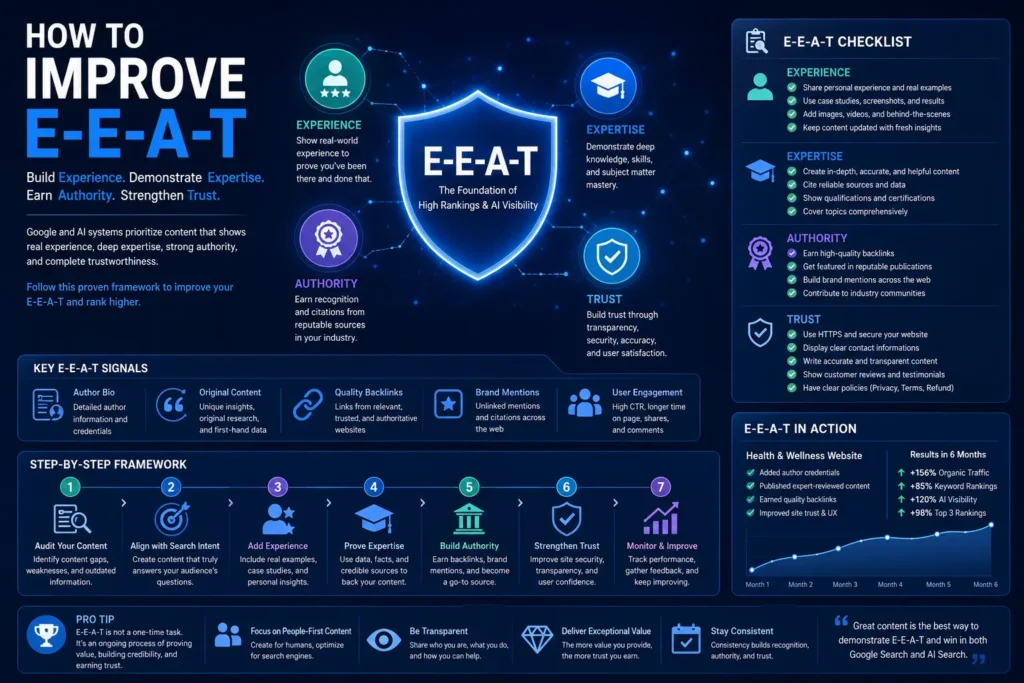
Author Pages
A weak or missing author page is one of the most common EEAT failures. A strong author page should include:
- Full name and professional headshot
- Credentials, certifications, and relevant experience
- A short bio explaining specific expertise in the site’s subject matter
- Links to the author’s other published work, social profiles, or professional affiliations
- Structured data (
Personschema) connecting the author to their content
For YMYL sites especially, every piece of content should be traceable to a real, verifiable person — not a placeholder byline.
Organization Pages
Your About page and organizational entity data matter as much as individual author pages. A strong organization presence includes:
- A detailed About page covering the company’s history, mission, and leadership team
- Clear contact information: physical address, phone number, support channels
Organizationschema markup with consistent NAP data- Third-party validation: press mentions, industry association memberships, verifiable reviews
- Transparent ownership and editorial policies
Reviews & Reputation
Reviews are a direct, external trust signal that Google and AI systems weigh heavily, especially for local and eCommerce businesses.
- Actively (and honestly) collect reviews on Google Business Profile and relevant industry platforms
- Respond to both positive and negative reviews professionally
- Never fabricate or purchase reviews — this is both a policy violation and a trust liability if discovered
- Surface review schema markup where genuinely earned
Case Study
Consider a mid-sized healthcare clinic site that struggled to rank for competitive, YMYL-adjacent terms despite technically solid SEO. The gaps: unattributed blog content, no physician bios, no organizational schema, and no third-party citations.
The fix involved rebuilding author pages for each contributing physician with verified credentials, adding Person and MedicalOrganization schema, securing citations from local health directories, and rewriting cornerstone content to include physician-reviewed disclaimers and update dates. Over the following months, the site saw meaningful improvement in visibility for its most competitive terms — not because of new keywords, but because the entity and trust signals behind the content finally matched the standard Google holds YMYL sites to.
The lesson generalizes: for YMYL and competitive niches, EEAT gaps are often the actual bottleneck, even when technical SEO looks clean.
EEAT for AI Search
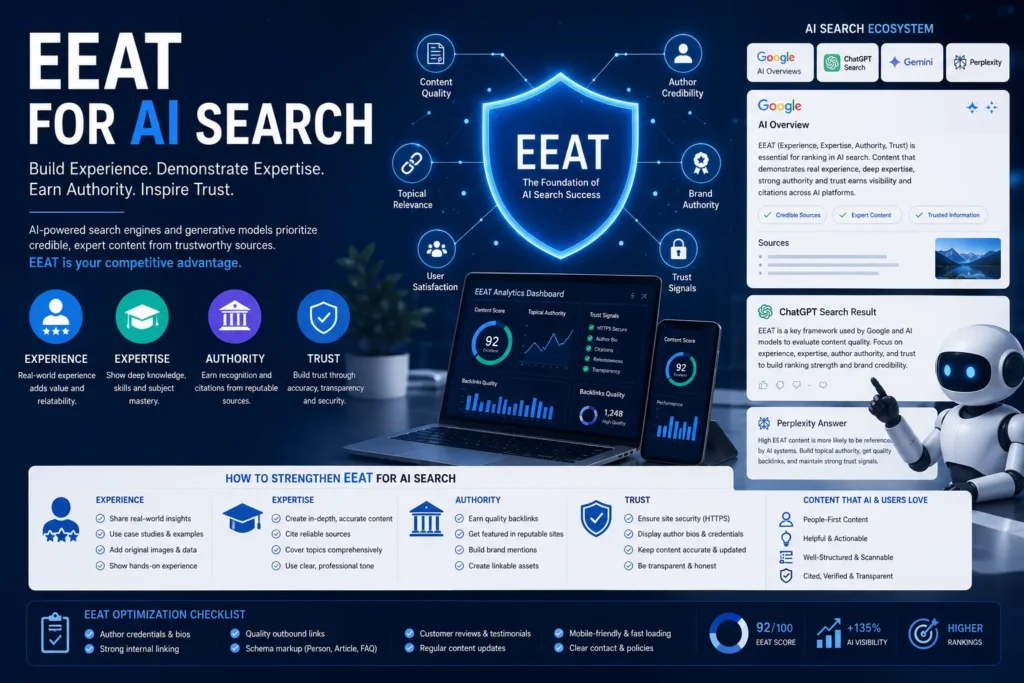
Google AI Overviews and AI-driven search experiences like ChatGPT Search don’t discard EEAT — they lean on the same underlying signals to decide which sources to cite or summarize. A few things matter specifically for AI visibility:
- Structured, extractable answers: Clear headers, direct answers near the top of sections, and well-organized content are easier for AI systems to parse and cite.
- Verifiable authorship and organizational data: AI systems increasingly cross-reference entity data, so the same author/organization signals that support traditional EEAT also support AI citation likelihood.
- Freshness and accuracy: AI Overviews favor content that’s demonstrably current and factually reliable, since citing outdated or wrong information carries reputational risk for the AI provider.
- Consistency across the web: If your claims about credentials, data, or facts are corroborated across multiple independent sources, AI systems are more likely to treat your content as a reliable citation.
This convergence is why EEAT, entity SEO, and what’s sometimes called GEO (Generative Engine Optimization) or AEO (Answer Engine Optimization) are really facets of the same underlying strategy, not separate disciplines.
EEAT for Local SEO
For local businesses, EEAT centers heavily on trust and real-world verifiability:
- Consistent NAP data across Google Business Profile, directories, and your website
- Genuine, responded-to customer reviews
- Local entity signals: local press mentions, sponsorships, community involvement
- Location-specific expertise content (service area pages written with real local knowledge, not templated city-swaps)
EEAT for Healthcare (YMYL)
Healthcare is the highest-scrutiny YMYL category. Requirements include:
- Content written or reviewed by licensed medical professionals, clearly credited
- Citations to peer-reviewed research and recognized medical authorities
- Visible “medically reviewed by” bylines with reviewer credentials and review dates
- Clear disclaimers distinguishing general information from medical advice
- Regular content audits to keep clinical information current
EEAT for eCommerce
For product and transactional content:
- Original product photography and genuine, verified customer reviews
- Transparent shipping, return, and pricing policies
- Author or brand expertise behind buying guides and comparison content
- Trust badges, secure checkout signals, and clear business legitimacy indicators
EEAT for SaaS
For software and B2B content:
- Content written by or with input from actual product engineers, founders, or customer-facing experts — not generic marketing copy
- Case studies with real, named customers and measurable outcomes
- Transparent pricing, security, and compliance documentation
- Author bylines tied to real team members with LinkedIn and public professional history
Common Mistakes
- Treating EEAT as an on-page checklist rather than a genuine reflection of who created the content
- Using generic “Admin” or AI-generated bylines on YMYL content
- Ignoring organizational and entity signals in favor of only optimizing individual pages
- Buying links or reviews instead of earning organic citations and reputation
- Publishing content without updating or reviewing it over time
- Assuming EEAT is only relevant to YMYL sites, when trust and clarity benefit every niche
Conclusion
EEAT isn’t a checklist you complete once — it’s an ongoing reflection of whether your content, your authors, and your organization genuinely deserve the trust you’re asking search engines and readers to place in you. The sites that treat it this way — building real author entities, earning genuine authority, and maintaining rigorous accuracy — are the ones positioned to succeed not just in traditional search, but in the AI-driven search landscape that’s rapidly becoming the default way people find information.
If your site touches semantic SEO, entity SEO, knowledge graph optimization, or AI search visibility, EEAT isn’t a separate initiative — it’s the foundation all of those strategies depend on.
Ready to Strengthen Your Site’s EEAT?
If you’re ready to audit your site’s Experience, Expertise, Authoritativeness, and Trustworthiness signals — or build out the author pages, organizational entity data, and structured content that search engines and AI systems are looking for — now is the time to start. A focused EEAT audit today can be the difference between visibility and invisibility as search continues to evolve.
FAQs
1. Is EEAT a direct Google ranking factor? Not in the sense of a single measurable signal. It’s a framework Google’s quality systems and human raters use to evaluate content, which indirectly influences rankings through many contributing signals.
2. Does EEAT apply to every website equally? No. YMYL sites (health, finance, legal, safety) face a much higher bar than low-stakes topics like hobbies or entertainment.
3. What’s the difference between Experience and Expertise? Experience is firsthand, lived involvement with a topic. Expertise is subject-matter knowledge or skill, which can be formal or informal.
4. Can AI-generated content have good EEAT? It can, if it’s reviewed, fact-checked, and attributed to a real, accountable expert. Unedited, unattributed AI content typically struggles with both experience and trust signals.
5. How important are author bios for EEAT? Very important, especially for YMYL content. A detailed, credentialed author bio is one of the clearest ways to demonstrate expertise and accountability.
6. Does EEAT affect local SEO? Yes. Consistent business information, genuine reviews, and local entity signals all feed into trust and authority for local search visibility.
7. What is YMYL? “Your Money or Your Life” — a classification for content that could significantly impact someone’s health, finances, safety, or wellbeing.
8. How do backlinks relate to EEAT? Quality, topically relevant backlinks from reputable sources contribute to authoritativeness. Volume alone matters far less than relevance and credibility.
9. Does schema markup improve EEAT? Schema markup doesn’t create trust by itself, but it helps search engines accurately parse and verify entity information (authors, organizations, reviews), reinforcing the signals underlying EEAT.
10. How does EEAT relate to AI Overviews and ChatGPT Search? AI search systems rely on similar underlying signals — verifiable authorship, accuracy, and reputation — to decide what to cite, making EEAT relevant to both traditional and AI-driven search visibility.
11. Can a new website build EEAT quickly? Not overnight. Authority and trust are cumulative and built through consistent, verifiable expertise and third-party validation over time.
12. Does having a Wikipedia page help EEAT? It can help, since Wikipedia and Wikidata are strong entity-verification sources that feed into Google’s Knowledge Graph — but it’s not a requirement, and Wikipedia has its own notability standards.
13. How often should YMYL content be updated? Regularly enough to reflect current facts, research, or regulations — often reviewed at least annually, or sooner in fast-changing fields like health or finance.
14. Do customer reviews count toward EEAT? Yes, particularly for trustworthiness. Genuine, responded-to reviews are a recognized reputation signal.
15. Is EEAT the same as brand SEO? They overlap but aren’t identical. EEAT is a quality framework; brand SEO focuses on building recognizable, searchable brand identity. Strong brand SEO often supports EEAT, but EEAT is fundamentally about demonstrated quality and trustworthiness, not brand recognition alone.