
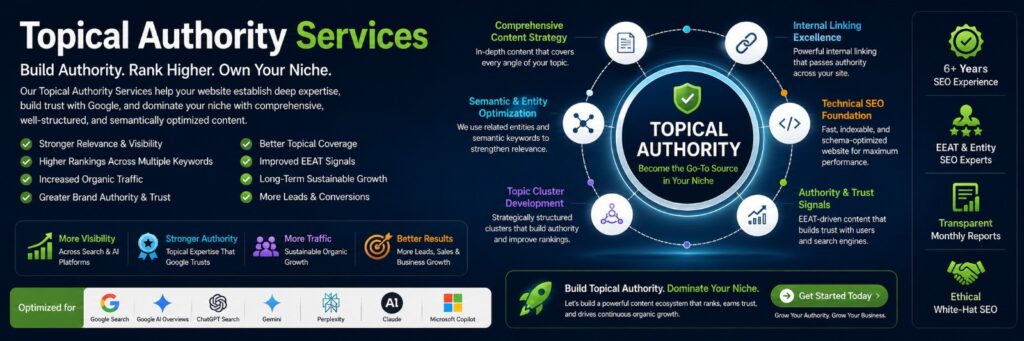
Topical Authority Services: Complete Guide to Building Google Rankings, AI Search Visibility & Industry Expertise
If SEO ten years ago was about keywords, SEO today is about expertise. Search engines have evolved far beyond matching words on a page. Modern algorithms attempt to understand entire subjects, identify relationships between concepts, and determine which websites demonstrate genuine expertise.
This shift has fundamentally changed how websites compete. Publishing a handful of keyword-optimized articles is no longer enough to establish long-term visibility. Today, Google wants to know whether your website truly understands a topic.
Artificial intelligence has accelerated this evolution. Google AI Overviews, ChatGPT, Gemini, Perplexity, and other AI-powered search engines increasingly recommend websites that consistently demonstrate expertise across an entire subject rather than isolated keyword pages. This is where Topical Authority becomes one of the most valuable SEO investments a business can make.
Professional Topical Authority Services help businesses organize, expand, and optimize their content so search engines recognize them as trusted experts within their industry. Instead of chasing individual rankings, the goal is to become the website that Google and AI search engines trust when answering questions related to your niche.
What Is Topical Authority?
Topical authority is the process of demonstrating comprehensive expertise around a specific subject. Instead of publishing isolated articles targeting individual keywords, a website develops complete coverage of an entire topic.
Imagine two websites. The first publishes five random SEO articles over a year. The second builds an interconnected content library covering technical SEO, AI SEO, Entity SEO, local SEO, link building, content optimization, Google Business Profile, structured data, AI search, and SEO measurement.
Which website appears more authoritative? The second. Search engines increasingly reward websites that thoroughly answer the questions users have throughout an entire customer journey rather than only addressing one search query. Comprehensive topic coverage, supported by internal linking and semantic relationships, has become a defining characteristic of topical authority.
Why Topical Authority Matters More Than Ever
Google’s algorithms have become increasingly semantic. Instead of asking:
“Does this page contain the keyword?” Search engines increasingly ask: “Does this website genuinely understand this topic?” The same principle applies to AI-powered search. Large language models attempt to identify the most reliable sources by evaluating expertise, consistency, semantic relationships, structured information, and authority signals.
Businesses with strong topical authority are more likely to appear in:
- Google Search
- Google AI Overviews
- ChatGPT recommendations
- Gemini answers
- Perplexity citations
Topical authority has become one of the strongest competitive advantages in modern SEO.
Topical Authority vs Traditional SEO
Traditional SEO often focuses on ranking individual pages. Topical Authority focuses on building expertise across an entire subject.
Traditional SEO asks:
“How do we rank this keyword?” Topical Authority asks: “How do we become the industry’s most trusted resource?” The most successful businesses combine both strategies.
Keywords continue attracting searches. Topical authority creates trust. Together, they produce sustainable organic growth.

How Google Understands Topical Authority
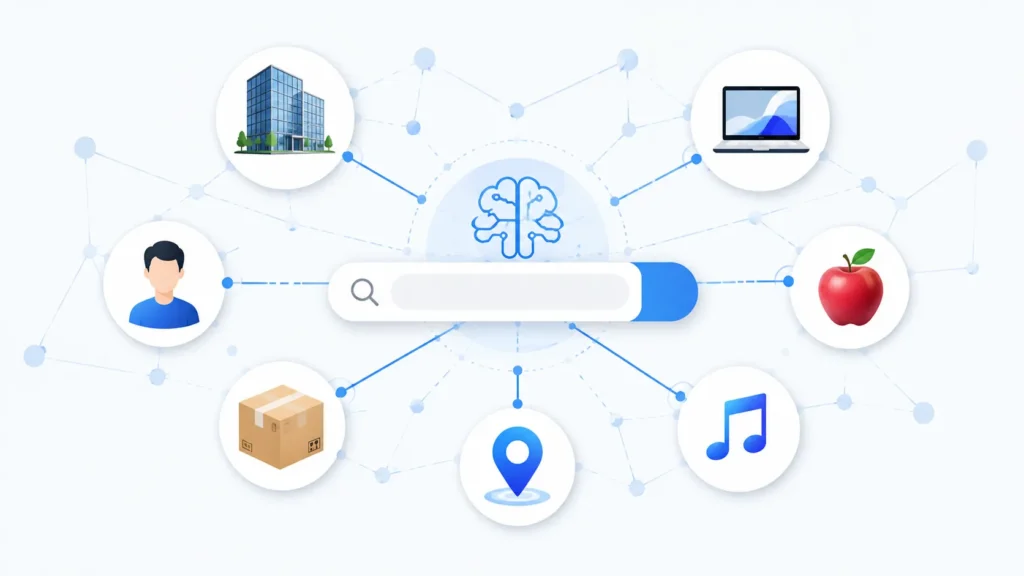
Google evaluates much more than individual pages.
It analyzes:
- Topic coverage
- Semantic relationships
- Internal linking
- Content quality
- User engagement
- Brand authority
- Entity relationships
- Structured data
When these signals consistently reinforce one subject, Google becomes more confident that your website deserves visibility for related searches.
Why AI Search Rewards Topical Authority
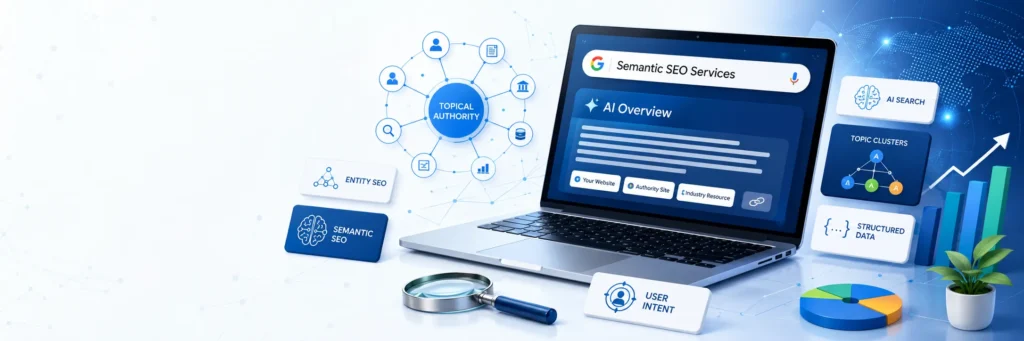
AI-powered search engines do not simply retrieve webpages. They synthesize information. When ChatGPT or Google AI Overviews answer a question, they prefer sources demonstrating depth, consistency, and authority across the entire topic.
This means businesses with strong topical authority are often better positioned for AI-generated recommendations than businesses relying only on keyword optimization. Integrated SEO, entity clarity, and content depth are increasingly viewed as essential for AI trust.
Our Topical Authority Services
Building topical authority isn’t about publishing hundreds of random blog posts or chasing individual keywords. It’s about creating a structured content ecosystem that demonstrates expertise, authority, and trust across an entire subject. Search engines want to recommend websites that provide complete, reliable information rather than isolated answers.
Our Topical Authority Services follow a proven, strategic framework that covers every stage of planning, content creation, optimization, and continuous improvement. From the initial audit to AI search optimization, every step is designed to strengthen your website’s authority, improve organic visibility, and position your brand as a trusted industry leader.
Steps
Step 1: Topical Authority Audit
Every successful topical authority campaign begins with a comprehensive audit. Before creating new content, we first evaluate how search engines currently perceive your website and identify the strengths and weaknesses of your existing content ecosystem.
Our audit includes a detailed analysis of your published content, keyword coverage, semantic relevance, internal linking structure, entity associations, content quality, topical depth, and competitor performance. We also identify content cannibalization issues, orphan pages, outdated resources, and missed opportunities that may be limiting your growth.
Rather than making assumptions, this audit provides a data-driven roadmap that highlights the areas capable of delivering the greatest SEO impact.
Step 2: Topic Cluster Strategy
Publishing standalone articles is no longer enough to establish authority. Instead, we organize your website into carefully planned topic clusters that help search engines understand your expertise across an entire subject.
Each topic cluster revolves around a comprehensive pillar page that serves as the central resource for a specific topic. Around that pillar, we create supporting articles, educational guides, FAQs, service pages, comparison articles, case studies, and industry resources that answer related questions from different angles.
Every piece of content is strategically connected, creating a semantic network that reinforces the authority of the entire cluster. This structured approach improves crawlability, strengthens internal linking, and signals to Google that your website is a trusted source of information.
Step 3:Keyword & Entity Research
While keywords remain an essential part of SEO, modern search engines rely heavily on entities and semantic relationships to understand context. That’s why our research process goes far beyond traditional keyword analysis.
We identify primary and secondary keywords, related entities, semantic concepts, industry-specific terminology, user intent, frequently asked questions, and conversational search queries. We also analyze how topics connect with one another and which supporting concepts should be included to create comprehensive content.
By combining keyword research with entity research, we develop a complete content ecosystem that aligns with both traditional search algorithms and AI-powered search engines.
Step 4: Pillar Page Development
Pillar pages are the foundation of topical authority. These are comprehensive, in-depth resources designed to cover an entire topic rather than focusing on a single keyword.
For example, if your business provides SEO services, your pillar pages might focus on AI SEO, Local SEO, Technical SEO, Entity SEO, Healthcare SEO, or eCommerce SEO. Each pillar page acts as the central hub for dozens of related articles that explore specific subtopics in greater detail.
A well-developed pillar page not only improves rankings for competitive keywords but also helps establish your website as an authoritative source within your industry.
Step 5: Supporting Content Creation
Authority is built through depth, not quantity. Once pillar pages are established, we create supporting content that answers every important question your target audience may have.
This includes beginner guides, advanced tutorials, industry comparisons, best practices, case studies, troubleshooting articles, FAQs, trend reports, and practical how-to resources. Each supporting article is written to complement the pillar page while targeting additional long-tail keywords and user intents.
Over time, this growing library of interconnected content strengthens your website’s topical relevance and increases the likelihood of ranking for hundreds or even thousands of related search queries.
Step 6: Internal Linking Architecture
Internal links do much more than help visitors navigate your website—they help search engines understand how your content is connected.
We develop a strategic internal linking architecture that connects related articles, service pages, pillar content, and supporting resources using meaningful contextual links. This distributes authority throughout your website while reinforcing semantic relationships between topics.
A strong internal linking structure improves crawl efficiency, enhances user experience, strengthens topic hierarchy, and accelerates the development of topical authority across your entire website.
Step 7: Entity SEO Integration
Topical Authority and Entity SEO are two complementary strategies that work best when implemented together.
While topic clusters demonstrate the breadth of your expertise, Entity SEO helps search engines clearly understand your brand, products, services, people, locations, and relationships within your industry.
We integrate structured data, Knowledge Graph optimization, consistent brand signals, entity relationships, and semantic markup throughout your website. This strengthens your brand authority, improves machine understanding, and increases your visibility in Google Search, Google AI Overviews, ChatGPT, Gemini, and other AI-powered search platforms.
Step 8: Semantic Content Optimization
Modern search engines evaluate meaning rather than simply counting keyword occurrences. Our semantic optimization process ensures that every page naturally covers the concepts users expect to find.
Instead of forcing keywords into every paragraph, we enrich content with related concepts, synonyms, industry terminology, contextual explanations, and supporting information that demonstrates genuine expertise.
This creates more natural, engaging content for readers while helping search engines understand the depth and relevance of each page.
Step 9: Content Gap Analysis
One of the fastest ways to outperform competitors is by identifying what they’re missing.
Our content gap analysis compares your website against leading competitors to uncover unanswered questions, missing topics, underdeveloped content, outdated information, and emerging industry trends.
We then prioritize these opportunities based on search demand, business value, and ranking potential. Rather than producing random blog posts, we create content that fills strategic gaps in your industry and positions your website as the most comprehensive resource available.
Step 10: AI Search Optimization
As AI-powered search continues to evolve, optimizing for traditional rankings alone is no longer enough.
We structure your content to improve visibility across Google AI Overviews, ChatGPT, Gemini, Perplexity, and other AI-driven search experiences. This includes improving content structure, semantic clarity, entity optimization, schema markup, topical completeness, and factual consistency.
Our goal is to help AI systems recognize your website as a trusted source of information that deserves to be referenced, cited, and recommended in AI-generated answers. By combining traditional SEO with AI search optimization, we prepare your website for the future of search while continuing to drive long-term organic growth.
Industries That Benefit Most
Topical Authority Services benefit almost every industry.
Examples include:
- SaaS
- Healthcare
- Law Firms
- Finance
- Real Estate
- Home Services
- eCommerce
- Education
- Manufacturing
- Enterprise Brands
Businesses operating in competitive markets typically gain the greatest value.
Success extends beyond keyword rankings.
We monitor:
- Organic traffic
- Keyword growth
- Topic coverage
- AI citations
- Google AI Overviews visibility
- Internal link health
- Engagement
- Leads
- Revenue
These metrics connect SEO performance with business outcomes.

Topical Authority Framework
Building topical authority isn’t about publishing dozens of random blog posts—it’s about creating a structured content ecosystem that proves your expertise to both search engines and users.
Our process begins with in-depth topic research to identify the subjects, questions, and search intent that matter most to your audience. We then create a topic map, organizing these subjects into logical categories and subtopics before grouping related keywords into semantic keyword clusters.
From there, we develop comprehensive pillar pages that serve as the primary authority resource for each topic, supported by detailed articles that answer specific questions, solve problems, and cover every important aspect of the subject. Next, we strengthen your website through Entity SEO, helping search engines understand your brand, services, and relationships while implementing a strategic internal linking architecture that connects every piece of content into one cohesive knowledge network.
We enhance machine understanding with structured schema markup, then build authority through high-quality backlinks, digital PR, brand mentions, and trust signals. Finally, we continuously monitor rankings, traffic, keyword growth, user engagement, AI visibility, and content performance, refining the strategy over time to ensure your website remains the most comprehensive and authoritative resource in your industry.
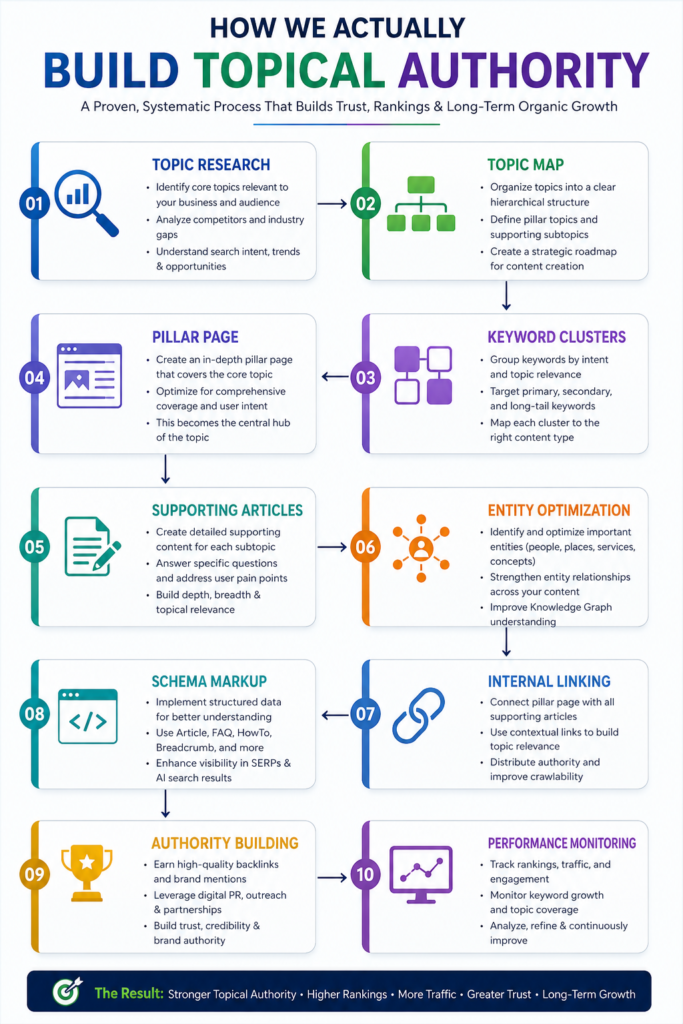
Example flow:
Topic Research
↓
Topic Map
↓
Keyword Clusters
↓
Pillar Page
↓
Supporting Articles
↓
Entity Optimization
↓
Internal Linking
↓
Schema
↓
Authority Building
↓
Performance Monitoring
What Google Uses to Measure Topical Authority
Google no longer ranks pages based solely on keywords. Modern search algorithms evaluate hundreds of signals to determine whether a website demonstrates genuine expertise, authority, and trust across an entire subject. The stronger these signals are, the more likely Google is to recognize your website as an authoritative resource and reward it with higher rankings, greater visibility, and increased appearances in AI-powered search experiences. Below are the most important signals that contribute to building topical authority.
1. Content Depth
Google favors comprehensive content that thoroughly covers a topic rather than providing superficial information. A high-authority page should answer primary questions while also addressing related subtopics, common concerns, practical examples, and advanced insights. Instead of publishing multiple short articles that barely scratch the surface, businesses should create detailed resources that become the definitive guide on a subject. Comprehensive content demonstrates expertise and increases the likelihood of satisfying user intent.
2. Semantic Coverage
Modern search engines understand language semantically, meaning they evaluate the relationships between concepts rather than simply counting keyword occurrences. Strong topical authority content naturally includes related terms, synonyms, industry terminology, and supporting concepts that provide context. This helps Google understand that your content covers the full scope of a topic rather than focusing on a single keyword.
3. Entity Relationships
Google increasingly understands websites through entities such as businesses, people, products, services, locations, and organizations. By clearly defining these entities and demonstrating how they relate to one another, you help search engines better understand your expertise. For example, an SEO agency should naturally connect topics like Technical SEO, Local SEO, AI SEO, Entity SEO, Content Strategy, and Google Business Profile within its content ecosystem. Strong entity relationships improve semantic understanding and reinforce your website’s authority.
4. Internal Linking
Internal links do much more than guide visitors between pages—they help search engines understand the structure of your website and the relationships between your content. Strategic internal linking distributes authority from pillar pages to supporting articles, reinforces topical clusters, improves crawlability, and creates a logical knowledge network. A well-designed internal linking strategy makes it easier for Google to recognize your website as a comprehensive resource on a subject.
5. Search Intent Alignment
Creating high-quality content is only valuable if it satisfies the user’s intent. Google evaluates whether your page provides the type of information people expect when they perform a search. Informational searches require educational content, commercial searches need comparisons and buying guidance, while transactional searches should lead users toward products or services. Matching search intent improves user satisfaction and strengthens topical relevance.
6. Experience, Expertise, Authoritativeness & Trust (E-E-A-T)
Google places significant importance on the quality and credibility of content, particularly for competitive and high-impact industries. Websites demonstrating real-world experience, subject matter expertise, professional authority, and trustworthiness are more likely to earn stronger rankings. Displaying author credentials, showcasing industry experience, publishing original insights, earning quality backlinks, and maintaining transparent business information all contribute to stronger E-E-A-T signals.
7. Content Freshness
Topical authority is not built once and forgotten. Search engines prefer content that remains current, accurate, and relevant. Regularly updating articles with new statistics, industry developments, algorithm changes, AI advancements, and practical examples signals that your website continues to provide reliable information. Fresh content is particularly important in rapidly evolving industries such as SEO, technology, finance, and healthcare.
8. Helpful Content
Google’s Helpful Content System rewards websites that create content primarily for people rather than search engines. Articles should provide genuine value by solving problems, answering questions clearly, and offering actionable guidance. Thin content, excessive keyword optimization, or articles created solely to target rankings are less likely to perform well. Helpful, user-focused content naturally builds trust and strengthens topical authority over time.
9. User Signals
While Google does not rely on a single engagement metric, it evaluates various user behavior signals that indicate whether visitors find your content valuable. Longer engagement, meaningful interactions, repeat visits, lower bounce rates in appropriate contexts, and successful completion of user goals suggest that your content satisfies search intent. Positive user experiences reinforce the quality and relevance of your website.
10. Brand Mentions
Authority extends beyond your own website. When trusted publications, industry blogs, local organizations, media outlets, and other authoritative sources mention your brand, Google receives additional trust signals. Even unlinked brand mentions help reinforce your business’s reputation within its niche. Consistent recognition across the web strengthens both brand authority and topical authority.
11. Structured Data (Schema Markup)
Structured data helps search engines understand your content more accurately by providing machine-readable information about your pages. Schema markup can define your organization, services, articles, FAQs, authors, reviews, and other important entities. Proper implementation improves search engine understanding, increases eligibility for rich search results, and enhances visibility across traditional and AI-powered search experiences.
12. Knowledge Graph Signals
Google’s Knowledge Graph connects billions of entities and their relationships to understand the world better. When your business becomes a clearly recognized entity with consistent information, authoritative citations, structured data, and strong topical associations, Google gains greater confidence in recommending your content. Optimizing for the Knowledge Graph helps strengthen brand recognition, improve semantic understanding, and increase visibility in Google Search, Google AI Overviews, and other AI-driven search platforms.
Why These Signals Matter Together
No single factor creates topical authority on its own. Instead, Google evaluates how all of these signals work together to determine whether your website consistently demonstrates expertise across an entire subject. Comprehensive content, semantic relevance, strong entity relationships, effective internal linking, helpful user experiences, structured data, and authoritative brand signals collectively build trust in your website.
The stronger and more consistent these signals become, the easier it is for Google to recognize your expertise, improve your rankings for related topics, and recommend your content in both traditional search results and AI-powered search experiences. In today’s search landscape, topical authority is no longer about optimizing individual pages—it’s about building an interconnected ecosystem of high-quality content that establishes your website as the definitive resource in your industry.
Content Cluster Example
SEO
↓
Technical SEO
↓
Semantic SEO
↓
Entity SEO
↓
AI SEO
↓
Google AI Overviews
↓
Topical Authority
↓
Internal Linking
↓
SEO Audit
Google understands this relationship extremely well.
Why Topical Authority Matters for AI Search
This is one of the largest gaps among competitors.
Cover:
Google AI Overviews
ChatGPT Search
Gemini
Claude
Perplexity
Microsoft Copilot
Explain that AI prefers websites covering an entire subject instead of isolated pages.
Tools We Use
Google Search Console
Google Analytics 4
Ahrefs
Semrush
Screaming Frog
Surfer SEO
MarketMuse
InLinks
Frase
PageSpeed Insights
Adds trust and EEAT.
Success extends beyond keyword rankings.
We monitor:
- Organic traffic
- Keyword growth
- Topic coverage
- AI citations
- Google AI Overviews visibility
- Internal link health
- Engagement
- Leads
- Revenue
These metrics connect SEO performance with business outcomes.
Common Mistakes Businesses Make
Many websites struggle because they:
- Publish unrelated content
- Ignore internal linking
- Create duplicate pages
- Focus only on keywords
- Skip content updates
- Neglect Entity SEO
These issues prevent search engines from recognizing true expertise.
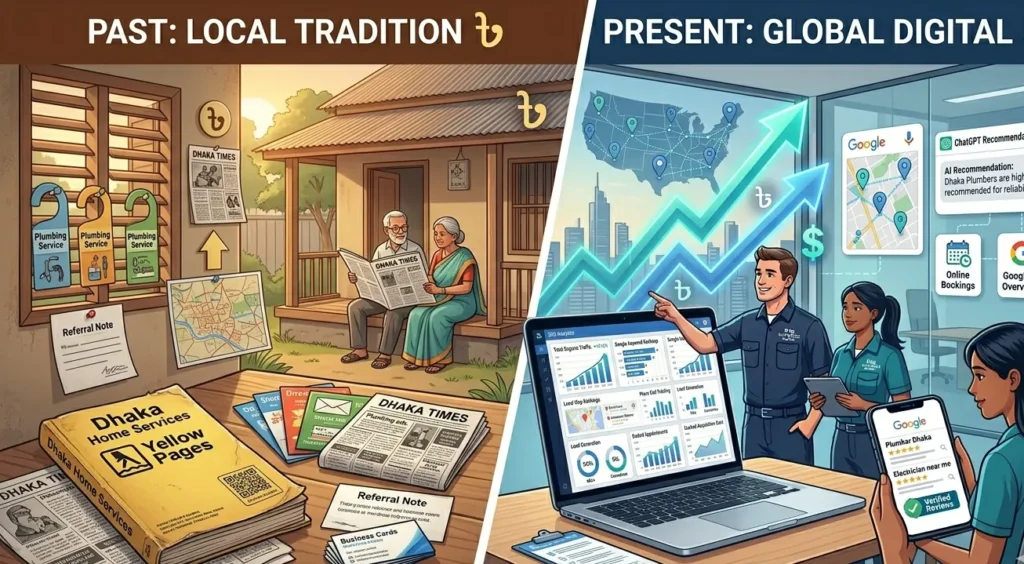
Topical Authority vs Brand Authority

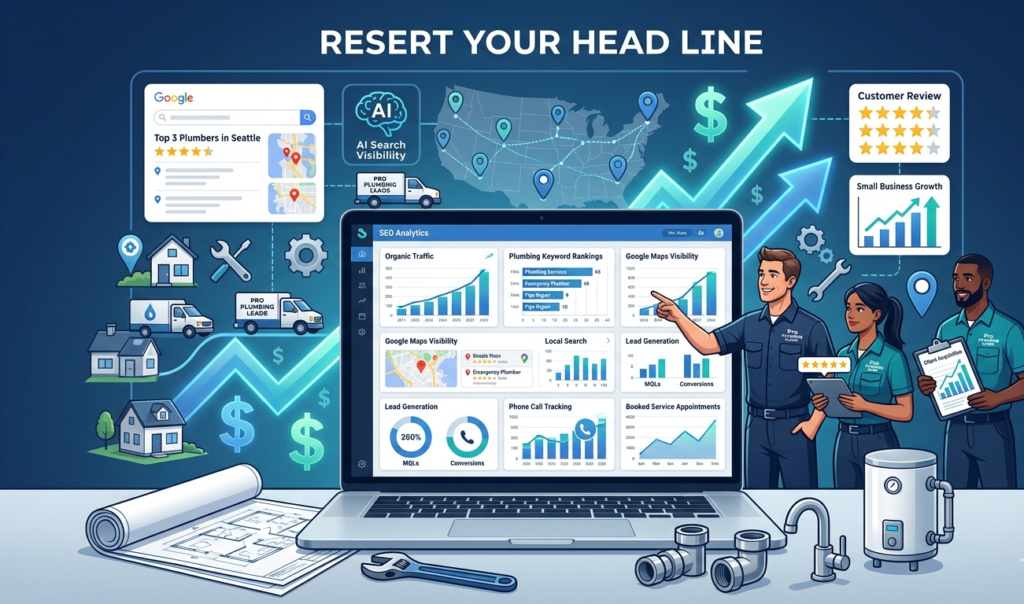
One emerging trend is the relationship between topical authority and brand authority. Publishing more content alone is not enough.
Brands also need:
- Trust
- Recognition
- Reviews
- Mentions
- Digital PR
- Expertise
The strongest SEO strategies combine topical authority with strong brand authority rather than treating them as competing concepts.
The Future of Topical Authority
Search is moving toward understanding, not matching.
Future ranking systems will continue emphasizing:
- Semantic relationships
- Entity understanding
- AI citations
- Knowledge Graphs
- Content ecosystems
- User trust
Businesses investing in topical authority today are preparing for the next generation of search.
Why Choose Professional Topical Authority Services?
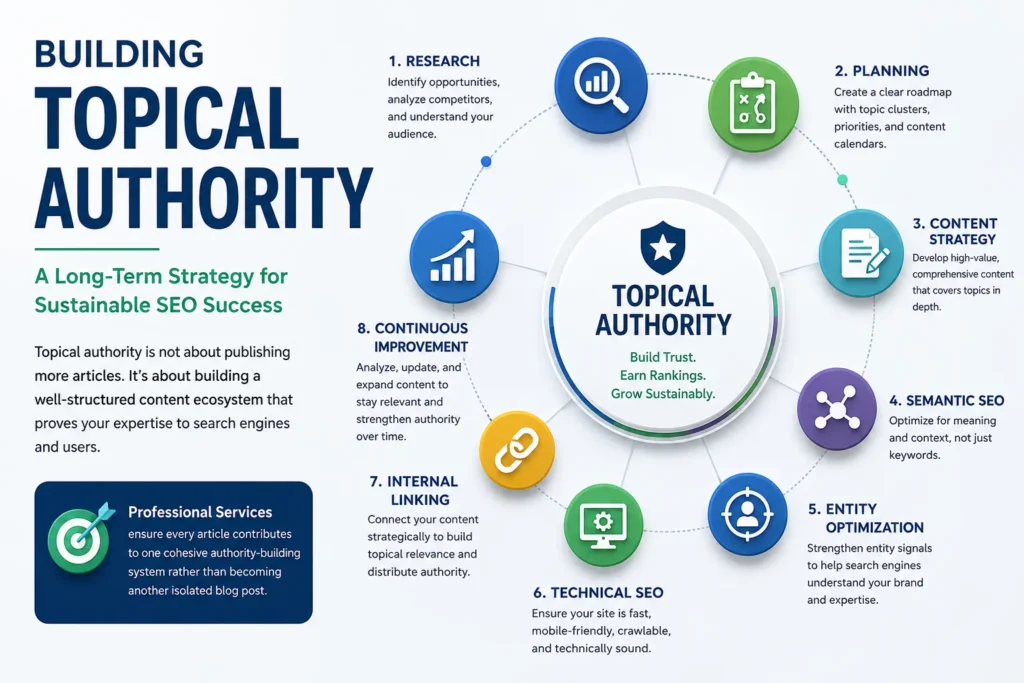
Building topical authority is a long-term strategy.
It requires:
- Research
- Planning
- Content strategy
- Semantic SEO
- Entity optimization
- Technical SEO
- Internal linking
- Continuous improvement
Professional services ensure every article contributes to one cohesive authority-building system rather than becoming another isolated blog post.
Final Thoughts
Topical authority is no longer optional for businesses that want sustainable organic growth. Search engines and AI platforms increasingly reward websites that demonstrate genuine expertise, comprehensive topic coverage, and strong semantic relationships.
Professional Topical Authority Services help transform a collection of pages into a trusted knowledge ecosystem. Whether your goal is to improve Google rankings, appear in Google AI Overviews, earn ChatGPT citations, or build long-term industry authority, topical authority provides the strategic foundation. The businesses that invest in comprehensive topic coverage today will be the ones that dominate both traditional search and AI-powered search tomorrow.
FAQs
Topical Authority Services help businesses build comprehensive expertise around a specific subject by creating well-structured content clusters, pillar pages, semantic content, internal linking, and Entity SEO strategies. The goal is to establish your website as the most authoritative resource in your industry, improving both Google rankings and AI search visibility.
Topical authority improves SEO by helping search engines understand that your website provides complete, trustworthy, and in-depth coverage of a subject. Instead of ranking for a single keyword, your website becomes eligible to rank for hundreds of related keywords, increasing organic traffic and long-term search visibility.
Traditional SEO focuses on optimizing individual pages for specific keywords, while Topical Authority focuses on building comprehensive expertise across an entire subject. The best SEO strategies combine keyword optimization with topic clusters, semantic SEO, and entity optimization to achieve sustainable rankings.
Building topical authority is a long-term strategy. Depending on your industry, competition, and existing website authority, noticeable improvements typically begin within 3 to 6 months, while strong topical authority usually develops over 6 to 12 months through consistent content creation, optimization, and authority building.
A topic cluster is a group of related content centered around one comprehensive pillar page. The pillar page covers the main topic, while supporting articles explore individual subtopics in greater detail. Strategic internal linking connects all content, helping search engines understand the relationships between pages and strengthening topical relevance.
Entity SEO helps search engines understand your business, services, products, people, and industry relationships. When combined with topic clusters and semantic content, Entity SEO strengthens your website's expertise, improves Knowledge Graph recognition, and increases visibility in Google Search, Google AI Overviews, ChatGPT, Gemini, and other AI-powered search platforms.
Yes. While no one can guarantee inclusion, websites with strong topical authority are more likely to be recognized as trusted sources by AI-powered search engines. Comprehensive content, semantic optimization, structured data, entity relationships, and consistent expertise significantly improve your chances of being referenced in Google AI Overviews, ChatGPT, Gemini, and Perplexity.
Almost every industry can benefit from topical authority, including SEO agencies, healthcare providers, law firms, accounting firms, real estate companies, eCommerce stores, SaaS businesses, educational platforms, home service providers, financial institutions, and enterprise organizations. Competitive industries often see the greatest long-term impact.
Success is measured using a combination of SEO and business performance metrics, including organic traffic growth, keyword rankings, topic coverage, Google AI Overviews visibility, AI citations, internal link health, user engagement, lead generation, conversions, and overall return on investment (ROI).
Building topical authority requires much more than writing blog posts. It involves strategic topic research, keyword clustering, semantic SEO, Entity SEO, pillar page development, content planning, internal linking, schema markup, technical SEO, and continuous performance optimization. A professional agency ensures every piece of content contributes to one unified authority-building strategy that delivers sustainable search visibility and long-term business growth.