
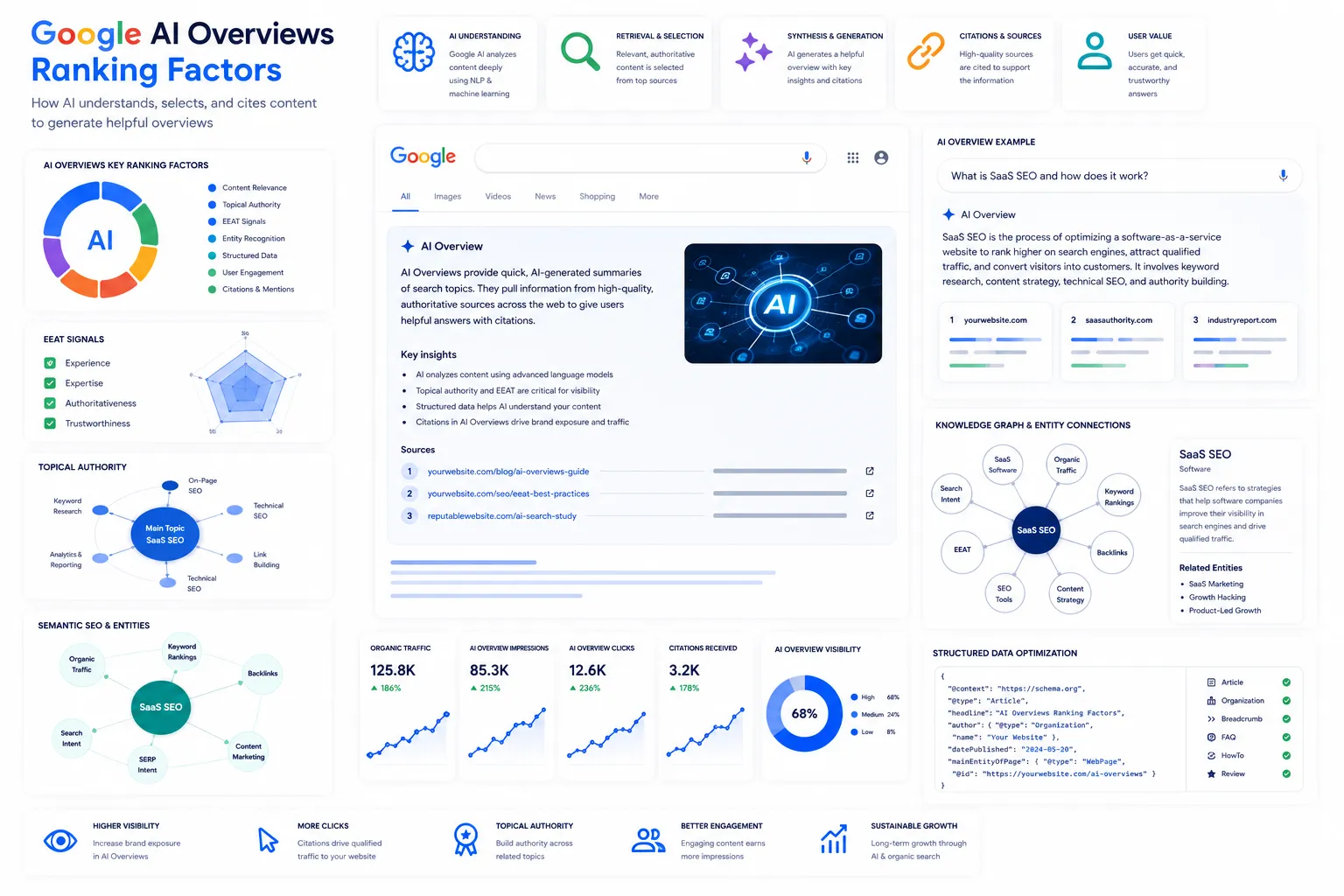
Google AI Overviews Ranking Factors: The Complete Guide to Ranking in AI-Powered Search Results
Google Search is undergoing its biggest transformation since its launch. With the introduction of Google AI Overviews, users can now receive AI-generated answers directly within search results without clicking through multiple websites.
This shift is changing how businesses approach SEO.
Ranking #1 in traditional search results is no longer the only goal. Today, brands must also optimize their content to become trusted sources that Google’s AI can cite and reference within AI Overviews.
Many website owners are asking:
- How does Google choose sources for AI Overviews?
- What ranking factors influence AI-generated answers?
- Can SEO help websites appear in AI Overviews?
- What is the difference between traditional rankings and AI citations?
The reality is that AI Overviews rely on many traditional SEO signals while also introducing new requirements related to entities, authority, semantic understanding, and answer quality.
In this guide, you’ll learn the most important Google AI Overviews ranking factors and how to optimize your website for AI-powered search.
What Are Google AI Overviews?
Google AI Overviews are AI-generated summaries that appear at the top of search results.
Instead of showing only blue links, Google’s AI creates direct answers by combining information from multiple trusted sources.
These AI-generated responses often include:
- Definitions
- Explanations
- Recommendations
- Comparisons
- Lists
- Summaries
The AI may also cite websites that contribute information to the generated response.
For businesses, appearing within AI Overviews can significantly increase visibility, authority, and brand recognition.
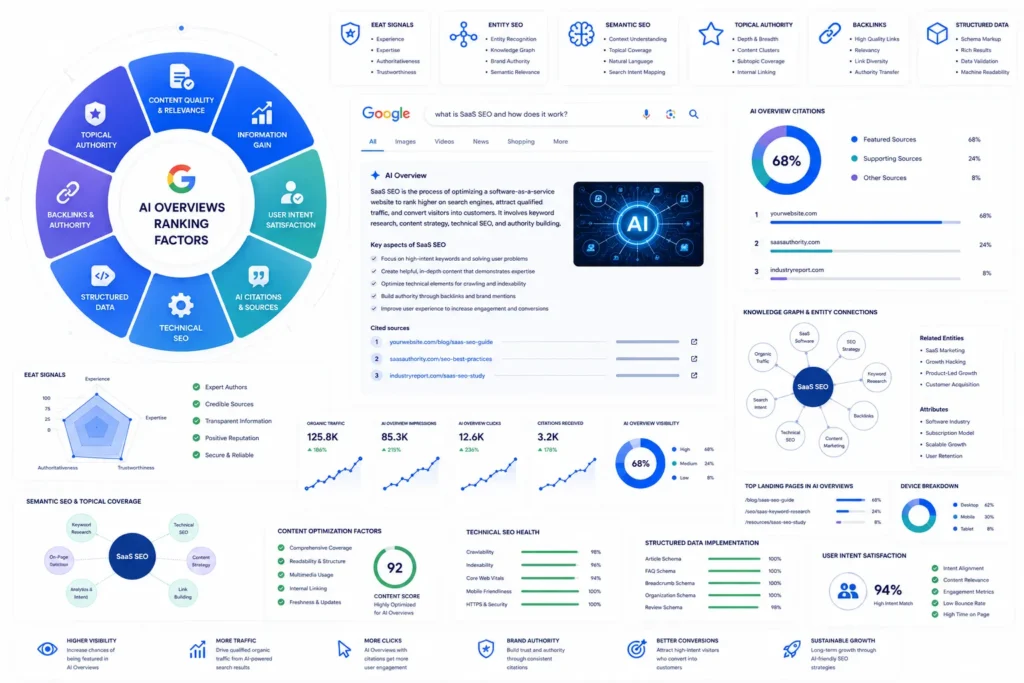
Why Google AI Overviews Matter
AI-powered search is changing user behavior.
Instead of searching:
“Best project management software”
Users increasingly ask:
“What is the best project management software for remote teams under 50 employees?”
Google AI can answer directly.
This means:
- Fewer clicks on traditional search results
- More visibility for trusted sources
- Increased competition for AI citations
- Greater emphasis on authority and expertise
Businesses that adapt early will gain a significant advantage.
How Google AI Overviews Work
Google’s AI systems analyze information from:
- Indexed webpages
- Knowledge Graph entities
- Structured data
- Trusted sources
- User intent signals
- Search quality systems
The AI then synthesizes information into a concise answer.
Unlike traditional rankings, AI Overviews focus on:
- Accuracy
- Authority
- Relevance
- Trustworthiness
- Information completeness
1. EEAT (Experience, Expertise, Authoritativeness, Trustworthiness)
EEAT remains one of the strongest ranking factors influencing AI Overviews.
Google wants AI-generated answers to come from trustworthy and authoritative sources.
Experience
Content should demonstrate real-world experience.
Examples include:
- Case studies
- Personal insights
- Practical examples
- Industry experience
Expertise
Google favors content written by subject matter experts.
Ways to demonstrate expertise:
- Author profiles
- Professional credentials
- Detailed explanations
- Expert commentary
Authoritativeness
Authority is built through:
- Industry recognition
- Quality backlinks
- Brand mentions
- Media coverage
Trustworthiness
Trust signals include:
- Contact information
- Secure website
- Accurate information
- Transparent authorship
The stronger your EEAT signals, the higher the likelihood of being cited by AI systems.
2. Entity SEO and Knowledge Graph Signals
One of the most overlooked AI Overview ranking factors is Entity SEO.
Google increasingly understands:
- People
- Companies
- Products
- Services
- Locations
as entities rather than keywords.
Why Entities Matter
AI systems rely heavily on entity relationships.
For example:
Google understands that:
- OpenAI is a company
- ChatGPT is a product
- Sam Altman is a person
The stronger your entity presence, the easier it becomes for AI systems to trust and reference your content.
Entity Optimization Strategies
- Organization Schema
- Person Schema
- Consistent NAP information
- Brand mentions
- Wikidata references
- Knowledge Graph optimization
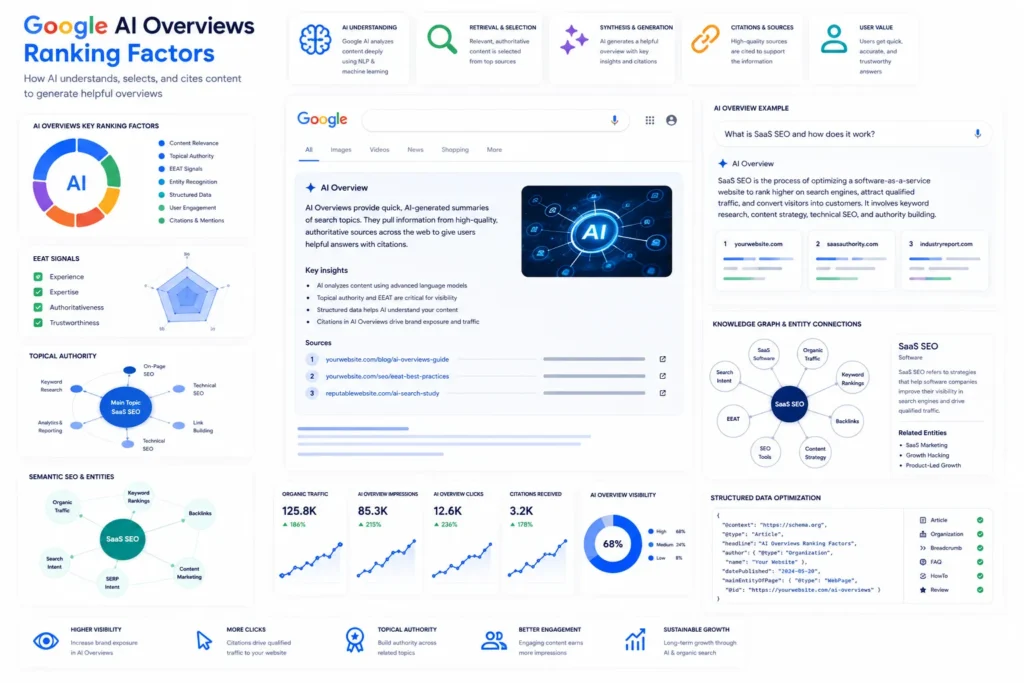
3. Semantic SEO
AI systems do not rely on exact-match keywords.
They focus on meaning.
For example:
A page about “Google AI Overviews Ranking Factors” should naturally cover:
- AI Search Optimization
- Generative Engine Optimization
- Answer Engine Optimization
- AI Citations
- Semantic Search
- Knowledge Graphs
- AI SEO
This semantic coverage helps AI understand topical depth.
4. Topical Authority
Google prefers citing websites that demonstrate expertise across an entire topic.
Weak Topical Authority
One article about AI SEO.
Strong Topical Authority
A complete content cluster covering:
- AI SEO
- GEO
- AEO
- AI Overviews
- Entity SEO
- Semantic SEO
- Knowledge Graph Optimization
- AI Search Ranking Factors
The more comprehensive your topic coverage, the more likely AI systems will trust your content.
5. Information Gain
One of Google’s most important modern ranking concepts is Information Gain.
AI systems prioritize content that adds something unique.
Examples
Instead of repeating what competitors say:
Provide:
- Original research
- Case studies
- Proprietary data
- Unique frameworks
- Expert analysis
Information gain increases citation opportunities.
6. Answer-Focused Content Structure
AI systems prefer content that answers questions clearly.
Effective Formats
Definition Blocks
What is Google AI Overviews?
Step-by-Step Guides
How to optimize for AI Overviews.
Comparison Tables
SEO vs GEO vs AEO.
FAQ Sections
Question-and-answer formats improve AI comprehension.
Structured answers increase citation likelihood.
7. Content Quality and Depth
Thin content rarely performs well in AI environments.
Google favors content that:
- Fully answers questions
- Covers related topics
- Provides context
- Includes examples
- Demonstrates expertise
Generally, comprehensive content outperforms shallow content.
8. Structured Data and Schema Markup
Schema helps Google understand content.
Important schema types include:
- FAQ Schema
- Article Schema
- Organization Schema
- Service Schema
- Author Schema
- Review Schema
Schema improves machine readability and content understanding.
9. Brand Authority Signals
Strong brands are cited more often.
AI systems evaluate:
- Brand mentions
- Media references
- Industry citations
- Online reputation
- Social proof
Building authority beyond your website improves AI trust.
10. Backlinks and External References
Backlinks remain important.
However, AI systems focus more on:
- Quality
- Relevance
- Authority
A few authoritative backlinks often outperform hundreds of low-quality links.
11. User Intent Satisfaction
Google wants AI Overviews to satisfy user intent immediately.
Content should match:
Informational Intent
Educational content.
Commercial Intent
Product and service comparisons.
Transactional Intent
Buying-focused pages.
Navigational Intent
Brand-specific searches.
Intent alignment significantly influences AI Overview visibility.
12. Internal Linking and Website Architecture
AI systems benefit from clear content relationships.
A strong website architecture includes:
↓
Category Pages
↓
Service Pages
↓
Supporting Articles
↓
Case Studies
↓
FAQs
This structure strengthens topical authority and crawlability.
13. Technical SEO Foundation
AI visibility depends on technical SEO.
Critical factors include:
- Crawlability
- Indexability
- Mobile usability
- Core Web Vitals
- HTTPS security
- Structured URLs
Technical issues can prevent otherwise excellent content from being cited.
14. Freshness and Content Updates
Google prefers accurate and current information.
Regular updates help maintain relevance.
Update:
- Statistics
- Examples
- Industry trends
- AI platform changes
Fresh content increases trust.
15. AI Citation Optimization
A new discipline is emerging:
AI Citation Optimization.
Strategies include:
- Clear answers
- Original insights
- Strong entities
- Trusted sources
- Semantic relevance
- EEAT improvements
The goal is becoming a source AI systems choose to reference.
How to Increase Your Chances of Appearing in Google AI Overviews
Create Comprehensive Topic Clusters
Cover entire topics rather than isolated keywords.
Build Strong Entity Signals
Help Google understand who you are.
Publish Expert-Led Content
Demonstrate experience and authority.
Implement Schema Markup
Improve machine understanding.
Improve Technical SEO
Ensure crawlability and indexation.
Focus on User Intent
Answer questions completely and clearly.
The Future of AI Overview Rankings
Google’s AI systems will continue evolving.
Future ranking signals will likely place greater emphasis on:
- Entities
- Authority
- Originality
- Information gain
- Expert content
- Trust signals
Businesses that build authority now will be better positioned for future AI search experiences.
Conclusion
Google AI Overviews are transforming how search works.
While traditional SEO remains important, success in AI-powered search requires a broader strategy focused on authority, entities, semantic understanding, and trust.
The most important Google AI Overview ranking factors include:
- EEAT
- Entity SEO
- Semantic SEO
- Topical Authority
- Information Gain
- Structured Data
- Content Quality
- Brand Authority
- Technical SEO
- User Intent Satisfaction
Businesses that optimize for these factors can improve visibility, earn AI citations, and gain a competitive advantage as search continues to evolve.
The future belongs to brands that are not only easy to find but also trusted enough to become part of the answer itself.