

Best SEO Strategy for Startups in the USA (2026 Growth Framework)
The best SEO strategy for startups in the USA focuses on long-tail buyer intent keywords, lean execution, and scalable authority building
If you’re building a startup in the United States, you already know one thing:
Attention is expensive.
Paid ads burn capital fast. Social media is unpredictable. Cold outreach doesn’t scale easily.

That’s why founders ask:
What is the best SEO strategy for startups in the USA?
The right SEO strategy can:
- Reduce customer acquisition cost
- Build long-term organic traffic
- Increase investor confidence
- Generate predictable leads
- Scale without increasing ad spend
In this guide, we’ll break down a proven, structured SEO strategy tailored specifically for U.S. startups.
Why Startups Need a Different SEO Strategy
Most SEO advice online is generic.
Startups face unique challenges:
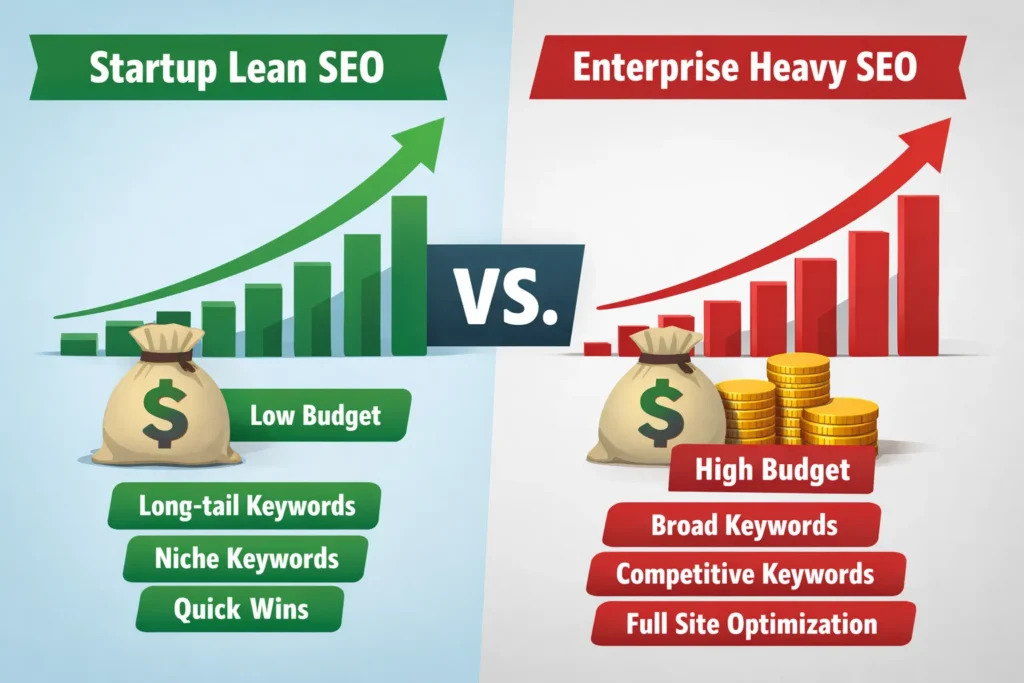
- Limited budget
- Aggressive competition
- Pressure for fast traction
- Product-market fit uncertainty
- Lean marketing teams
A startup SEO strategy must be:
- Lean
- Intent-focused
- Scalable
- ROI-driven
Not bloated or enterprise-style.
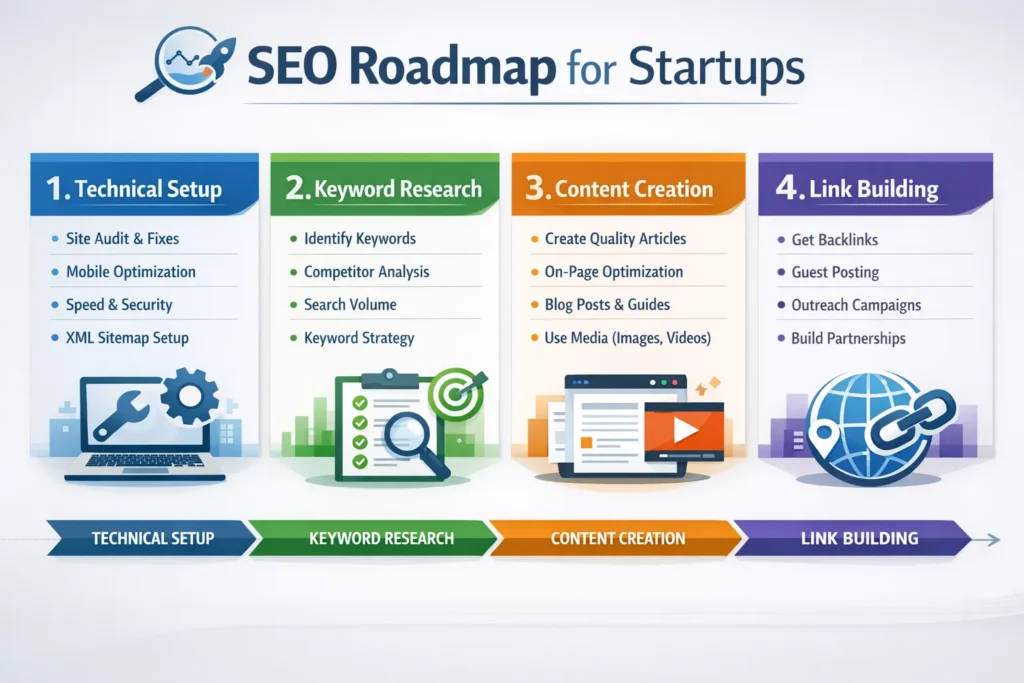
1st Step: Validate Search Demand Before Scaling
Competitor gap insight:
Most articles talk about “optimize your site” but skip validation.
Before building content, validate:
- Are people searching for your solution?
- What keywords show commercial intent?
- Are competitors ranking organically?
Focus on:
- Transactional keywords
- Problem-based search queries
- Long-tail commercial phrases
Example:
Instead of targeting:
“project management software”
Start with:
“project management software for remote startups”
“best project management tool for early stage teams”
Long-tail strategy wins early.
2nd Step: Build a Lean SEO Foundation
Startups don’t need 100 blog posts immediately.
They need structure.
Technical Basics:
- Fast loading website
- Mobile-first optimization
- Clean URL structure
- Proper indexing
- Schema markup
- Conversion tracking
Technical SEO ensures future scaling works smoothly.
3rd Step: Target Buyer-Intent Keywords First
Many startups waste time on informational content too early.
Instead, prioritize:
- “best [your service] for startups”
- “[your service] pricing”
- “[solution] for small businesses”
- “[industry] software USA”
Buyer-intent keywords drive revenue faster.
Traffic without conversions does not help runway.
4th Step: Create High-Impact Landing Pages
Start with:
- Core service page
- Use case page
- Comparison page
- Pricing page
- Feature-specific pages
Each page should target a specific intent.
Avoid generic homepage-only optimization.
5th Step: Content Cluster Strategy for Startups
Competitor gap:
Most SEO articles suggest blogging frequently but ignore structure.
Instead of random blog posts, build clusters:
Example Cluster:
Main Page:
SEO Services for Startups USA
Supporting Content:
- SEO Strategy for Early-Stage Startups
- SaaS SEO for Startups
- Startup Marketing vs SEO Comparison
- SEO vs Paid Ads for Startups
- How Long Does SEO Take for Startups
This builds topical authority.
Google rewards depth, not randomness.
6th Step: Build Authority Gradually
Startups cannot compete with enterprise brands on day one.
Authority strategy:
- Guest posting in startup blogs
- Tech community collaborations
- Startup directories
- PR mentions
- Niche SaaS placements
Focus on quality, not quantity.
5 strong backlinks are better than 50 spam links.
7th Step: Optimize for Local + National Depending on Model
If your startup serves local customers:
Invest in:
- Google Business Profile
- Location landing pages
- Local keyword targeting
If you operate nationwide:
Invest in:
- Industry-specific keywords
- Comparison content
- Authority building
Your geographic model defines SEO direction.
8th Step: Combine SEO with Product-Led Growth
SEO works best when aligned with product experience.
Example:
- Publish feature-based content
- Optimize knowledge base articles
- Build FAQ pages
- Rank for integration queries
SEO should support product discovery.
9th Step: Set Realistic Timeline Expectations
Startups often expect fast results.
Realistic timeline:
Month 1–2 → Foundation + keyword mapping
Month 3–4 → Long-tail ranking
Month 5–6 → Lead generation growth
Month 6–12 → Strong authority expansion
SEO is not instant. But it compounds.
10th Step: Track Revenue, Not Just Traffic
Competitor content gap:
Most articles emphasize traffic.
Startups should track:
- Organic signups
- Cost per acquisition
- Conversion rate
- Revenue from organic
- Lifetime value
Traffic is vanity. Revenue is survival.
Common SEO Mistakes Startups Make
- Chasing high-volume keywords too early
- Ignoring technical SEO
- Publishing thin content
- Stopping after 2–3 months
- Choosing the cheapest SEO provider
Structured execution matters.
Best SEO Strategy Summary for U.S. Startups
| Phase | Focus Area | Primary Goal | Expected Outcome |
|---|---|---|---|
| Month 1–2 | Technical SEO + Keyword Mapping | Build strong foundation | Improved indexing and crawl efficiency |
| Month 3–4 | Long-Tail Content Creation | Rank for buyer-intent keywords | Early organic traffic growth |
| Month 5–6 | Authority & Link Building | Increase domain trust | Higher keyword rankings |
| Month 6–12 | Scaling & Expansion | Dominate competitive keywords | Sustainable lead generation |
The best SEO strategy for startups in the USA includes:
- Validating search demand
- Targeting long-tail buyer intent
- Building strong landing pages
- Developing content clusters
- Gradual authority building
- Tracking revenue-based metrics
Lean, focused, scalable.
Is SEO Worth It for Startups?
Yes — when:
- You commit long term
- You align SEO with product-market fit
- You measure ROI
- You execute strategically
SEO becomes one of the most cost-effective growth channels over time.
Final Thought
Startups that invest early in SEO build a long-term competitive advantage.
Instead of constantly paying for traffic, they build an organic asset that compounds.
If you want to design a startup-specific SEO strategy aligned with your funding stage and growth goals, we can help you create a structured roadmap.
Contact us for a startup SEO consultation.