
Every business investing in SEO eventually asks the same question: “Is SEO actually generating revenue?”
It’s a fair question. While rankings, traffic, impressions, and clicks are important indicators, executives and business owners care about one thing above all else: Return on investment. The challenge is that SEO ROI is often misunderstood.
Many businesses measure rankings. Others measure traffic. Some focus on backlinks. But none of these metrics directly answer whether SEO is making money. SEO ROI connects organic search performance to real business outcomes such as revenue, leads, customers, and profit.
In 2026, measuring SEO ROI has become even more important because search is evolving rapidly. Google AI Overviews, ChatGPT, Gemini, Perplexity, and other AI-powered search platforms are changing how users discover businesses and consume information.
Companies that understand how to measure and improve SEO ROI will make better investment decisions and outperform competitors who rely on vanity metrics. This guide explains everything you need to know about SEO ROI, including how to calculate, forecast, report, and maximize it.
What Is SEO ROI?
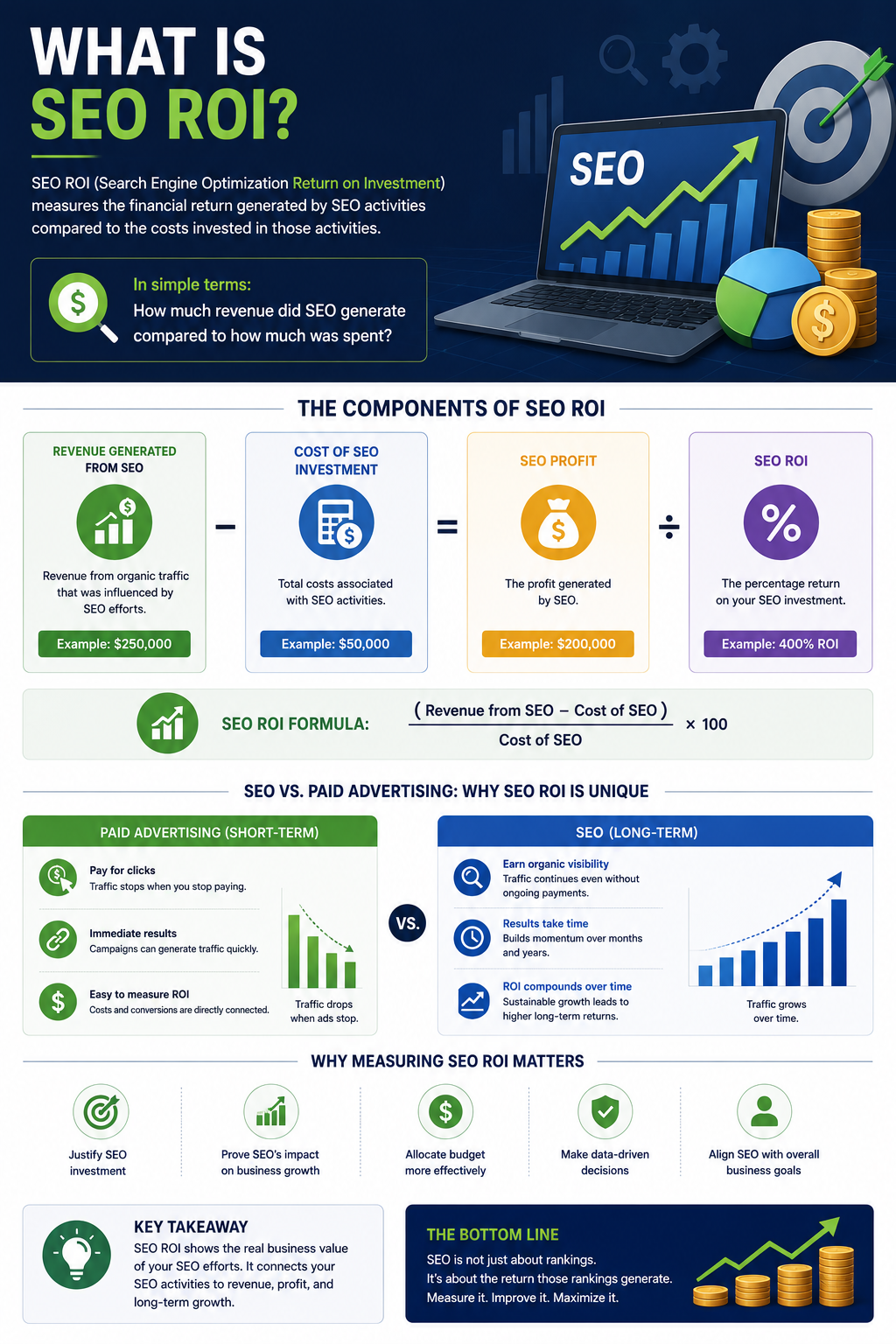
SEO ROI (Search Engine Optimization Return on Investment) measures the financial return generated by SEO activities compared to the costs invested in those activities.
In simple terms: How much revenue did SEO generate compared to how much was spent?
Unlike paid advertising, where costs and clicks are directly connected, SEO often delivers results over months or years. That makes measuring ROI more challenging but also more valuable.
SEO ROI helps answer questions like:
- Is our SEO investment profitable?
- Which SEO activities generate the highest returns?
- Should we increase our SEO budget?
- How does SEO compare to PPC?
- What is the long-term value of organic search?
Organizations that measure SEO ROI effectively make better strategic decisions and allocate marketing budgets more efficiently.
Why SEO ROI Matters More Than Ever
Many companies still evaluate SEO using:
- Rankings
- Traffic
- Keyword positions
- Impressions
While these metrics are useful, they don’t directly impact revenue. A CFO doesn’t care if a keyword moved from position 8 to position 4.
They care whether SEO contributed to business growth. SEO ROI translates search performance into business language.
Benefits include:
- Better budget allocation
- Stronger executive buy-in
- More accurate forecasting
- Improved resource prioritization
- Clearer performance reporting
The organizations that connect SEO to revenue are often the organizations that invest more aggressively in organic growth.
The SEO ROI Formula
The standard SEO ROI formula is:
SEO ROI = ((Revenue from SEO – Cost of SEO) ÷ Cost of SEO) × 100
For example:
SEO Revenue = $50,000
SEO Cost = $10,000
ROI = (($50,000 – $10,000) ÷ $10,000) × 100
ROI = 400%
This means every $1 invested in SEO generated $4 in return. This formula is widely used in the SEO industry to evaluate organic search performance.
Understanding the True Cost of SEO
One of the biggest ROI mistakes is underestimating SEO costs. Many companies only count agency fees. A complete SEO investment includes:
Agency Costs
Monthly retainers and consulting fees.
Internal Team Costs
SEO managers, content writers, designers, developers, and marketing staff.
Content Production
Blog articles, landing pages, videos, graphics, and research.
Technical SEO
Site improvements, development resources, migrations, and optimization projects.
SEO Tools
Examples include:
- Ahrefs
- Semrush
- Screaming Frog
- GA4
- SEO monitoring platforms
To calculate ROI accurately, every SEO-related expense should be included.
How to Measure Revenue from SEO
Revenue tracking depends on your business model.
eCommerce SEO ROI
Track:
- Organic transactions
- Organic revenue
- Average order value
- Customer lifetime value
GA4 can directly attribute revenue from organic search.
Lead Generation SEO ROI
Track:
- Form submissions
- Phone calls
- Demo requests
- Consultation bookings
Assign a monetary value to each lead.
Example:
Lead Value = $500
Organic Leads = 100
Revenue Attribution = $50,000
SaaS SEO ROI
SaaS companies should focus on:
- Customer acquisition
- Subscription revenue
- Customer lifetime value (LTV)
LTV-based calculations often provide a more accurate view of SEO ROI. Using customer lifetime value rather than only first-month revenue is particularly important for SaaS and recurring-revenue businesses.
SEO ROI vs PPC ROI
Many businesses compare SEO and PPC incorrectly.
PPC
Advantages:
- Immediate traffic
- Fast testing
- Predictable scaling
Disadvantages:
- Traffic stops when spending stops
- Increasing acquisition costs
SEO
Advantages:
- Compounding returns
- Long-term visibility
- Lower long-term acquisition costs
Disadvantages:
- Slower initial results
- Longer payback period
Think of PPC as renting visibility.
Think of SEO as owning a digital asset.
Over time, SEO often delivers stronger cumulative returns because organic traffic continues after initial investments are made.
The SEO Payback Period
One of the most overlooked SEO metrics is the payback period.
This measures how long it takes for SEO investments to recover their costs.
Typical ranges:
Local SEO
3–6 months
SMB SEO
6–12 months
Competitive Markets
12–18 months
Enterprise SEO
12–24 months SEO should be viewed as a long-term investment rather than a short-term campaign.
SEO Attribution Models Explained
Attribution dramatically impacts ROI calculations.
First-Touch Attribution
Credits the first interaction. Useful for awareness-focused campaigns.
Last-Touch Attribution
Credits the final interaction before conversion. Simple but often incomplete.
Linear Attribution
Distributes credit evenly. Provides a broader view.
Data-Driven Attribution
Uses machine learning to assign credit based on user behavior.
Most organizations benefit from multi-touch attribution when evaluating SEO performance. Attribution model selection significantly affects reported SEO ROI.
How AI Search Impacts SEO ROI
Search behavior is changing.
Users increasingly ask:
- Best CRM software
- Top SEO agency
- Best accounting software
AI systems generate answers directly.
Platforms include:
- ChatGPT
- Google AI Overviews
- Gemini
- Perplexity
Traditional rankings alone may no longer represent total search visibility.
Future SEO ROI measurement should also track:
- AI citations
- AI brand mentions
- AI referral traffic
- AI-generated conversions
Organizations that ignore AI visibility may underestimate the value of SEO. AI-powered discovery is becoming part of the modern organic search ecosystem.
Forecasting SEO ROI Before Investing
Executives often ask:
“What ROI can we expect before we start?”
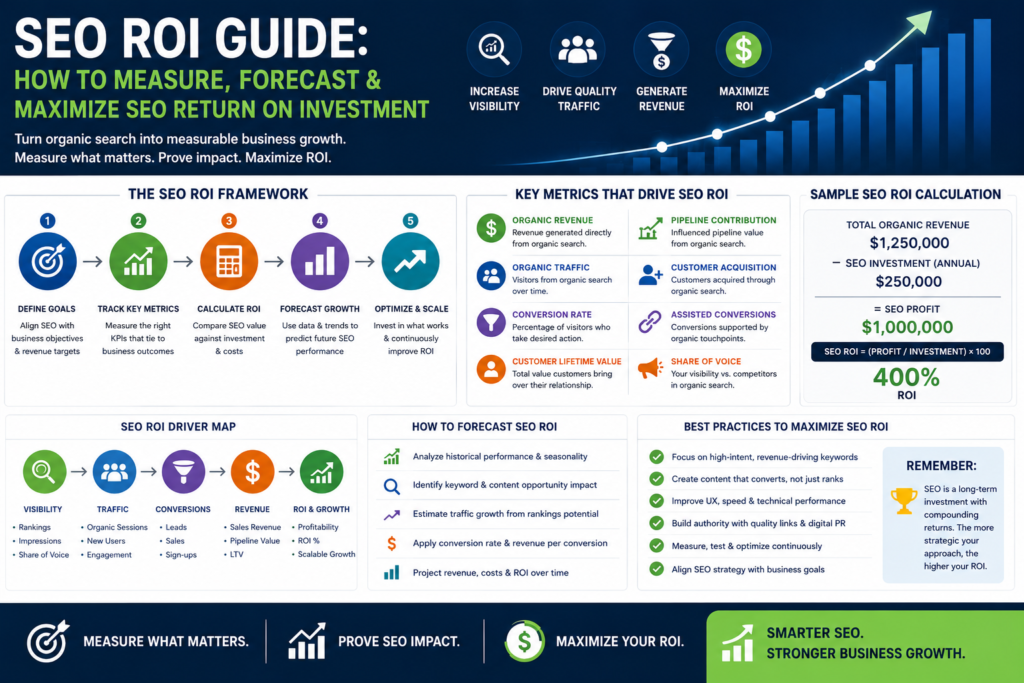
Forecasting involves:
Step 1
Estimate search volume.
Step 2
Estimate ranking potential.
Step 3
Estimate click-through rate.
Step 4
Estimate conversion rate.
Step 5
Estimate average customer value.
This process creates realistic revenue projections before investment begins.
Common SEO ROI Mistakes
Many businesses report SEO incorrectly.
Common mistakes include:
Tracking Rankings Only
Rankings do not equal revenue.
Ignoring Attribution
Customers often interact with multiple channels.
Underestimating Costs
Incomplete cost tracking inflates ROI.
Ignoring Customer Lifetime Value
LTV significantly impacts ROI calculations.
Measuring Too Early
SEO often requires months before meaningful returns appear.
Avoiding these mistakes improves reporting accuracy.
The Executive SEO Dashboard
Executives rarely want detailed SEO reports.
They want business metrics.
A strong SEO dashboard includes:
- Organic revenue
- Organic leads
- Customer acquisition cost
- Conversion rate
- Pipeline contribution
- SEO ROI
- AI visibility metrics
- Year-over-year growth
Presenting SEO in financial terms improves stakeholder confidence and investment approval.
How to Increase SEO ROI
Improving ROI requires more than increasing traffic.
Focus on:
Conversion Rate Optimization
Turn more visitors into customers.
High-Intent Keywords
Target keywords with commercial value.
Technical SEO
Improve crawlability and user experience.
Content Refreshes
Update existing assets.
AI Search Optimization
Increase visibility in AI-generated responses.
Authority Building
Strengthen trust and brand recognition.
The highest ROI often comes from improving existing assets rather than constantly creating new content.
SEO ROI Benchmarks by Business Type
Local Businesses
200–800% ROI
B2B Companies
300–1,000% ROI
SaaS Companies
500–1,500% ROI
eCommerce Brands
200–700% ROI
Actual performance depends on competition, execution, and market conditions.
The Future of SEO ROI
The future of SEO ROI extends beyond rankings and traffic.
Organizations will increasingly measure:
- Revenue attribution
- Customer lifetime value
- AI visibility
- Brand mentions
- Knowledge Graph presence
- Entity authority
The businesses that connect SEO directly to revenue and customer acquisition will gain the greatest competitive advantage.
Final Thoughts
SEO ROI is the most important metric in modern search marketing. Traffic, rankings, and impressions matter, but they are only meaningful when they contribute to business growth.
By measuring costs accurately, tracking revenue properly, implementing the right attribution models, and accounting for AI-powered search visibility, organizations can understand the true value of SEO.
In 2026 and beyond, the companies that master SEO ROI measurement will be the companies that invest more confidently, scale faster, and dominate organic search.