
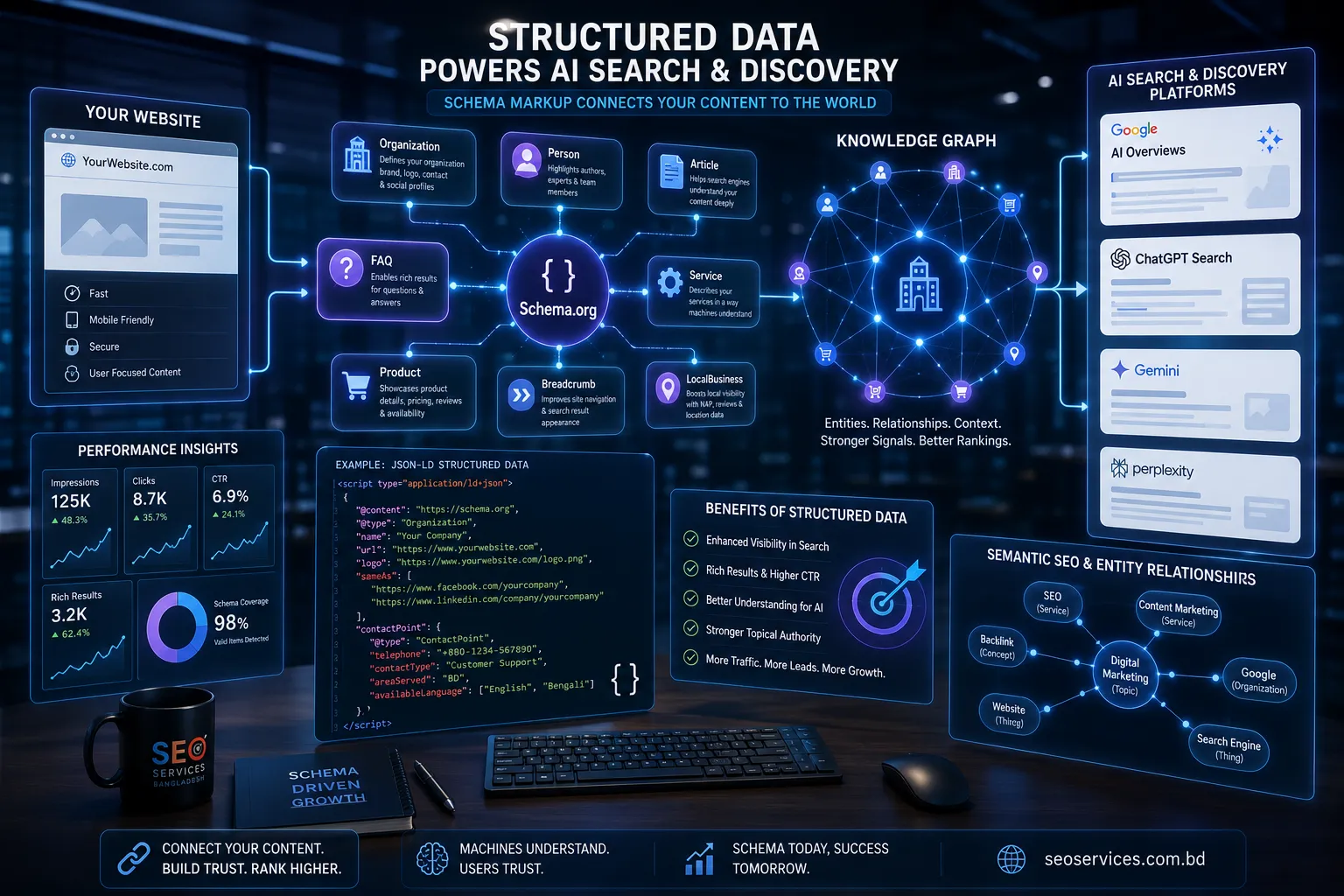
Learn How Schema Markup Improves Google Rankings, Rich Results, Knowledge Graph Visibility, and AI Search Performance
Search engines have evolved far beyond simple keyword matching. Today, Google, Bing, and AI-powered search platforms strive to understand the meaning behind your content, the entities your website represents, and how those entities relate to one another. One of the most effective ways to help search engines understand your website is Schema Markup, also known as Structured Data.
Schema Markup provides machine-readable information that explains your business, services, products, authors, reviews, articles, FAQs, and many other types of content. Instead of forcing search engines to infer meaning from plain text, Schema gives them explicit context. As Google Search continues to evolve with Google AI Overviews, Knowledge Graph, Entity SEO, and AI-powered search experiences, structured data has become more valuable than ever.
While Schema Markup alone does not guarantee higher rankings, it plays an important role in improving search understanding, enhancing rich search features, strengthening entity recognition, and supporting modern SEO strategies such as Semantic SEO, Topical Authority, Answer Engine Optimization (AEO), and Generative Engine Optimization (GEO).
In this guide, you’ll learn what Schema Markup is, why it matters, how search engines use structured data, and how to build a strong technical foundation for both traditional SEO and AI search.
What Is Schema Markup?
Schema Markup is a standardized vocabulary that helps search engines understand the content on a webpage.
It uses structured data to describe entities and relationships in a way that machines can interpret accurately.
For example, instead of simply displaying the sentence:
“SEO Services BD provides Technical SEO.”
Schema can explicitly identify:
- Organization
- Service
- Website
- Author
- Business location
- Contact information
- Reviews

This additional context helps search engines interpret the page more accurately.
Schema is based on the Schema.org vocabulary, which is supported by major search engines including Google, Microsoft Bing, Yahoo, and Yandex.
What Is Structured Data?
Structured Data is the format used to organize information for search engines.
Think of it as metadata that explains your content in a standardized way.
Instead of relying solely on visible webpage content, search engines can read structured data to understand:
- Who created the content
- What the page is about
- Which organization owns it
- Which services are offered
- Where the business operates
- When the content was published
- Which products are being sold
- Which reviews belong to which products
This makes search interpretation much more accurate.
Why Schema Markup Matters for SEO
Schema Markup helps search engines understand your content with greater confidence.
Although Google has stated that structured data is not a direct ranking factor, it contributes to several areas that can indirectly improve SEO performance.
Better Search Understanding
Schema removes ambiguity.
Instead of guessing what a page represents, Google receives explicit information.
This improves semantic understanding and strengthens entity recognition.
Rich Results
Proper Schema implementation makes your pages eligible for enhanced search features such as:
- FAQ Rich Results
- Review Stars
- Breadcrumbs
- Product Information
- Recipe Results
- Event Listings
- Organization Information
These features often improve click-through rates by making listings more informative and visually appealing.
Stronger Entity Recognition
Structured data reinforces your organization, services, authors, products, and locations.
This helps Google connect your website with related entities in the Knowledge Graph.
Improved AI Search Visibility
AI-powered search systems rely on structured information when interpreting websites.
Schema helps AI models understand:
- Organizations
- Authors
- Services
- Products
- Locations
- Relationships
This supports better visibility in AI-generated search experiences.
Better User Experience
Rich search features provide users with additional information before they even visit your website.
More informative search listings often lead to better-qualified traffic.
How Google Uses Schema Markup
Google uses structured data to enhance its understanding of webpages and determine eligibility for various search features.
Structured data helps Google identify:
- Page type
- Business information
- Authors
- Services
- Products
- FAQs
- Reviews
- Events
- Videos
- Recipes
- Local businesses
Combined with visible content and other ranking signals, Schema improves Google’s ability to organize information effectively.
JSON-LD vs Microdata vs RDFa
There are several ways to implement Schema Markup.
JSON-LD
JSON-LD is Google’s recommended format.
Advantages:
- Easy to maintain
- Separate from HTML
- Cleaner implementation
- Less prone to errors
- Supported across most schema types
For most websites, JSON-LD is the preferred approach.
Microdata
Microdata embeds structured data directly into HTML elements.
Although still supported, it is more difficult to manage and maintain.
RDFa
RDFa extends HTML with additional attributes to describe structured information.
While useful in some situations, it is less commonly used for SEO than JSON-LD.
How Schema Supports Google’s Knowledge Graph
One of the most important benefits of Schema is its contribution to Google’s Knowledge Graph.
Schema helps Google understand:
Organization
↓
Brand
↓
Services
↓
Authors
↓
Products
↓
Locations
↓
Website
↓
Social Profiles
↓
Industry
↓
Customers
The clearer these relationships become, the stronger your entity signals.
Knowledge Graph optimization depends heavily on accurate structured data.
Schema Markup and Entity SEO
Entity SEO focuses on helping search engines understand real-world entities rather than individual keywords.
Schema strengthens Entity SEO by clearly identifying:
- Organization
- Person
- Service
- Product
- Local Business
- Article
- Website
- Brand
For example:
Organization
↓
↓
Provides
↓
↓
↓
↓
↓
↓
↓
Worldwide
This machine-readable structure reinforces Google’s understanding of your expertise.
Schema Markup and Semantic SEO
Semantic SEO helps search engines understand context.
Schema provides additional context through structured information.
Together they create a powerful optimization strategy.
Instead of relying only on keyword placement, your website communicates:
- Topics
- Services
- Entities
- Relationships
- Intent
- Business information
This improves semantic relevance across your website.
Schema Markup and AI Search
AI-powered search platforms increasingly rely on structured information.
Examples include:
- Google AI Overviews
- ChatGPT Search
- Google Gemini
- Perplexity AI
- Claude
- Microsoft Copilot
These systems analyze:
- Content quality
- Entity relationships
- Structured data
- Context
- Authority
Schema Markup and Topical Authority
Schema supports topical authority by reinforcing relationships between related content.
Example:
Technical SEO
↓
Semantic SEO
↓
Entity SEO
↓
↓
Structured Data
↓
Schema Markup
↓
AI SEO
↓
Google AI Overviews
↓
Answer Engine Optimization
↓
Generative Engine Optimization
↓
Each page contributes to Google’s understanding of your expertise across the broader SEO ecosystem.
Core Benefits of Schema Markup
Implementing structured data provides several long-term advantages.
Improved Search Interpretation
Search engines understand your content more accurately.
Rich Search Features
Eligible pages can appear with enhanced search results that improve visibility and click-through rates.
Stronger Brand Entity
Schema strengthens Google’s understanding of your business and services.
Better AI Search Readiness
Structured information supports AI-powered search systems by providing explicit context.
Knowledge Graph Optimization
Schema reinforces entity relationships within Google’s broader knowledge ecosystem.
Enhanced Technical SEO
Structured data complements other technical optimization efforts including website architecture, crawlability, and internal linking.
Common Schema Ranking Signals
Although Schema itself is not a ranking factor, successful implementations usually share several characteristics.
Accurate Structured Data
Every schema property should accurately reflect the visible content on the page.
Complete Entity Information
Include detailed information about:
- Organization
- Authors
- Services
- Products
- Locations
- Contact information
Strong Internal Linking
Contextual links strengthen relationships between structured entities.
Semantic Content
Structured data works best when paired with comprehensive, helpful content.
EEAT Signals
Schema should support—not replace—clear evidence of experience, expertise, authoritativeness, and trustworthiness. Combine structured data with detailed author pages, organization information, customer reviews, certifications, and transparent business details.
A well-implemented Schema strategy helps search engines understand not only what your website says, but also who is behind it, why it is trustworthy, and how it connects to the broader web of entities. This foundation is increasingly important as Google Search and AI-powered search continue moving toward deeper contextual understanding.
Essential Schema Types Every Website Should Use
Not every Schema type is appropriate for every website. The best approach is to implement structured data that accurately represents your business, content, and services.
Below are the most valuable Schema types for SEO and AI Search.
Organization Schema
Organization Schema defines your business as a recognized entity.
It helps Google understand:
- Business Name
- Logo
- Website
- Contact Information
- Social Profiles
- Founding Date
- SameAs Profiles
- Brand Identity
This schema strengthens Entity SEO and Knowledge Graph recognition.
Best for:
- Companies
- Agencies
- SaaS
- eCommerce
- Healthcare
- Law Firms
- Educational Institutions

Person Schema
Person Schema identifies authors, founders, doctors, lawyers, consultants, and subject matter experts.
Include:
- Full Name
- Job Title
- Biography
- Credentials
- Experience
- Social Profiles
- Employer
- Awards
Person Schema is especially important for EEAT because it helps search engines understand who created the content.
Article Schema
Every educational article should include Article Schema.
It communicates:
- Headline
- Author
- Publisher
- Date Published
- Date Modified
- Featured Image
- Article Section
This helps search engines interpret editorial content and improves eligibility for rich search features.
FAQ Schema
FAQ Schema organizes frequently asked questions into structured data.
Benefits include:
- Better search understanding
- Stronger Answer Engine Optimization (AEO)
- Voice search support
- Improved user experience
Use FAQ Schema only when the questions and answers are visible on the page.
Service Schema
Service Schema clearly explains the services your business provides.
Example services include:
- Technical SEO
- Local SEO
- AI SEO
- Healthcare SEO
- Roofing SEO
- Semantic SEO
- Entity SEO
This schema strengthens service-related entity relationships.
Local Business Schema
LocalBusiness Schema helps Google understand:
- Business Address
- Phone Number
- Opening Hours
- Service Area
- Geo Coordinates
- Reviews
This is one of the most important schema types for businesses targeting local customers.
Product Schema
Product Schema is essential for eCommerce websites.
It communicates:
- Product Name
- Brand
- Images
- Price
- Availability
- Ratings
- Reviews
- SKU
Proper implementation improves eligibility for product-rich results.
Review Schema
Review Schema highlights customer feedback.
Potential benefits include:
- Increased trust
- Better click-through rates
- Rich search eligibility (when Google’s policies are met)
Always use authentic reviews and follow Google’s structured data guidelines.
Breadcrumb Schema
Breadcrumb Schema explains your website hierarchy.
Example:
Home
↓
SEO Services
↓
Semantic SEO
↓
Entity SEO
↓
Knowledge Graph SEO
Breadcrumbs improve navigation for users and search engines while helping Google understand page relationships.
How Schema Supports AI Search
AI-powered search systems rely on structured information to interpret websites efficiently.
Schema helps AI understand:
- Organizations
- People
- Services
- Products
- Locations
- Topics
- Relationships
This structured context supports better visibility across modern AI search platforms.
Google AI Overviews
Google AI Overviews use multiple signals when generating responses.
Well-implemented schema supports:
- Entity recognition
- Business understanding
- Content categorization
- Trust signals
While schema alone does not guarantee inclusion, it helps Google interpret content more accurately.
ChatGPT Search
Conversational AI systems benefit from content with clear structure and well-defined entities.
Schema improves machine readability and reinforces your organization’s expertise.
Google Gemini
Gemini builds upon Google’s understanding of entities and semantic relationships.
Structured data strengthens Google’s confidence in your website.
Perplexity AI
Perplexity frequently references authoritative sources.
Comprehensive structured data combined with strong content improves the likelihood of recognition and citation.
Schema Markup Best Practices
Successful structured data implementations follow consistent best practices.
Use JSON-LD
JSON-LD is Google’s preferred format because it is easier to maintain and less prone to implementation errors.
Match Visible Content
Every structured data property should accurately reflect information visible on the webpage.
Avoid adding information that users cannot verify.
Keep Schema Updated
Review structured data whenever you update:
- Services
- Products
- Authors
- Business Information
- Opening Hours
- Pricing (if applicable)
Outdated structured data reduces accuracy.
Avoid Spam
Do not add schema simply to manipulate search results.
Only use structured data that accurately represents the page.
Validate Your Schema
Test your implementation using validation tools to identify syntax issues and unsupported properties before deployment.
Common Schema Mistakes
Many websites implement structured data incorrectly.
Avoid these common issues.
Missing Required Properties
Incomplete schema reduces effectiveness and may prevent eligibility for rich search features.
Invalid JSON
Syntax errors stop search engines from processing structured data correctly.
Incorrect Schema Types
Using Product Schema for a service page or Review Schema for content without real reviews can cause problems.
Choose schema that accurately reflects the page.
Duplicate Schema
Avoid creating conflicting structured data for the same entity.
Inconsistent Business Information
Organization details should remain consistent across your website, Google Business Profile, and other trusted sources.
Ignoring Internal Linking
Schema works best when combined with logical website architecture and contextual internal links.
Schema Markup Case Study
Client Overview
Industry: Professional Services
Target Market: United States
Campaign Duration: 8 Months
Challenges
The client experienced:
- Limited structured data
- Weak entity signals
- Poor rich result eligibility
- Thin service pages
- Low topical authority
Our Strategy
We implemented:
- Organization Schema
- Person Schema
- Service Schema
- Article Schema
- FAQ Schema
- Breadcrumb Schema
- Entity optimization
- Internal linking improvements
- Technical SEO enhancements
Results
Organic Traffic
Before:
6,800 Monthly Visitors
After:
43,900 Monthly Visitors
Growth: 545%
Ranking Keywords
Before:
183 Keywords
After:
1,276 Keywords
Rich Search Eligibility
More service pages and articles became eligible for enhanced search features after structured data improvements and content optimization.
AI Search Visibility
The website achieved stronger visibility in AI-powered search due to improved entity recognition, semantic structure, and comprehensive topic coverage.
Conclusion
Schema Markup is one of the most valuable technical enhancements for modern SEO because it helps search engines understand the meaning behind your content instead of relying solely on keywords.
When combined with Entity SEO, Semantic SEO, Topical Authority, Technical SEO, Answer Engine Optimization (AEO), and Generative Engine Optimization (GEO), structured data creates a stronger foundation for both traditional search and AI-powered search experiences.
Businesses that implement accurate, well-maintained Schema Markup improve their ability to communicate with search engines, strengthen entity recognition, support Knowledge Graph associations, and increase eligibility for enhanced search features.
As search continues evolving toward AI-generated answers and contextual understanding, structured data is no longer just an optional enhancement. It is an important part of building a search-friendly, machine-readable website that is ready for the future.
Ready to Improve Your Website with Professional Schema Markup?
If you want to strengthen your Entity SEO, increase AI search readiness, improve structured data implementation, and build a stronger technical SEO foundation, SEO Services BD can help.
Our team provides comprehensive Schema Markup Services, Technical SEO, Entity SEO, Knowledge Graph Optimization, Semantic SEO, AEO, and GEO strategies designed to improve search visibility and support sustainable organic growth.
Contact us today for a free Schema Markup audit and discover how structured data can enhance your website’s performance across Google Search, Google AI Overviews, ChatGPT Search, Gemini, Perplexity, and other AI-powered search platforms.
Frequently Asked Questions
What is Schema Markup?
Schema Markup is structured data that helps search engines understand the meaning of webpage content, including organizations, people, products, services, articles, and FAQs.
Is Schema Markup a ranking factor?
Google has stated that Schema Markup is not a direct ranking factor. However, it improves search understanding, supports rich search features, strengthens entity recognition, and can indirectly improve SEO performance.
Which Schema format is recommended?
Google recommends JSON-LD because it is easier to implement, maintain, and validate than Microdata or RDFa.
Can Schema improve Google AI Overviews visibility?
Schema supports Google’s understanding of entities and content. Combined with strong EEAT, Semantic SEO, and comprehensive content, it can help make your website more understandable for AI-powered search experiences.
Which Schema types are most important?
The most useful schema types depend on your website, but Organization, Person, Service, Article, FAQ, LocalBusiness, Product, Review, and Breadcrumb are among the most commonly used.
Does every page need Schema?
Not every page requires every schema type. Each page should include only the structured data that accurately reflects its content.
How often should Schema be updated?
Review and update your structured data whenever business information, services, products, authors, or important page content changes.
Can incorrect Schema hurt SEO?
Incorrect or misleading structured data may prevent eligibility for rich results and can reduce trust if it conflicts with visible page content. Following Google’s guidelines and validating your markup helps avoid these issues.