
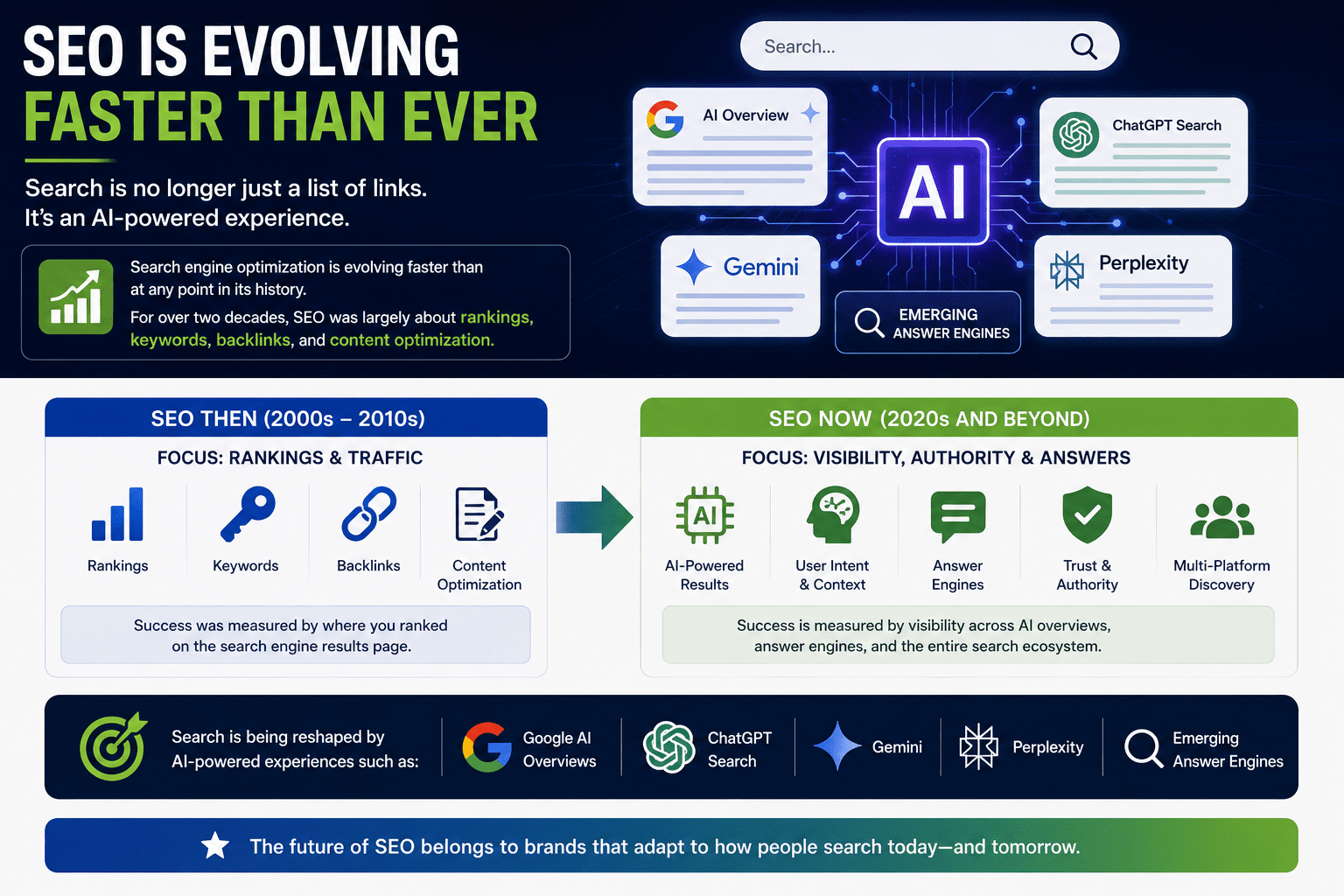
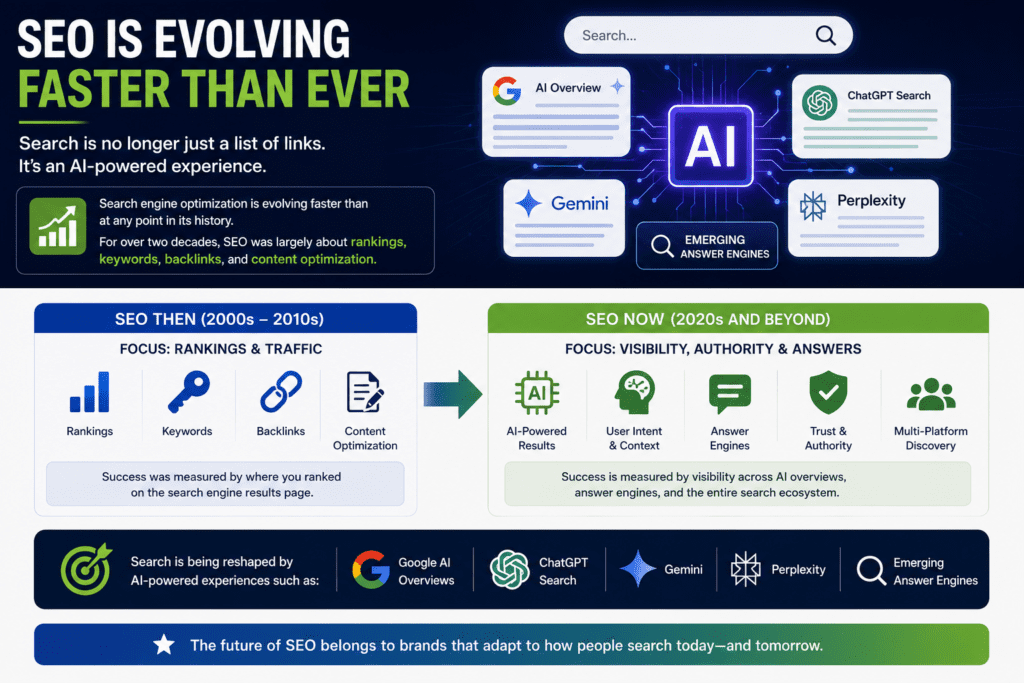
Search engine optimization is evolving faster than at any point in its history. For over two decades, SEO was largely about rankings, keywords, backlinks, and content optimization. Today, search is being reshaped by AI-powered experiences such as Google AI Overviews, ChatGPT Search, Gemini, Perplexity, and emerging answer engines.
As a result, marketers can no longer rely solely on traditional SEO metrics. The businesses that win in 2026 will be those that understand where search is heading and adapt their strategies accordingly.
This guide compiles the most important SEO statistics for 2026 and explains what they mean for marketers, agencies, SaaS companies, local businesses, eCommerce brands, and enterprise organizations.
Instead of simply listing statistics, we’ll explain how each trend impacts real-world SEO performance.
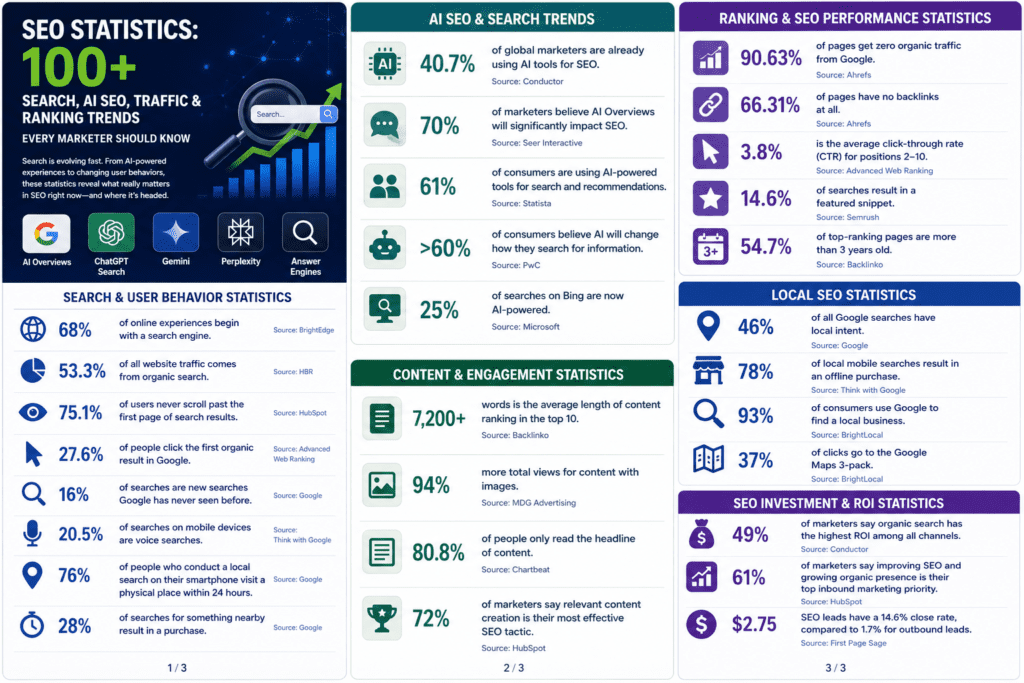
Search Engine Market Share Statistics
Despite increasing competition from AI platforms, Google remains the dominant search engine globally.
Key Statistics
- Google controls nearly 90% of the global search market share.
- Billions of searches occur every day across Google properties.
- Google remains the primary source of organic traffic for most websites.
- AI-powered search engines continue growing, but have not replaced Google.
What This Means
Many marketers assume AI search will replace Google. The reality is different.
Organic Search Traffic Statistics
Organic search continues to be one of the most valuable digital acquisition channels.
Key Statistics
- Organic search remains one of the highest ROI marketing channels.
- Websites ranking on Page 1 capture the overwhelming majority of clicks.
- Nearly all search clicks occur on the first page of Google.
- Top-ranking pages consistently outperform lower-ranking competitors.
What This Means
Ranking improvements still matter. Moving from page two to page one often has a larger impact than any other SEO activity. Organizations should prioritize ranking opportunities with commercial intent rather than chasing vanity traffic.
Google Ranking Statistics
Understanding how rankings influence user behavior remains critical.
Key Statistics
- The #1 organic result receives the highest share of clicks.
- The top three organic positions capture the majority of search traffic.
- Lower first-page positions receive significantly fewer clicks than top positions.
What This Means
Being on page one is no longer enough. The difference between position #1 and position #8 can be massive. SEO strategies should focus on winning top positions rather than simply achieving first-page visibility.
Google AI Overviews Statistics
Google AI Overviews are changing how users interact with search results.
Key Statistics
- AI Overviews now appear for a significant percentage of search queries.
- Some industry studies show AI Overview visibility exceeding 25% of tracked queries.
- Commercial industries have seen particularly strong AI growth.
- AI Overview adoption continues to expand globally.
What This Means
Traditional rankings are no longer the only visibility opportunity. Businesses must optimize content so it can be cited and referenced within AI-generated answers. This is one of the biggest shifts in SEO since mobile search.
AI Search Statistics
AI-powered search is rapidly transforming user behavior.
Key Statistics
- AI search traffic increased dramatically year-over-year.
- Google AI Overviews reach billions of users globally.
- AI-driven discovery continues expanding across industries.
- AI search adoption is accelerating among younger demographics.
What This Means
Businesses that ignore AI visibility risk losing future traffic opportunities.
SEO now includes optimization for:
- ChatGPT
- Google AI Overviews
- Gemini
- Perplexity
- AI assistants
ChatGPT & AI Visibility Statistics
AI-generated answers are becoming a major discovery channel.
Key Statistics
- More marketers are investing in AI visibility tracking.
- AI citations increasingly influence brand discovery.
- Enterprise organizations are prioritizing AI discoverability initiatives.
- AI-generated recommendations are becoming part of customer journeys.
What This Means
Brands must think beyond rankings. Future visibility depends on whether AI systems understand, trust, and cite your organization.
This is driving demand for:
- Entity SEO
- Knowledge Graph Optimization
- GEO (Generative Engine Optimization)
Zero-Click Search Statistics
Users increasingly receive answers without visiting websites.
Key Statistics
- A large percentage of searches now end without a click.
- AI summaries reduce click-through rates for many informational queries.
- Publishers are experiencing measurable traffic declines from answer-first search experiences.
What This Means
Traffic alone is becoming a weaker success metric.
Businesses should focus on:
- Brand visibility
- Lead generation
- Conversions
- AI citations
- Market share
The future of SEO is visibility, not just clicks.
SEO CTR Statistics
Click-through rate remains one of the most important performance metrics.
Key Statistics
- AI-generated search features have impacted organic CTR.
- Queries containing AI Overviews often experience lower organic click rates.
- Traditional ranking positions still influence CTR significantly.
What This Means
SEO professionals must optimize:
- Title tags
- Meta descriptions
- Structured data
- Rich results
- Brand recognition
Higher visibility no longer guarantees higher clicks.
Content Marketing Statistics
Content remains the foundation of successful SEO.
Key Statistics
- Content marketing generates significantly more leads than traditional marketing channels.
- High-quality content continues driving organic growth.
- Businesses investing consistently in content outperform competitors.
What This Means
Content creation is still essential.
However, success depends on:
- Expertise
- Topical authority
- Original insights
- User experience
Publishing large volumes of low-quality content is no longer effective.
AI Content Statistics
AI tools are transforming content production.
Key Statistics
- AI adoption among marketers continues to grow rapidly.
- Most organizations now use AI in some part of the content process.
- AI-assisted workflows improve efficiency when paired with human oversight.
What This Means
The future is not AI-only content. The future is AI-assisted, expert-reviewed content that combines efficiency with credibility.
SEO ROI Statistics
SEO continues to deliver strong long-term returns.
Key Statistics
- Organic search remains one of the highest ROI marketing channels.
- Businesses increasingly connect SEO efforts directly to revenue.
- AI-assisted SEO initiatives are showing positive ROI trends.
What This Means
SEO should be measured through:
- Revenue
- Leads
- Conversions
- Customer acquisition cost
Not rankings alone.
Enterprise SEO Statistics
Large organizations are changing how they approach SEO.
Key Statistics
- Enterprise teams increasingly prioritize AI discoverability.
- SEO is becoming more integrated with product, engineering, and content teams.
- Automation is becoming a core enterprise SEO capability.
What This Means
Enterprise SEO is evolving from a marketing function into a business growth function.
Cross-functional collaboration is becoming essential.
Technical SEO Statistics
Technical SEO remains a foundational ranking factor.
Key Statistics
- Crawlability and indexing remain critical.
- Structured data adoption continues to increase.
- Websites are gradually becoming easier for search engines to crawl and understand.
What This Means
Technical SEO is no longer optional.
Organizations must continuously monitor:
- Site performance
- Crawl health
- Indexation
- Structured data
Local SEO Statistics
Local search remains a major driver of customer acquisition.
Key Statistics
- Local searches frequently result in business interactions.
- Google Maps visibility significantly influences local lead generation.
- Reviews remain one of the strongest local trust signals.
What This Means
For local businesses, Local SEO often delivers faster ROI than broader national SEO campaigns.
Link Building Statistics
Backlinks continue influencing rankings.
Key Statistics
- High-authority backlinks remain strong ranking signals.
- Brand mentions increasingly support overall authority.
- Digital PR is becoming a major link acquisition strategy.
What This Means
Quality consistently outperforms quantity. One authoritative link can outperform dozens of low-quality backlinks.
SEO Industry Statistics
The SEO industry continues to expand globally.
Key Statistics
- The global SEO services market exceeds $100 billion.
- Businesses continue increasing SEO investment.
- AI-driven optimization is creating new service categories.
What This Means
SEO is no longer viewed as a tactical marketing channel. It is increasingly recognized as a strategic growth investment.
SEO Predictions
Based on current trends, the future of SEO will likely include:
- Greater AI search adoption
- More AI-generated answers
- Increased GEO implementation
- Stronger entity-based optimization
- More AI visibility tracking
- Reduced reliance on traditional rankings
- Greater emphasis on brand authority
- More integration between SEO, PR, and content marketing
Industry leaders increasingly agree that businesses must optimize for both humans and AI agents simultaneously.
Final Thoughts
SEO in 2026 is no longer just about rankings. The industry is entering an era where visibility exists across traditional search engines, AI-generated answers, voice assistants, and answer engines.
The most important takeaway from these statistics is simple: Businesses that focus exclusively on rankings will fall behind.
Businesses that optimize for search visibility, AI discoverability, entity authority, content quality, and customer outcomes will be positioned to dominate the next generation of search. As search continues evolving, the organizations that adapt first will capture the largest share of future organic growth.