
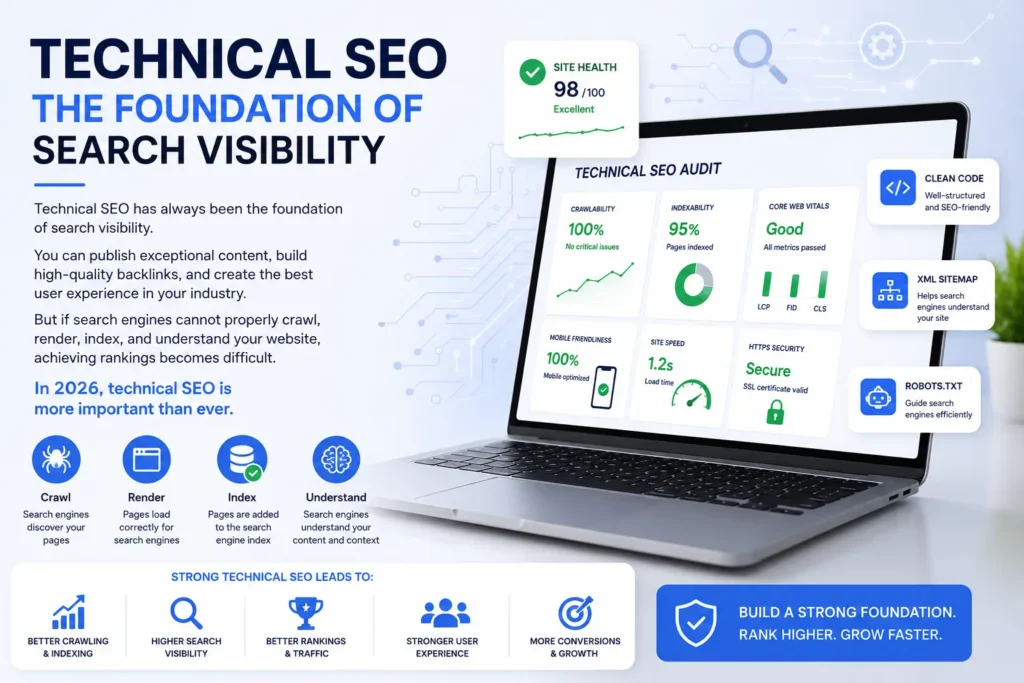
Technical SEO has always been the foundation of search visibility. You can publish exceptional content, build high-quality backlinks, and create the best user experience in your industry.
But if search engines cannot properly crawl, render, index, and understand your website, achieving rankings becomes difficult.
In 2026, technical SEO is more important than ever.
The rise of Google AI Overviews, ChatGPT, Gemini, Perplexity, and AI-powered search experiences has introduced a new challenge: websites must now be optimized for both traditional search engines and AI systems.
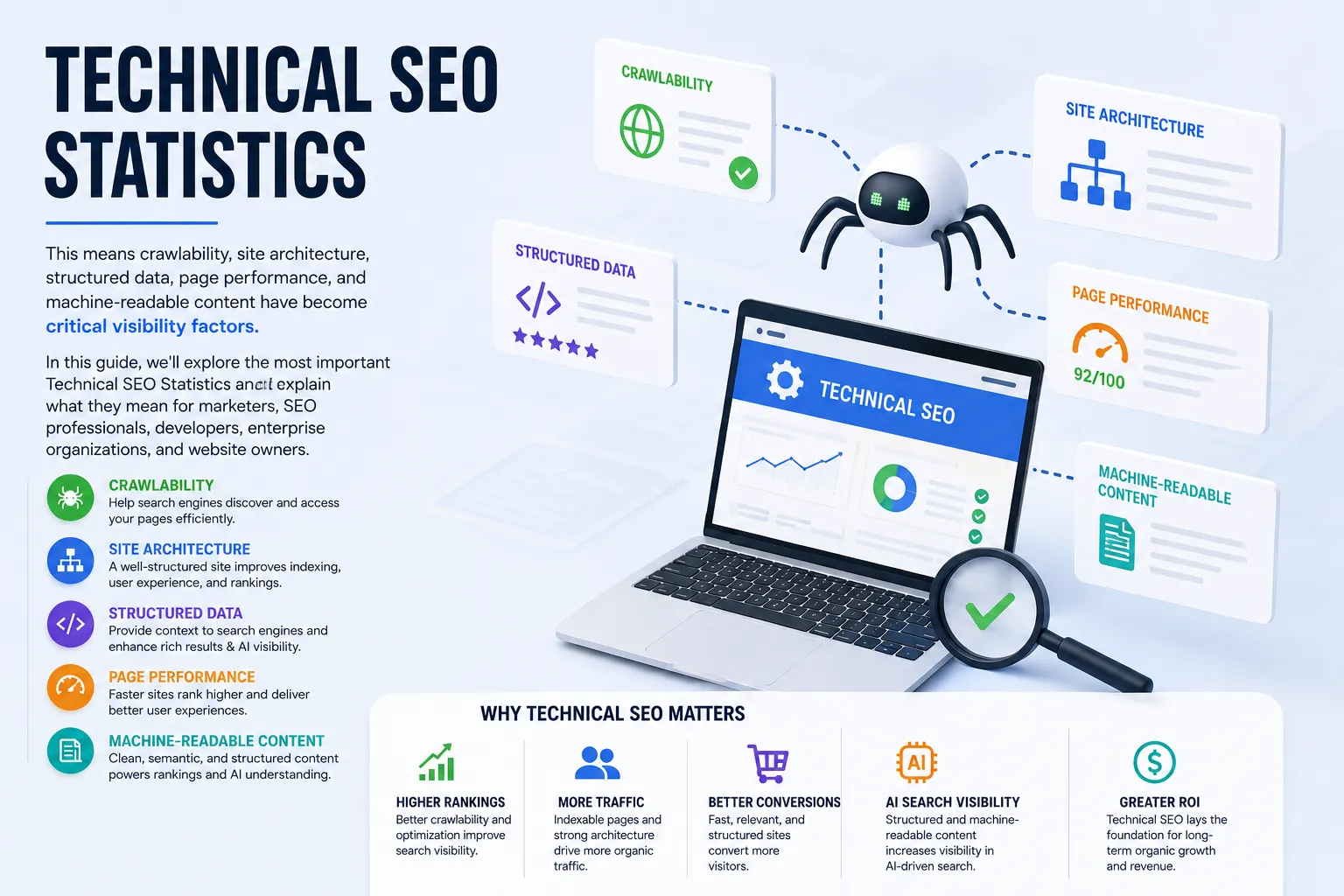
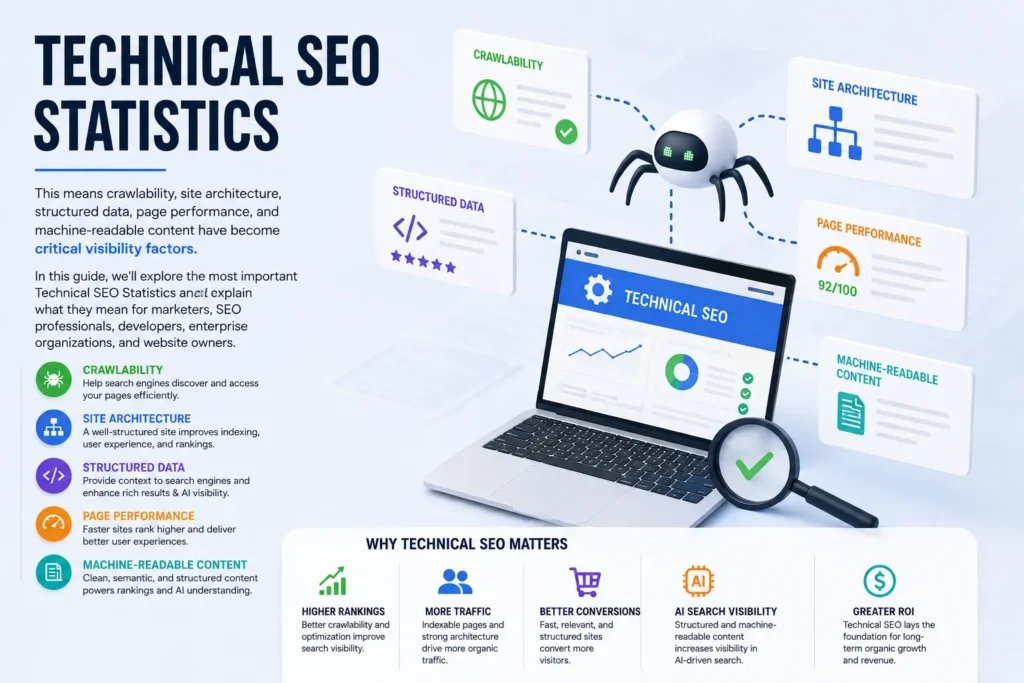
This means crawlability, site architecture, structured data, page performance, and machine-readable content have become critical visibility factors.
In this guide, we’ll explore the most important Technical SEO Statistics for 2026 and explain what they mean for marketers, SEO professionals, developers, enterprise organizations, and website owners.
Rather than simply listing statistics, we’ll explain how each trend affects rankings, traffic, conversions, and AI search visibility.
Why Technical SEO Matters More Than Ever
Technical SEO is often invisible to users. But search engines see everything.
They evaluate:
- Crawlability
- Indexability
- Site architecture
- Page performance
- Structured data
- Mobile usability
- Security
- Rendering capabilities
If technical barriers exist, even the best content can struggle to rank.
Industry experts continue to emphasize that successful SEO depends on crawlable, accessible, technically sound websites rather than chasing short-term trends.
Core Web Vitals Statistics
Core Web Vitals remain one of the most discussed technical SEO topics.
Google defines Core Web Vitals as metrics that measure real-world user experience related to loading performance, visual stability, and interactivity.
Key Statistics
- Only 42% of websites currently pass all three Core Web Vitals metrics.
- The median page load time among Google’s top-ranking pages is approximately 1.65 seconds.
- Core Web Vitals remain one of the most widely monitored technical SEO metrics.
What This Means
Most websites still fail to meet Google’s recommended user experience standards. This creates an opportunity.
Businesses that improve Core Web Vitals can gain advantages in:
- User experience
- Conversion rates
- Engagement
- Search visibility
Page Speed Statistics
Site speed remains a critical ranking and conversion factor.
Key Statistics
- Faster websites consistently generate better engagement metrics.
- Poor page performance increases bounce rates and reduces conversions.
- Mobile users are especially sensitive to loading delays.
What This Means
Speed optimization isn’t just about SEO.
It’s also about revenue.
A faster website typically creates better user experiences and stronger business outcomes.
Mobile SEO Statistics
Google’s indexing and ranking systems are built around mobile experiences.
Key Statistics
- Mobile-first indexing remains Google’s standard.
- Most searches now occur on mobile devices.
- Mobile usability issues directly affect crawlability and visibility.
What This Means
A desktop-optimized website is no longer enough.
Every technical SEO strategy must prioritize mobile performance.
Crawlability Statistics
Search engines cannot rank pages they cannot crawl.
Key Statistics
- Crawlability issues remain among the most common technical SEO problems.
- Broken internal links, poor architecture, and blocked resources continue to limit visibility.
- Crawl budget management is becoming increasingly important for large websites.
What This Means
Many ranking issues originate from crawl inefficiencies rather than content quality. Improving crawlability often produces immediate SEO benefits.

Indexation Statistics
Being crawled does not guarantee being indexed.
Key Statistics
- Index bloat remains a common challenge for enterprise websites.
- Duplicate content and low-value pages frequently consume crawl resources.
- Indexation problems continue to affect rankings across industries.
What This Means
Businesses should regularly audit:
- Indexed URLs
- Excluded pages
- Duplicate content
- Canonicalization issues
A smaller, cleaner index often performs better than a larger one.
Structured Data Statistics
Structured data has become increasingly important.
Key Statistics
- Schema adoption continues to increase across industries.
- Structured data improves search engine understanding.
- Rich results often improve visibility and click-through rates.
What This Means
Structured data helps search engines understand:
- Products
- Services
- Organizations
- Reviews
- FAQs
- Articles
It also strengthens AI readability.
HTTPS & Security Statistics
Security remains a foundational ranking signal.

Key Statistics
- HTTPS adoption exceeds 95% across major websites.
- Security remains part of the overall page experience evaluation.
- Secure websites build greater user trust.
What This Means
Any website still using HTTP should prioritize migration immediately.
JavaScript SEO Statistics
Modern websites increasingly rely on JavaScript.
Key Statistics
- JavaScript-heavy websites often experience rendering challenges.
- Search engines continue improving their rendering capabilities.
- Complex JavaScript implementations can delay indexation.
What This Means
Developers should ensure critical content remains accessible during rendering. JavaScript SEO is now a core technical SEO discipline.
Internal Linking Statistics
Internal links remain one of the most overlooked SEO assets.
Key Statistics
- Strong internal linking improves crawl efficiency.
- Site architecture influences ranking performance.
- Well-connected pages receive more crawl attention.
What This Means
Internal linking helps search engines discover and prioritize important pages.
Technical SEO Audit Statistics
Regular audits remain essential.
Key Statistics
- Technical issues accumulate over time.
- Quarterly technical audits are widely recommended.
- Technical debt is one of the leading causes of ranking stagnation.
What This Means
Technical SEO should be treated as an ongoing process rather than a one-time project.
AI Search & Technical SEO Statistics
One of the biggest changes in 2026 is AI-powered search.
Key Statistics
- AI search visibility increasingly depends on technical accessibility.
- Structured data and entity clarity influence AI understanding.
- AI crawlers consume websites differently from traditional search engines.
What This Means
Technical SEO now affects visibility in:
- Google AI Overviews
- ChatGPT
- Gemini
- Perplexity
Traditional search optimization alone is no longer enough.
AI Overviews & Technical SEO
Google AI Overviews are changing technical requirements.
Key Statistics
- AI-generated answers rely heavily on structured, machine-readable information.
- Technical performance affects content accessibility.
- AI systems increasingly reward well-structured content ecosystems.
What This Means
Technical SEO is becoming a direct contributor to AI search visibility.
Enterprise Technical SEO Statistics
Large websites face unique challenges.
Key Statistics
- Enterprise websites often manage millions of URLs.
- Crawl budget inefficiencies become more severe at scale.
- Automation is increasingly required for technical SEO management.
What This Means
Enterprise SEO success depends heavily on technical infrastructure and governance.
Technical SEO ROI Statistics
Technical SEO frequently delivers some of the highest ROI opportunities.
Key Statistics
- Fixing crawl and indexation issues can unlock substantial organic growth.
- Performance improvements often increase both rankings and conversions.
- Technical fixes frequently impact hundreds or thousands of pages simultaneously.
What This Means
Technical SEO often produces compounding returns. One fix can improve performance across an entire website.
Technical SEO Tools Statistics
SEO professionals increasingly rely on advanced audit tools.
Popular platforms include:
- Google Search Console
- Screaming Frog
- Ahrefs
- Semrush
- PageSpeed Insights
Modern SEO tools are increasingly adding AI-powered analysis and automation capabilities.
What This Means
Tool adoption continues growing because technical SEO complexity is increasing.
The Future of Technical SEO
Technical SEO is evolving beyond traditional optimization.
Future priorities include:
- AI crawler accessibility
- Generative Engine Optimization (GEO)
- Entity architecture
- Structured knowledge systems
- AI-readable content frameworks
- Automated technical monitoring
Research suggests AI-driven search environments will continue changing how websites are discovered and evaluated.
Most Important Technical SEO Statistics
If you remember only a few numbers, remember these:
- Only 42% of websites pass all Core Web Vitals.
- Top-ranking pages average roughly 1.65-second load times.
- HTTPS adoption exceeds 95%.
- Mobile-first indexing remains the standard.
- AI search visibility increasingly depends on technical accessibility.
- Structured data adoption continues growing across industries.
These statistics highlight the growing importance of technical excellence in modern SEO.
Final Thoughts
Technical SEO in 2026 is no longer simply about fixing errors. It is about creating a website that search engines and AI systems can efficiently crawl, understand, trust, and recommend.
The most successful organizations will combine:
- Technical SEO
- Structured data
- Core Web Vitals optimization
- Crawl budget management
- AI visibility optimization
- Entity-based architecture
As search evolves toward AI-powered discovery, technical SEO will become even more important.
The businesses that invest in strong technical foundations today will be best positioned to dominate both traditional search results and the next generation of AI-driven search experiences.