
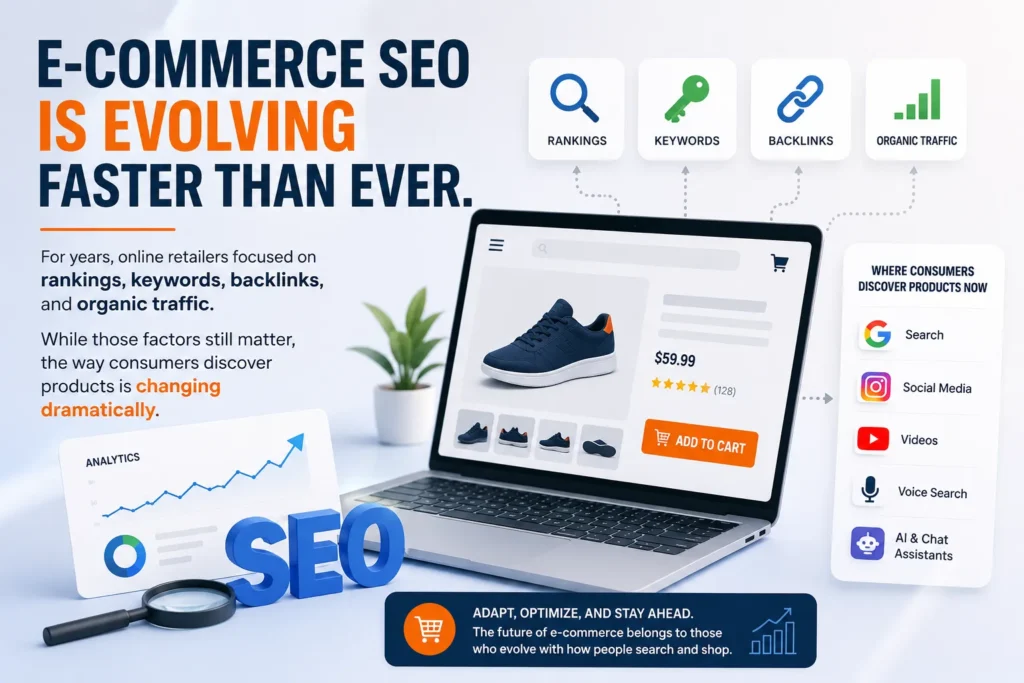
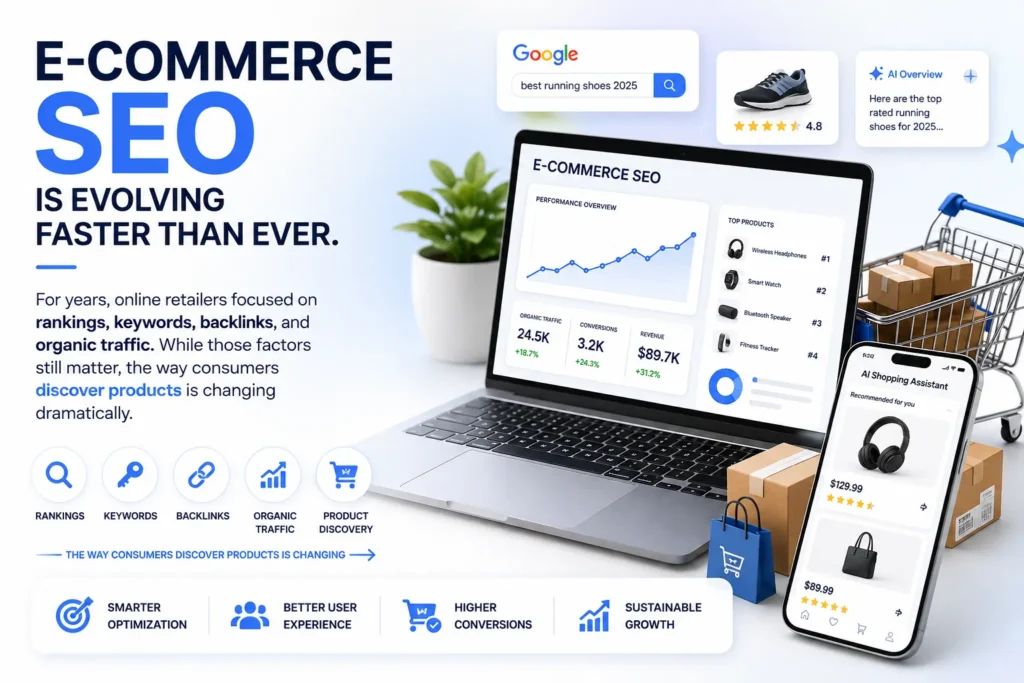
E-commerce SEO is evolving faster than ever. For years, online retailers focused on rankings, keywords, backlinks, and organic traffic. While those factors still matter, the way consumers discover products is changing dramatically.
Google AI Overviews, ChatGPT, Gemini, Perplexity, AI shopping assistants, and answer engines are transforming the customer journey. Today, shoppers don’t always click through multiple websites.
Instead, AI increasingly recommends products, compares options, summarizes reviews, and helps customers make purchasing decisions.
As a result, modern eCommerce SEO is no longer just about ranking products. It’s about being discoverable wherever customers search.
This guide explores the most important eCommerce SEO statistics for 2026 and explains what they mean for retailers, marketers, agencies, and online store owners.
Rather than simply listing numbers, we’ll explain how these trends impact real-world revenue and growth.
Why E-commerce SEO Matters More Than Ever
Paid advertising costs continue rising.
At the same time, customer acquisition is becoming more competitive.
For many online retailers, organic search remains one of the highest ROI marketing channels available.
Unlike paid ads, organic traffic can continue generating revenue long after content is published.
Businesses investing in SEO benefit from:
- Lower acquisition costs
- Long-term visibility
- Higher trust
- Better conversion potential
- Sustainable growth
This is why eCommerce SEO remains a core growth strategy for successful online brands.
E-commerce Market Growth Statistics
Online retail continues to expand globally.
Key Statistics
- Global eCommerce sales are projected to exceed $6.8 trillion in 2026.
- Online retail is expected to account for more than 21% of total retail sales.
- Digital commerce continues to grow despite economic uncertainty.
What This Means
The market opportunity continues to grow. As more consumers purchase online, competition for organic visibility becomes increasingly important.
Organic Search Traffic Statistics
Organic search remains one of the largest traffic sources for e-commerce websites.
Key Statistics
- Organic search consistently ranks among the highest-performing acquisition channels.
- Product and category pages generate significant portions of e-commerce traffic.
- Websites ranking on Google’s first page capture the majority of clicks.
What This Means
SEO continues to drive high-intent shoppers who are actively looking for products.
Organic traffic often converts better than many awareness-focused channels because users are already searching for solutions.
Google Ranking Statistics for E-commerce
Search rankings continue to influence purchasing decisions.
Key Statistics
- Top-ranking product pages receive substantially more traffic.
- First-page rankings dominate click share.
- Product category pages often generate significant revenue opportunities.
What This Means
Moving from page two to page one can dramatically impact revenue. Ranking improvements often create compounding growth over time.
Product Page SEO Statistics
Product pages remain the foundation of eCommerce SEO.
Key Statistics
- Product pages optimized with structured data often achieve stronger visibility.
- Rich snippets improve product discoverability.
- Detailed product information improves both rankings and conversions.
What This Means
Winning eCommerce SEO requires more than keywords.
Product pages should include:
- Detailed descriptions
- Reviews
- FAQs
- Product schema
- High-quality images
Category Page SEO Statistics
Category pages remain one of the most valuable assets for eCommerce SEO.
Key Statistics
- Category pages often target high-volume commercial keywords.
- Well-structured category pages drive significant organic revenue.
- Internal linking strengthens category authority.
What This Means
Many retailers over-focus on product pages while neglecting category optimization. Category pages often generate some of the highest-value traffic.
Conversion Rate Statistics
Traffic alone doesn’t generate revenue. Conversions do.
Key Statistics
- Conversion optimization remains one of the highest-leverage eCommerce growth strategies.
- Small conversion improvements often produce substantial revenue gains.
- Trust signals directly influence conversion rates.
What This Means
Increasing conversion rates can sometimes deliver greater ROI than increasing traffic.
Product Review Statistics
User-generated content remains a powerful SEO and conversion asset.
Key Statistics
- Product reviews improve trust and purchase confidence.
- Review content creates unique page content.
- Products with strong review profiles often perform better in search.
What This Means
Reviews influence:
- Rankings
- Conversions
- AI recommendations
- Customer trust
Building review acquisition systems should be a priority.
Mobile Commerce Statistics
Mobile shopping continues dominating online retail.
Key Statistics
- Most eCommerce traffic originates from mobile devices.
- Mobile-first experiences influence both rankings and conversions.
- Site speed remains critical for mobile users.
What This Means
A poor mobile experience can significantly reduce revenue.
Mobile optimization remains essential.
AI Search Statistics
One of the biggest changes in eCommerce SEO is AI-powered discovery.
Key Statistics
- AI search traffic increased over 500% year-over-year.
- AI search platforms are becoming significant referral sources.
- AI-driven product discovery continues to expand rapidly.
What This Means
Businesses must optimize for:
- ChatGPT
- Google AI Overviews
- Gemini
- Perplexity
Traditional SEO alone is no longer sufficient.
AI Shopping Statistics
AI shopping behavior is accelerating rapidly.
Key Statistics
- Generative AI referral traffic to retail sites grew approximately 4,700% year-over-year.
- AI-driven visitors often demonstrate higher engagement rates.
- Retailers increasingly prioritize AI visibility.
What This Means
AI is becoming a new product discovery channel.
Brands that optimize for AI visibility today may gain an early advantage.
Google AI Overviews Statistics
AI Overviews are reshaping search visibility.
Key Statistics
- AI-generated answers appear for increasing numbers of searches.
- Informational queries are most likely to trigger AI Overviews.
- AI summaries can reduce traditional click-through rates.
What This Means
Retailers must think beyond rankings. Visibility within AI-generated responses is becoming increasingly important.
Zero-Click Search Statistics
Search behavior continues evolving.
Key Statistics
- Roughly 60% of searches may now end without a click.
- AI-generated answers are reducing website visits for some query types.
What This Means
Success metrics should expand beyond clicks.
Brands should also measure:
- Visibility
- Mentions
- AI citations
- Conversion quality
Product Schema Statistics
Structured data remains one of the highest-impact SEO investments.
Key Statistics
- Product schema improves search engine understanding.
- Rich results increase visibility.
- Structured product data supports AI shopping systems.
What This Means
Every eCommerce store should implement:
- Product Schema
- Review Schema
- Breadcrumb Schema
- Organization Schema
AI SEO Statistics for E-commerce
AI is transforming SEO workflows.
Key Statistics
- Nearly 70% of businesses report higher ROI from AI-assisted SEO.
- Over 92% of marketers are already optimizing for both traditional and AI-powered search experiences.
What This Means
AI optimization is rapidly becoming a standard SEO practice.
E-commerce SEO ROI Statistics
SEO remains one of the most cost-effective acquisition channels.
Key Statistics
- Organic search continues to generate strong long-term returns.
- SEO investments compound over time.
- High-ranking pages can drive revenue for years.
What This Means
SEO should be measured through:
- Revenue
- Transactions
- Customer acquisition cost
- Customer lifetime value
Not rankings alone.
AI Commerce Statistics
The future of e-commerce is increasingly AI-driven.
Key Statistics
- AI-enabled eCommerce adoption continues to accelerate.
- Retailers are increasing AI investments.
- Agentic commerce and AI shopping assistants are emerging trends.
What This Means
Future eCommerce SEO strategies must account for AI-powered purchasing journeys.
The Future of E-commerce SEO
The next generation of eCommerce SEO will focus on:
- AI visibility
- Product entities
- Structured data
- GEO (Generative Engine Optimization)
- AEO (Answer Engine Optimization)
- AI shopping discovery
- Product feed optimization
Brands that adapt early will gain significant advantages.
Most Important E-commerce SEO Statistics for 2026
If you remember only a few numbers, remember these:
- Global eCommerce sales are expected to exceed $6.8 trillion.
- AI search traffic increased by more than 500% year-over-year.
- Generative AI retail traffic grew approximately 4,700%.
- Around 60% of searches may result in no clicks.
- Over 92% of marketers are optimizing for AI-powered search.
- AI shopping behavior is becoming mainstream.
These statistics summarize the future direction of eCommerce SEO.
Final Thoughts
E-commerce SEO in 2026 is no longer just about rankings. The industry is shifting toward a broader visibility model where products must be discoverable through search engines, AI assistants, shopping agents, and answer engines.
The brands that succeed will be those that combine traditional SEO fundamentals with AI visibility strategies, structured data, strong product content, customer reviews, and conversion optimization.
As search evolves into AI-assisted commerce, businesses that adapt early will capture the greatest share of future organic growth.