
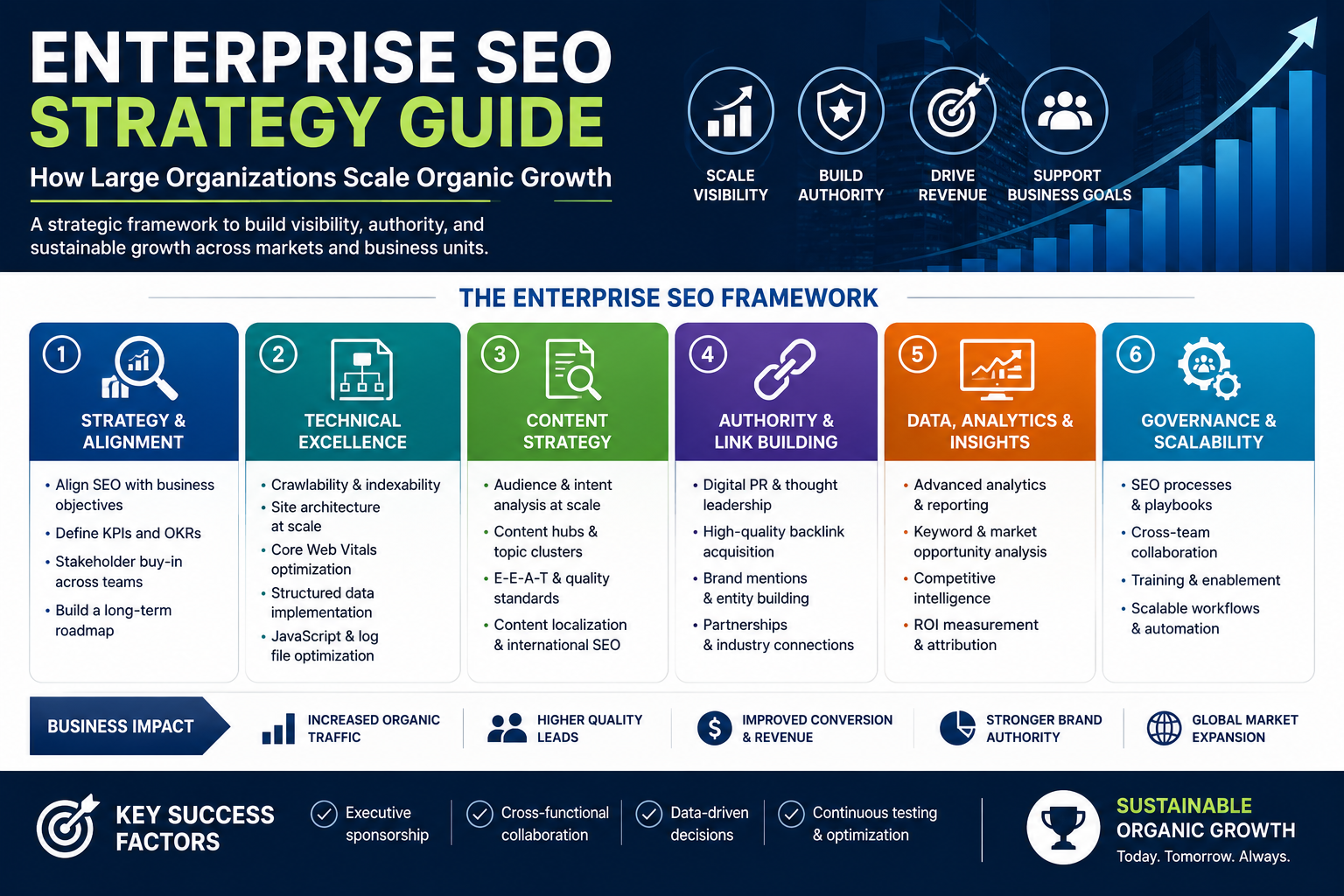
Enterprise SEO is no longer simply about ranking web pages. For large organizations, SEO has evolved into a business growth function that impacts revenue, brand visibility, customer acquisition, and market share.
While small businesses may optimize dozens of pages, enterprise organizations often manage thousands, hundreds of thousands, or even millions of URLs across multiple products, locations, countries, and business units.
The challenge isn’t just ranking. The challenge is scaling visibility while maintaining governance, consistency, technical performance, and measurable business outcomes.
In today’s search landscape, enterprise SEO must also account for AI-powered discovery platforms, including Google AI Overviews, ChatGPT, Gemini, Perplexity, and emerging answer engines.
Organizations that fail to adapt risk losing visibility not only in traditional search results but also in AI-generated recommendations.
This guide explains how enterprise SEO works, the challenges large organizations face, and the frameworks needed to build sustainable organic growth in 2026 and beyond.

What Is Enterprise SEO?
Enterprise SEO is the process of managing and optimizing search visibility for large, complex websites and digital ecosystems. Unlike traditional SEO, enterprise SEO operates at scale.
Enterprise websites often include:
- Thousands to millions of URLs
- Multiple departments
- International markets
- Complex technology stacks
- Large content inventories
- Multiple stakeholders
Examples include:
- SaaS platforms
- Enterprise software companies
- E-commerce marketplaces
- Financial institutions
- Healthcare networks
- Universities
- Global publishers
- Multi-location businesses
Enterprise SEO requires more than tactical optimization. It requires governance, automation, scalable systems, and cross-functional collaboration.
Why Enterprise SEO Matters
Search behavior is changing rapidly. Users increasingly rely on:
- Google Search
- Google AI Overviews
- ChatGPT
- Gemini
- Perplexity
- Voice search
- AI assistants
Organic search remains one of the highest-ROI acquisition channels, but enterprises must now optimize for both traditional search rankings and AI-generated visibility.
Enterprise SEO leaders are increasingly tracking AI citations, answer-engine visibility, and revenue attribution alongside traditional rankings.
The organizations that build strong search ecosystems today will be positioned to dominate tomorrow’s search experiences.
Enterprise SEO vs Traditional SEO
Many organizations assume enterprise SEO is simply “more SEO.” That assumption is wrong. Enterprise SEO introduces challenges that do not exist for smaller websites.
Traditional SEO focuses on:
- Rankings
- Keywords
- Content
- Backlinks
Enterprise SEO focuses on:
- Scale
- Governance
- Automation
- Stakeholder alignment
- Workflow management
- Revenue attribution
- Technical infrastructure
The shift from traditional SEO to enterprise SEO is not incremental—it is structural. Large organizations require processes and operating models that can support growth across millions of pages and multiple teams.
The Enterprise SEO Framework
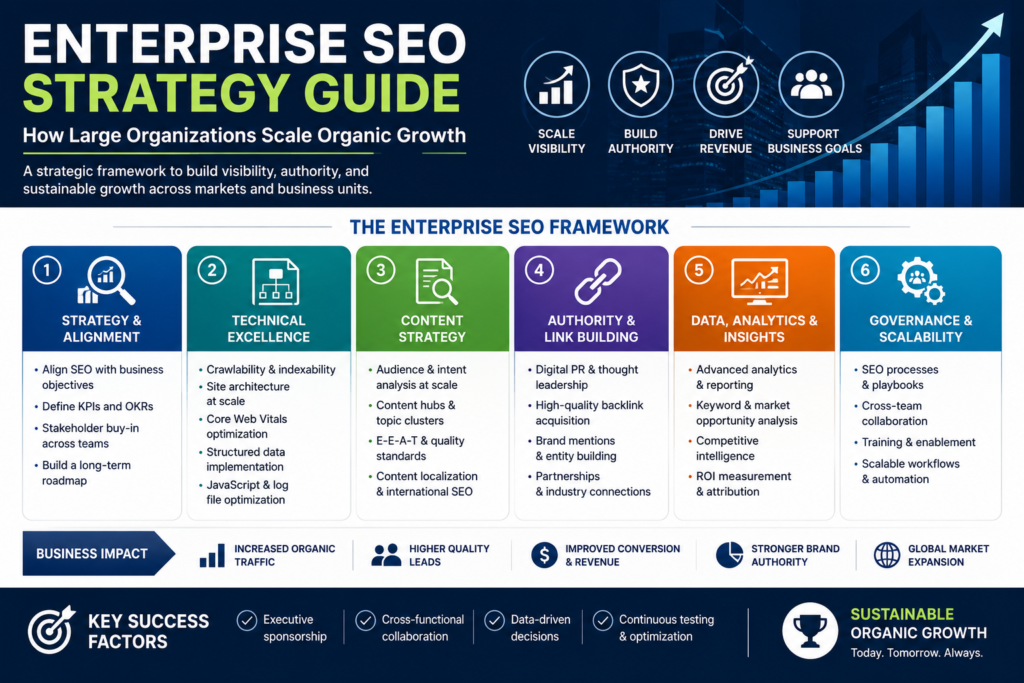
Successful enterprise SEO programs typically operate across six interconnected pillars.
1. Technical SEO
Technical SEO forms the foundation of enterprise growth.
Large websites often struggle with:
- Crawl inefficiencies
- Index bloat
- Duplicate content
- JavaScript rendering issues
- Site speed challenges
- Internal linking problems
Without strong technical SEO, even the best content struggles to perform.
2. Content Operations
Enterprise content requires systems, not isolated blog posts.
A scalable content operation includes:
- Topic clusters
- Editorial workflows
- Content governance
- Content audits
- Refresh cycles
- AI-assisted production
The goal is consistent content production without sacrificing quality.
3. Authority Building
Authority remains one of the strongest ranking signals.
Enterprise authority building includes:
- Digital PR
- Thought leadership
- Industry research
- Brand mentions
- Strategic partnerships
- Link acquisition
Authority influences both search engines and AI systems.
4. AI Search Optimization
One of the largest gaps in current enterprise SEO strategies is AI visibility.
Organizations must now optimize for:
- Google AI Overviews
- ChatGPT
- Gemini
- Perplexity
- AI assistants
AI optimization requires:
- Entity development
- Structured data
- Knowledge Graph signals
- Expert content
- Brand authority
Organizations that ignore AI search risk losing future market share.
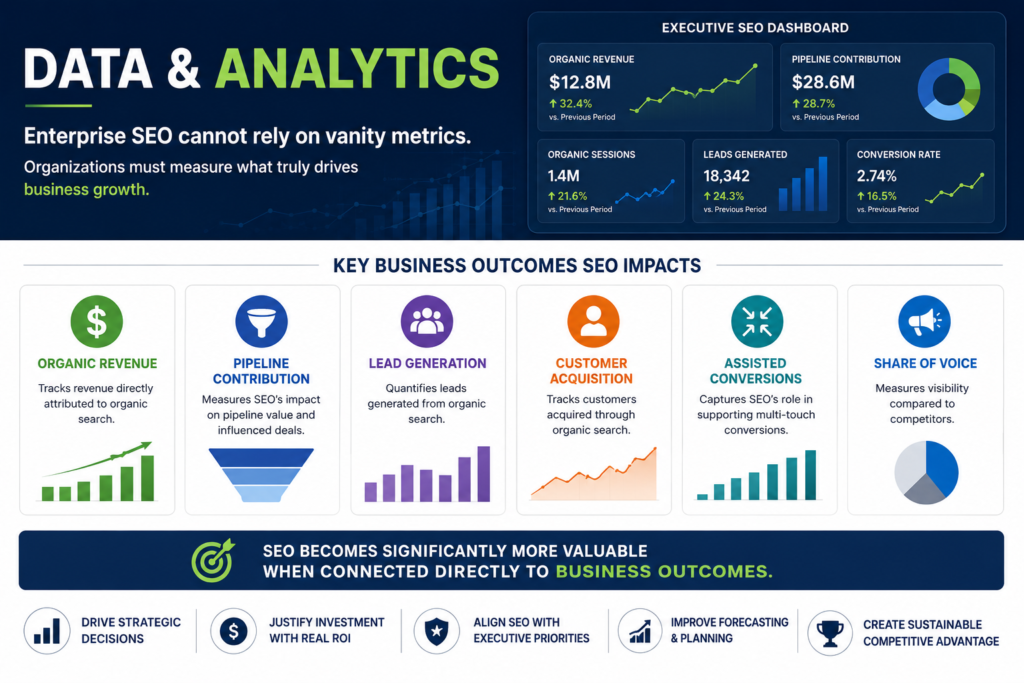
5. Data & Analytics
Enterprise SEO cannot rely on vanity metrics.
Organizations must measure:
- Organic revenue
- Pipeline contribution
- Lead generation
- Customer acquisition
- Assisted conversions
- Share of voice
SEO becomes significantly more valuable when connected directly to business outcomes.
6. Governance & Execution
Governance is often the most overlooked aspect of enterprise SEO.
Large organizations require:
- Documentation
- SEO policies
- Workflow approvals
- Stakeholder alignment
- Performance accountability
Without governance, SEO initiatives often stall despite strong recommendations.
Enterprise SEO Governance Model
One of the biggest reasons enterprise SEO programs fail is organizational complexity.
Marketing teams, developers, content teams, product managers, executives, legal departments, and regional stakeholders often have competing priorities.
A successful governance model includes:
Executive Leadership
Provides strategic direction and budget approval.
SEO Leadership
Defines standards and priorities.
Content Teams
Create and maintain optimized content.
Development Teams
Implement technical improvements.
Analytics Teams
Measure business outcomes.
Regional Teams
Adapt SEO strategies for local markets.
Governance transforms SEO from a collection of projects into an organizational capability.
Technical SEO at Enterprise Scale
Technical SEO becomes exponentially more important as websites grow.
Key priorities include:
Crawl Budget Optimization
Ensure search engines focus on valuable pages.
Index Management
Prevent low-value pages from cluttering search indexes.
Site Architecture
Build scalable structures that support growth.
Core Web Vitals
Improve user experience and search performance.
Structured Data
Strengthen machine understanding and AI visibility. Organizations managing millions of URLs must prioritize automation and monitoring to maintain technical health.
Content Strategy for Enterprise SEO
Many enterprise websites suffer from content bloat.
Publishing more content does not guarantee better performance.
Instead, enterprises should focus on:
Topic Clusters
Create comprehensive coverage around core themes.
Content Consolidation
Merge overlapping pages.
Content Refreshes
Update existing assets regularly.
Semantic Optimization
Improve topical relevance.
AI-Friendly Content
Structure information for search engines and AI systems.
The goal is topical authority, not content volume.
Programmatic SEO for Enterprise Growth
Programmatic SEO allows organizations to scale content creation efficiently.
Examples include:
- Location pages
- Product pages
- Category pages
- Marketplace listings
- Comparison pages
When executed properly, programmatic SEO can generate thousands of highly relevant landing pages. However, poor execution often leads to thin content and index quality issues. Quality control remains essential.
Enterprise SEO Automation
Manual SEO processes do not scale.
Automation helps organizations:
- Generate metadata
- Monitor technical issues
- Group keywords
- Detect content gaps
- Analyze competitors
- Track AI visibility
Automation allows teams to focus on strategy rather than repetitive tasks.
Enterprise SEO for AI Search
AI-powered search represents one of the most important shifts in modern SEO.
Users increasingly ask:
- Which CRM software is best?
- What is the best cybersecurity platform?
- Who are the top enterprise SEO agencies?
AI systems generate answers rather than displaying only links.
To improve visibility:
- Strengthen entity signals
- Publish authoritative content
- Earn third-party mentions
- Build Knowledge Graph relationships
- Implement schema markup
Future enterprise SEO strategies must integrate traditional SEO and AI visibility.
Measuring Enterprise SEO ROI
Executives care about outcomes, not rankings.
Track metrics that connect SEO to business performance:
- Organic revenue
- Pipeline contribution
- Lead volume
- Customer acquisition cost
- Conversion rate
- Share of voice
- AI citations
- Market visibility
The most successful enterprise SEO programs speak the language of business, not rankings.
Common Enterprise SEO Challenges
Organizations frequently encounter:
- Slow implementation cycles
- Stakeholder conflicts
- Technical debt
- Legacy systems
- Content duplication
- Governance gaps
- Limited resources
- Data silos
Execution at scale remains one of the biggest challenges for enterprise SEO teams. Automation, prioritization, and stakeholder buy-in are critical for success.
The Future of Enterprise SEO
Enterprise SEO is evolving beyond search rankings.
The future includes:
- AI Search Optimization
- Generative Engine Optimization (GEO)
- Entity SEO
- Knowledge Graph development
- Automation-driven workflows
- Predictive analytics
- Revenue attribution modeling
Organizations that build scalable SEO systems today will have a significant advantage over competitors still relying on outdated approaches.
Final Thoughts
Enterprise SEO is not simply a larger version of traditional SEO. It is a strategic growth discipline that combines technology, content, governance, analytics, automation, and AI visibility.
Large organizations that invest in enterprise SEO gain more than rankings. They gain sustainable customer acquisition, stronger market visibility, improved brand authority, and long-term competitive advantage.
In 2026 and beyond, the enterprises that win search will be the organizations that treat SEO as a core business function rather than a marketing tactic.