 Skip to content

Top 7 SEO Tools for Higher Rankings and Organic Traffic
The top 7 SEO tools for higher rankings make search engine optimization simpler and more effective. SEO helps websites rank better and attract steady organic traffic over time. However, without the right tools, the process can feel slow and confusing. Reliable SEO tools show real data, uncover hidden problems, and help you make smarter decisions for better results.
They help you find profitable keywords, track rankings, study competitors, and improve content quality. With the proper tools, you save time and grow faster. In this guide, you will discover the best SEO tools to boost visibility, improve rankings, and drive consistent organic traffic.
Why SEO Tools are Important for Increasing Ranking and Traffic
SEO tools help you understand how your website performs in search engines. They show keyword rankings, traffic, and technical issues. They also reveal competitor strategies.
Bloggers, businesses, and marketers use SEO tools daily. These tools save time and improve decisions. Without them, SEO becomes very hard and time-consuming.
Good SEO tools help you:
- Find profitable keywords
- Track rankings
- Fix technical problems
- Improve content quality
- Build backlinks
- Increase organic traffic
Let us explore why SEO tools are essential.
Why SEO Tools Are Essential for Website Growth
SEO needs data. You cannot improve what you cannot measure. SEO tools give real insights about your website and competitors.
They help you build a strong and data-driven SEO strategy.
Key Benefits of SEO Tools
- Discover high traffic keywords
- Track ranking changes daily
- Find and fix technical SEO errors
- Analyze competitor strategies
- Optimize content for search engines
- Improve website performance
- Increase search visibility
SEO tools also save time. Manual SEO takes hours. Tools automate research, tracking, and auditing.
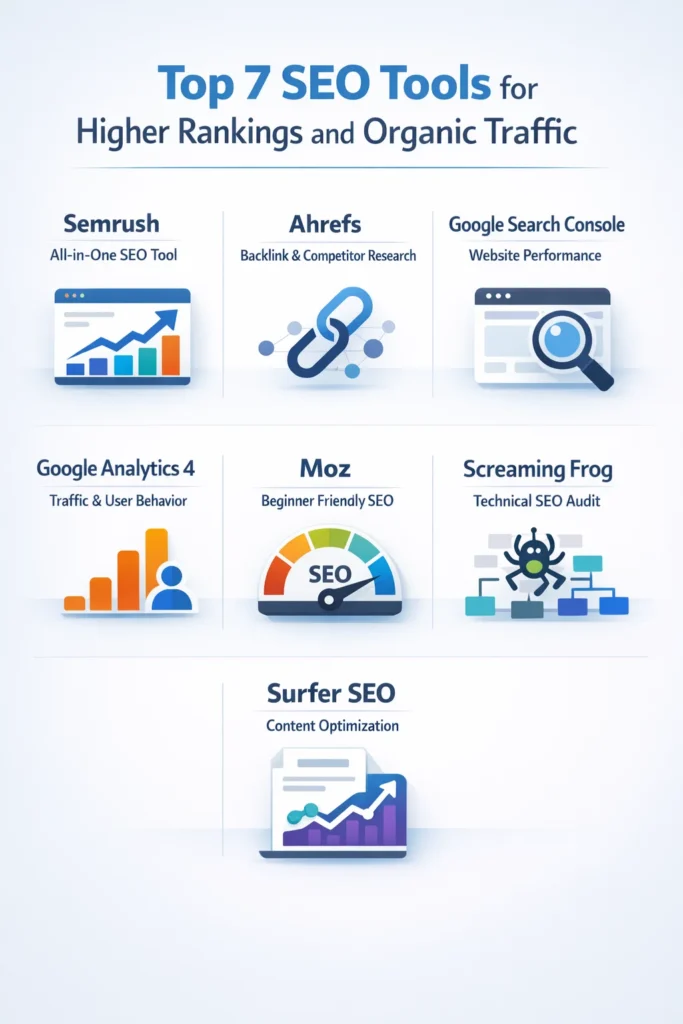
Top 7 SEO Tools for Higher Rankings and Traffic
Below are the best SEO tools for keyword research, technical SEO, backlinks, and content optimization.
1. Semrush – All-in-One SEO Tool
Semrush is one of the most powerful SEO tools. It is used by marketers, agencies, and businesses worldwide.
It offers a complete SEO solution in one platform.
Key Features
- Advanced keyword research tool
- Competitor analysis and keyword gap
- Site audit and technical SEO reports
- Backlink analysis and monitoring
- Rank tracking across locations
- Content marketing tools
Semrush helps you find profitable keywords quickly. It also shows competitor traffic and top pages. The site audit tool finds errors and suggests fixes.
Best Use Case: Full SEO management and growth strategy.
2. Ahrefs – Best for Backlinks and Competitor Research
Ahrefs is famous for its huge backlink database. It is widely used for link building and competitor analysis.
Backlinks remain a major ranking factor. Ahrefs helps you build strong links.
Key Features
- Backlink checker and link analysis
- Keyword explorer with search volume
- Content gap analysis
- Site audit and technical SEO
- Rank tracking
Ahrefs shows which websites link to your competitors. You can target those sites for backlinks. It also finds content ideas with high traffic potential.
Best Use Case: Backlink strategy and competitor research.
3. Google Search Console – Best Free SEO Tool
Google Search Console is a free tool from Google. It shows how your website performs in Google search.
Every website owner should use this tool.
Key Features
- Search clicks and impressions
- Keyword ranking data
- Indexing and crawl status
- Page experience and Core Web Vitals
- Sitemap submission
This tool shows which keywords bring traffic. It also reveals indexing problems and mobile usability issues.
You can fix errors and improve rankings using real Google data.
Best Use Case: Website monitoring and search performance tracking.
4. Google Analytics 4 – Best for Traffic and User Behavior
Google Analytics 4 helps you understand visitors and behavior. It shows how users interact with your website.
This tool is essential for measuring SEO results.
Key Features
- Traffic sources and channels
- User journey and engagement
- Bounce rate and session data
- Conversion tracking
- Audience insights
You can see which pages bring traffic and conversions. This helps improve content and SEO strategy.
Best Use Case: Measuring SEO performance and ROI.
5. Moz – Beginner Friendly SEO Tool
Moz is simple and easy to use. Beginners love this tool because of its clean interface.
It is great for learning SEO basics.
Key Features
- Keyword research tool
- Domain Authority score
- Rank tracking
- Site audit and SEO suggestions
- On-page optimization tips
Moz helps you track keyword rankings and improve on-page SEO. Domain Authority shows website strength compared to competitors.
Best Use Case: Beginners and small businesses.
6. Screaming Frog SEO Spider – Technical SEO Expert Tool
Screaming Frog crawls your website like a search engine. It finds technical issues that affect rankings.
Technical SEO is critical for website health.
Key Features
- Broken link detection
- Redirect and crawl errors
- Duplicate content detection
- Meta title and description audit
- XML sitemap analysis
This tool helps you fix technical SEO issues fast. It improves crawlability and indexing.
Best Use Case: Technical SEO audits and website optimization.
7. Surfer SEO – Content Optimization Tool
Surfer SEO helps you create SEO-friendly content. It uses NLP and SERP analysis to improve rankings.
Content quality strongly affects rankings.
Key Features
- Content score and optimization
- NLP keyword suggestions
- SERP analysis and structure
- On-page SEO recommendations
Surfer compares your content with top-ranking pages. It suggests improvements for better rankings.
Best Use Case: Content optimization and on-page SEO.
How to Choose the Right SEO Tool
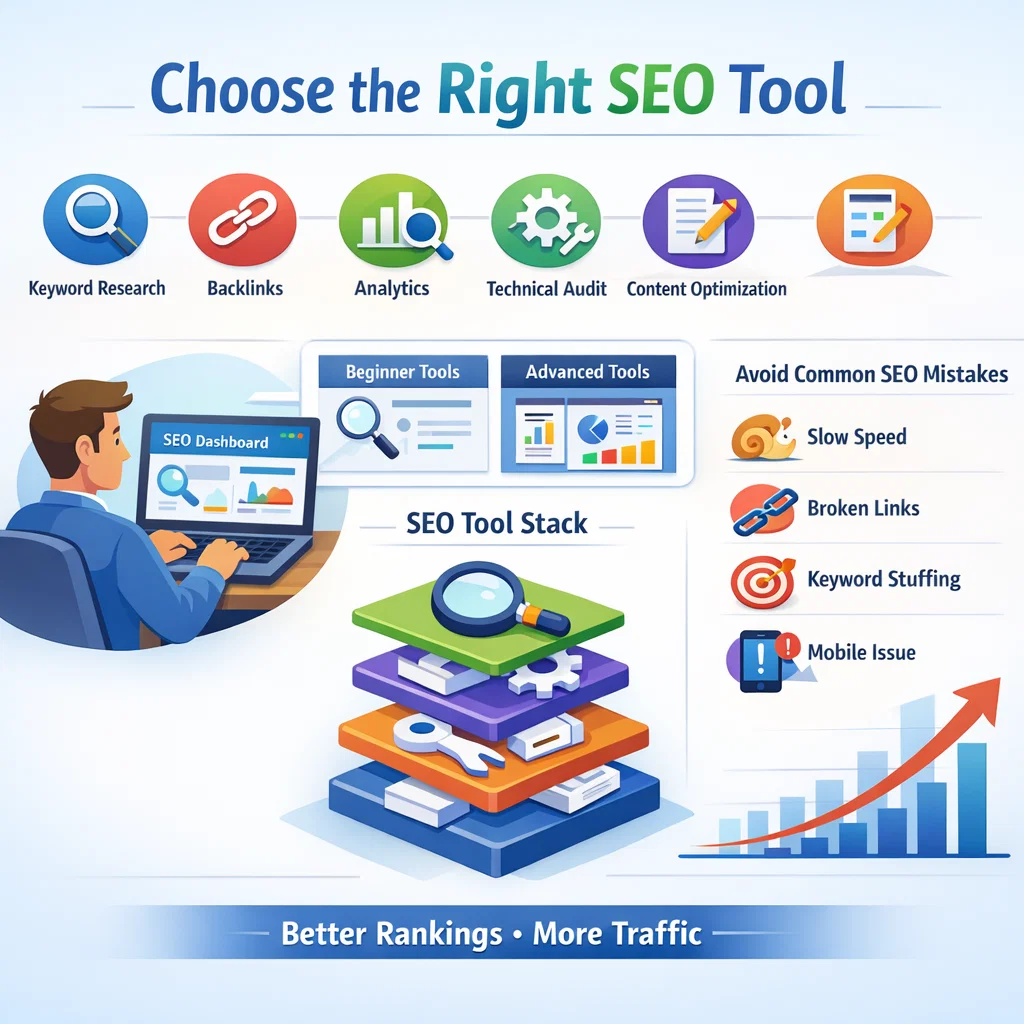
Not every SEO tool fits every user. You should choose a tool based on your goals and budget. First, decide what you want from SEO, such as keyword research, technical audits, or traffic growth.
Then check how much you can spend, because some tools are free while others are paid. Your experience level also matters, since beginners need simple tools while experts need advanced features.
Look at the specific features you need, like rank tracking, backlink analysis, or content optimization. Finally, consider your website size, because small websites and large websites often require different SEO capabilities.
For example, if you run a small blog and want to track keywords and fix basic errors, a simple and low-cost tool may be enough. But if you manage a large eCommerce website and want competitor analysis, backlink tracking, and full site audits, you will need a more advanced SEO tool with deeper data and features.
Tool Selection Guide
- For complete SEO: Semrush
- For backlinks: Ahrefs
- For free monitoring: Google Search Console
- For traffic insights: Google Analytics
- For beginners: Moz
- For technical SEO: Screaming Frog
- For content optimization: Surfer SEO
Using two or three tools together gives better results.
Best SEO Tool Stack for Maximum Results
Professional SEO uses multiple tools. Each tool serves a different purpose.
Recommended SEO Stack
- Keyword research: Semrush or Ahrefs
- Technical SEO: Screaming Frog
- Content optimization: Surfer SEO
- Performance tracking: Google Analytics
- Search monitoring: Google Search Console
Combining tools gives deeper insights and faster growth.
Common SEO Mistakes to Avoid
Many websites fail due to basic SEO mistakes. Avoid these to improve rankings.
Major SEO Mistakes
- Ignoring technical SEO problems
- Not tracking keyword rankings
- Keyword stuffing in content
- Publishing low-quality content
- Ignoring competitor analysis
- Not optimizing for mobile users
- Slow website speed
Fixing these mistakes can quickly improve rankings and traffic.
Conclusion
SEO tools are essential for website growth. They help you find keywords, track rankings, and fix issues. They also improve content and technical SEO.
Start with free tools like Google Search Console and Google Analytics. Then upgrade to advanced tools as your website grows.
The right SEO tools can increase rankings, boost organic traffic, and grow your business faster.
FAQ of Top 7 SEO Tools for Higher Rankings
What is the best SEO tool for beginners?
Moz and Google Search Console are great for beginners. They are simple and easy to use.
Are free SEO tools enough?
Free tools work for beginners. Paid tools provide deeper insights and faster growth.
Which SEO tool is best for keyword research?
Semrush and Ahrefs are excellent for keyword research and competitor analysis.
How many SEO tools should I use?
Use two to three tools for the best results. One tool cannot cover everything.
What is the best all-in-one SEO tool?
Semrush is one of the best all-in-one SEO tools available today.
