 Skip to content
Directory Submission for SEO: Benefits, Risks & Modern Best Practices
Directory submission has been part of SEO since the early days of search engines. Back then, the strategy was simple: submit your website to hundreds of directories, collect backlinks, and expect rankings to rise.
That approach no longer works.
Search engines — and AI-driven systems — are far more sophisticated today. Mass directory submissions can dilute your backlink profile and even harm visibility. However, when handled strategically, directory submission still plays a valuable supporting role in modern SEO.
This guide explains what directory submission is, whether it still works, its real benefits, the risks to avoid, and the best practices that keep it safe and effective.
What Is Directory Submission in SEO?
Directory submission is the process of adding your business or website details to reputable online directories to improve visibility, citation consistency, and brand trust.
A typical directory listing includes:
- Business or website name
- Website URL
- Address and service area
- Phone and email
- Business category
- Short description
- Sometimes hours, images, and social links
In modern SEO, directory submission is not about quantity. It is about placing accurate, consistent information on a curated set of trusted platforms.
Does Directory Submission Still Work for SEO?
Yes — but only when done correctly.
Directory submission no longer works as a bulk link-building tactic. It works as:
- A citation-building method
- A brand validation signal
- A local SEO reinforcement tactic
- A discovery aid for new websites
The goal today is credibility and consistency, not mass backlinks.
Benefits of Directory Submission for SEO
When executed carefully, directory submission can strengthen multiple SEO signals.
1. Stronger Local SEO Through NAP Consistency
Search engines compare your Name, Address, and Phone (NAP) across the web. Consistency improves trust.
Accurate directory listings support:
- “Near me” searches
- City-based queries
- Google Maps visibility
- Local pack rankings
Directory citations work best as part of a broader local SEO strategy.
2. High-Intent Referral Traffic
Users browsing directories are often:
- Actively comparing services
- Close to making decisions
- Looking for contact information
Traffic from niche or local directories often converts better than generic traffic.
3. Authority, E-E-A-T & Brand Trust
Search systems evaluate:
- Experience
- Expertise
- Authoritativeness
- Trustworthiness
Being listed on reputable industry directories or local business platforms acts as third-party validation. This strengthens both traditional rankings and AI trust signals.
4. Faster Discovery for New Websites
Search engine crawlers frequently revisit trusted directories. A few strategic listings can help new or rebranded sites get discovered and indexed faster.
Directory submission does not replace content strategy, but it can support early discovery.
5. Reviews & Reputation Signals
Many directories allow reviews.
Platforms like:
- Google Business Profile
- Yelp
- G2
- TripAdvisor
- Industry-specific portals
Reviews influence:
- Conversion rates
- Brand trust
- Rich results visibility
- AI system perception
Managed properly, these platforms become both citation and reputation assets.
Risks of Directory Submission in Modern SEO
Directory submission becomes harmful when outdated tactics are used.
1. Spammy Link Patterns
Risky behaviors include:
- Submitting to hundreds of auto-approve directories
- Using identical keyword-stuffed anchor text
- Participating in link networks
At best, these links are ignored. At worst, they contribute to algorithmic devaluation.
2. Wasted Time & Low ROI
After covering major directories, additional low-quality listings rarely provide meaningful SEO impact.
Time is better invested in:
- Content development
- Digital PR
- Technical SEO
- Authority building
3. Brand Reputation Damage
If your business appears on spam-filled directories, users may associate that low quality with your brand.
Search engines also evaluate link neighborhoods. Poor environments reduce trust signals.
4. Inconsistent Business Information
Incorrect addresses or outdated phone numbers confuse users and weaken local ranking signals.
Inconsistency quietly harms performance.
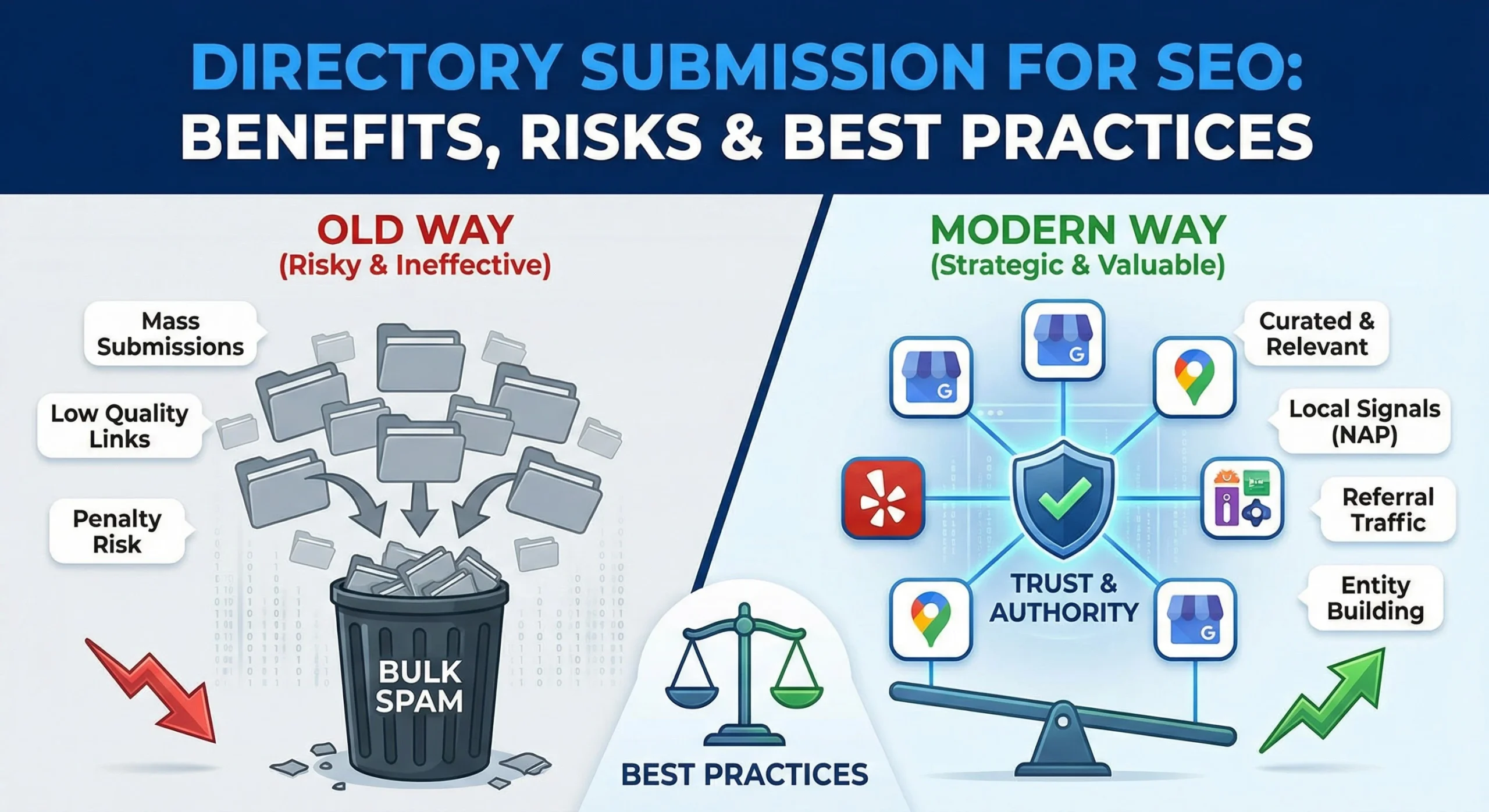
Old vs Modern Directory Submission
| Old SEO Approach | Modern SEO Approach |
|---|---|
| Mass submissions | Curated submissions |
| Quantity focus | Quality focus |
| Keyword anchor spam | Brand anchors |
| Link building goal | Entity trust & citation accuracy |
| Automated tools | Manual review & control |
This shift is critical.
Best Practices for Safe & Effective Directory Submission
1. Define Your Objective
Know what you want:
- Local visibility
- Citation consistency
- Referral traffic
- Brand validation
Clear goals guide directory selection.
2. Create a Canonical Business Profile
Before submitting anywhere, prepare one master document containing:
- Official business name
- Primary website URL
- Standardized address
- Main phone number
- Short & long descriptions
- Key services
- Hours
- Social links
- Logo & images
Use this as your source of truth.
3. Choose Directories Carefully
Evaluate each directory:
- Does it rank in Google?
- Is it actively maintained?
- Is it relevant to your niche?
- Is it free of spam?
- Does it serve your audience?
Focus on:
- Google Business Profile
- Reputable local directories
- Industry-specific directories
- Established review platforms
4. Optimize Listings for Humans
- Use exact NAP details
- Select accurate categories
- Write clear, value-focused descriptions
- Add quality images
- Include natural calls-to-action
Remember: people read these listings.
5. Use Natural Anchor Text
Prefer:
- Brand name
- Domain name
- “Visit website”
Avoid keyword-stuffed anchors.
6. Track & Maintain Listings
Keep a spreadsheet including:
- Directory name
- Login credentials
- Submission date
- Live URL
- Status
Audit annually or after any business change.
7. Integrate With Broader SEO
Directory submission works best alongside:
- On-page optimization
- Technical SEO
- Quality content
- Link earning strategies
- Site performance improvements
It is a supporting tactic, not a ranking shortcut.
Final Thoughts
Directory submission is no longer a shortcut to rankings.
But when handled strategically, it can:
- Reinforce local SEO through citation consistency
- Strengthen brand trust and entity signals
- Send high-intent referral traffic
- Help new sites gain visibility
Used carelessly, it creates clutter and risk.
Focus on quality over quantity. Maintain consistent data everywhere. Treat each listing as a professional extension of your brand.
That approach keeps directory submission firmly on the benefit side of your SEO strategy — and away from the risk list.
