
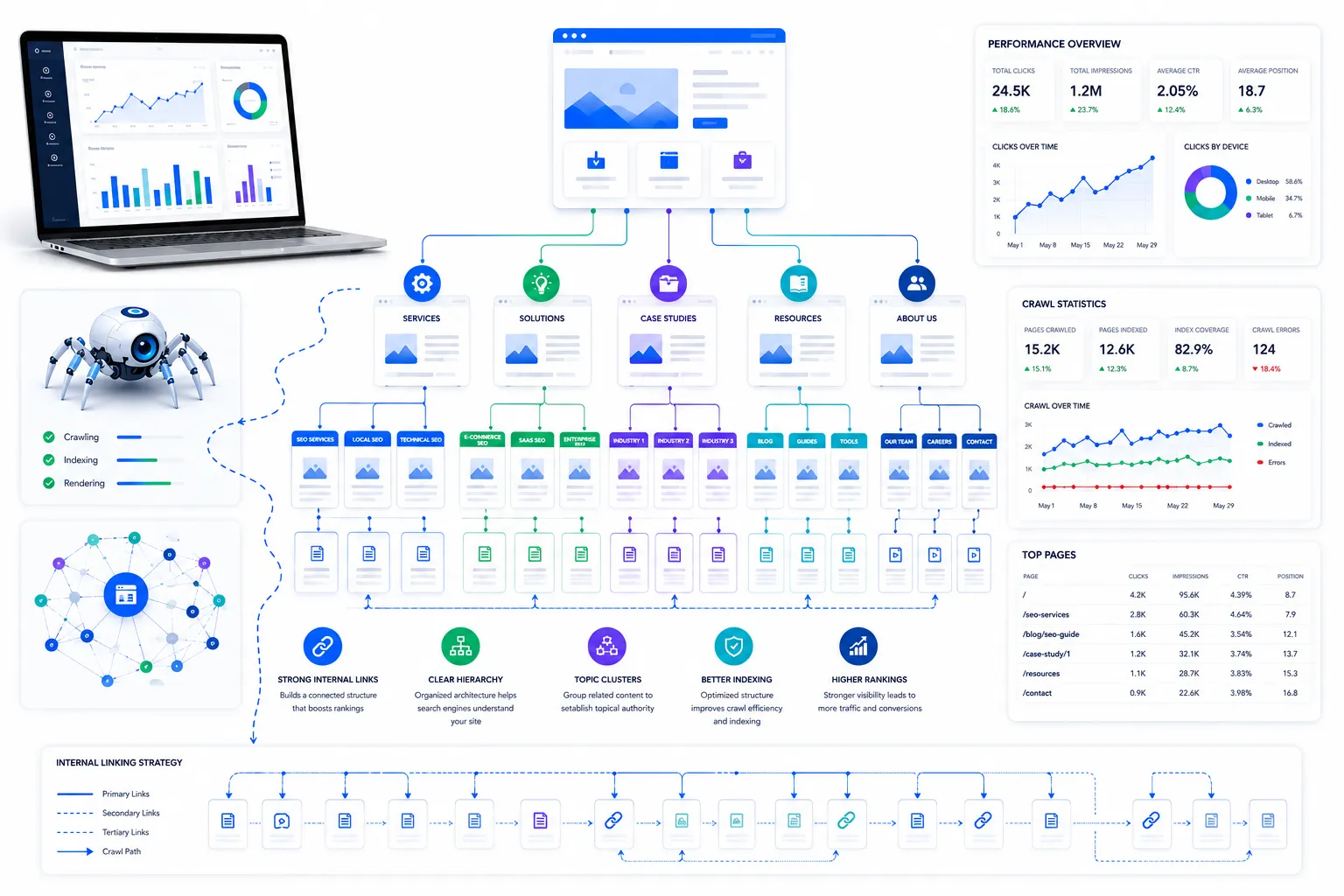
Website Architecture Case Study: How Strategic Site Structure Increased Organic Traffic by 391%
Introduction
Many websites fail to reach their SEO potential because of poor website architecture.
Even when content quality is strong, search engines can struggle to crawl, understand, and prioritize pages if the site’s structure is confusing. Weak internal linking, orphan pages, poor category organization, and unclear topic relationships can significantly limit rankings and traffic.
In this Website Architecture Case Study, you’ll learn how restructuring a website’s architecture, improving internal linking, and building topical authority increased organic traffic by 391%, improved crawl efficiency, and generated more qualified leads.
Client Overview
- Industry: Professional Services
- Platform: WordPress
- Target Market: USA
- Campaign Duration: 8 Months
- Primary Goal: Improve SEO Performance Through Better Site Architecture
Initial Challenges
The website faced several structural issues:
- Poor internal linking
- Orphan pages
- Weak category hierarchy
- Crawl inefficiencies
- Duplicate topic targeting
- Thin topical authority
- Low keyword visibility
Although the website contained more than 300 pages, many valuable assets were difficult for both users and search engines to discover.
Initial SEO Audit Findings
Weak Website Structure
The website lacked a logical hierarchy.
Typical structure looked like:
Home
↓
Random Blog Posts
↓
Disconnected Service Pages
↓
Scattered Resources
There was no clear relationship between content assets.
Orphan Pages
More than 80 important pages had little or no internal links pointing to them.
As a result:
- Google crawled them infrequently
- Rankings were weak
- Indexation was inconsistent
Keyword Cannibalization
Multiple pages targeted similar keywords.
This caused:
- Ranking instability
- Content overlap
- Reduced authority signals
Poor Crawl Efficiency
Googlebot spent significant resources crawling low-priority pages while important pages received limited attention.
Architecture Improvement Strategy
Phase 1: Content Mapping
The first step was categorizing all content.
Pages were grouped into:
Core Services
Primary revenue-generating pages.
Supporting Services
Related service offerings.
Educational Content
Blogs, guides, and resources.
Case Studies
Proof and trust-building content.
FAQ Content
Answer-focused resources.
Phase 2: Topic Cluster Development
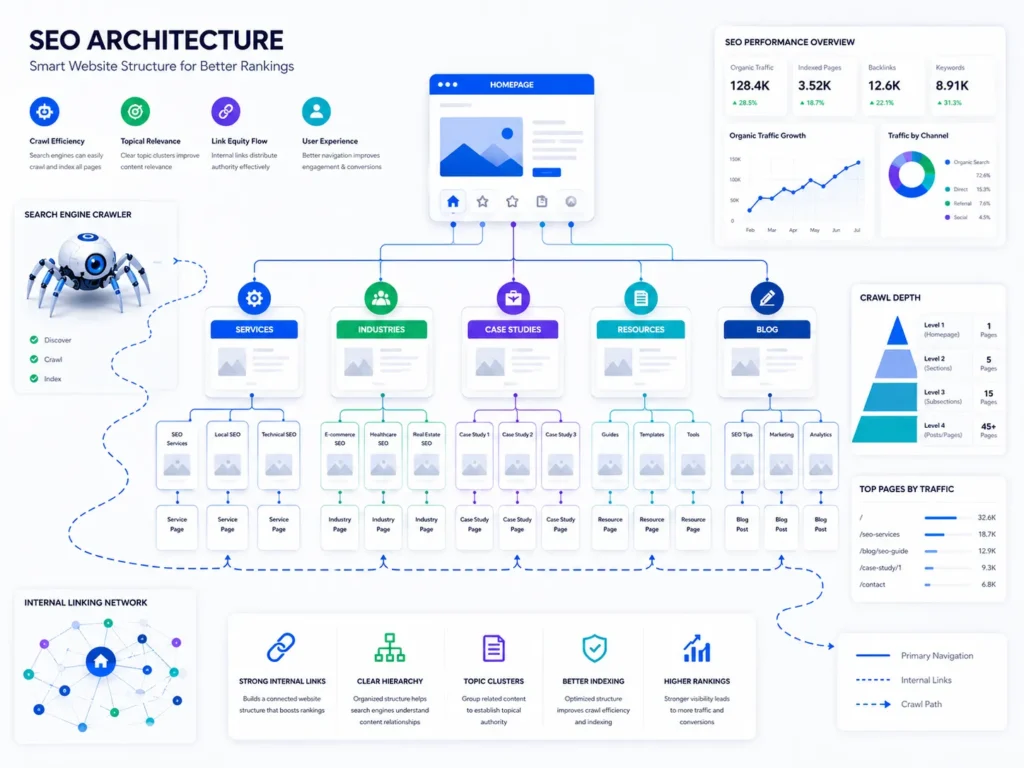
A topical authority framework was created.
Example Structure
Homepage
↓
↓
↓
↓
Core Web Vitals Guide
↓
↓
FAQ
This structure established stronger topical relevance.
Phase 3: Internal Linking Optimization
A strategic internal linking framework connected related content.
Improvements Included
- Contextual internal links
- Hub-and-spoke architecture
- Topic clusters
- Service-to-blog links
- Blog-to-service links
- Case study references
Internal links increased dramatically while maintaining relevance.
Phase 4: URL Structure Optimization
The website’s URLs were reorganized.
Before
example.com/blog-post-123
example.com/service-page-final
After
example.com/seo-services/
example.com/seo-services/technical-seo/
example.com/case-studies/
example.com/technical-seo-guide/
This improved clarity for both users and search engines.
Phase 5: Navigation Enhancement
The main navigation was redesigned.
Goals included:
- Better user experience
- Improved crawl paths
- Increased page discovery
- Reduced click depth
Important pages became accessible within three clicks or less.
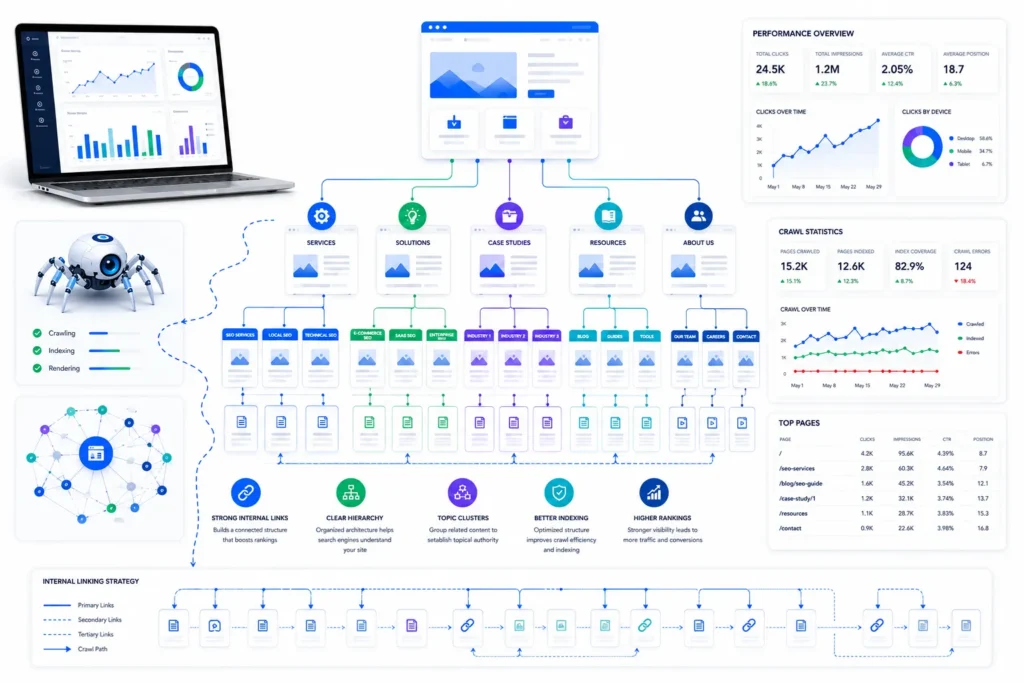
Results After 8 Months
Organic Traffic Growth
Before:
7,200 Monthly Visitors
After:
35,400 Monthly Visitors
Growth:
391%
Keyword Rankings
| Metric | Before | After |
|---|---|---|
| Top 3 Rankings | 12 | 83 |
| Top 10 Rankings | 46 | 298 |
| Top 20 Rankings | 118 | 587 |
Crawl Efficiency Improvements
Before:
- High crawl waste
- Low discovery rate
- Numerous orphan pages
After:
- Improved crawl efficiency
- Faster indexing
- Better content discovery
Internal Linking Metrics
Before:
- 1.4 Average Internal Links Per Page
After:
- 12.8 Average Internal Links Per Page
This significantly improved authority distribution.
Lead Generation
Before:
58 Monthly Leads
After:
217 Monthly Leads
Growth:
274%
Why the New Architecture Worked
Better Crawlability
Google could discover and understand content more efficiently.
Stronger Topical Authority
Content clusters reinforced expertise across core topics.
Improved Internal Linking
Authority flowed naturally between related pages.
Reduced Cannibalization
Clear page roles eliminated topic overlap.
Better User Experience
Visitors found information faster, improving engagement.
Key Lessons Learned
Architecture Impacts Rankings
Even excellent content can underperform if site structure is weak.
Internal Linking Is Critical
Strong internal links help search engines understand content relationships.
Topic Clusters Build Authority
Clusters improve relevance and expertise signals.
Click Depth Matters
Important pages should be accessible within a few clicks.
Scalability Is Essential
A well-designed architecture supports future content growth.
Final Results
After restructuring the website architecture, the business achieved:
391% Increase in Organic Traffic
298 Keywords Ranking in Top 10
274% Increase in Leads
Better Crawl Efficiency
Stronger Topical Authority
Improved User Experience
Faster Indexation
Conclusion
Website architecture is one of the most overlooked aspects of SEO.
A well-structured website helps search engines understand relationships between pages, improves crawlability, strengthens topical authority, and enhances user experience.
This case study demonstrates how strategic site architecture, topic clustering, and internal linking can transform SEO performance and create sustainable long-term growth.