
Generative Engine Optimization (GEO): The Complete Guide to Ranking in AI Search Results
Introduction
Search is evolving faster than ever. Traditional search engine optimization (SEO) remains essential, but a new challenge has emerged for businesses seeking online visibility: appearing within AI-generated answers.
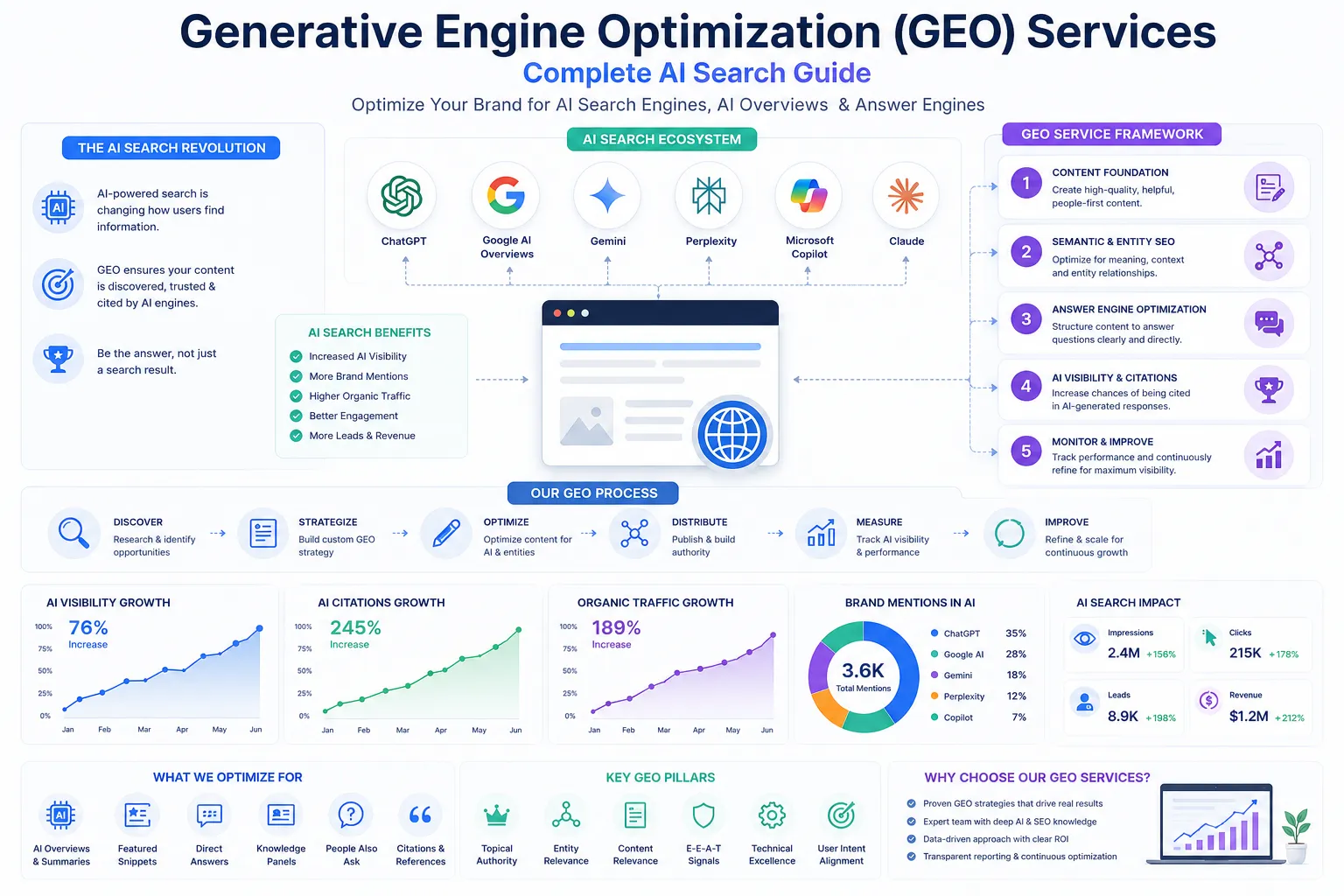
As platforms like ChatGPT, Google AI Overviews, Gemini, Perplexity, Claude, and Microsoft Copilot become increasingly popular, users are receiving direct answers instead of clicking through multiple websites. This shift is transforming how people discover information, compare products, and make purchasing decisions.
This is where Generative Engine Optimization (GEO) becomes critical.
Generative Engine Optimization is the process of optimizing content, entities, and digital assets to increase visibility within AI-generated responses. Instead of focusing solely on ranking in traditional search engine results pages (SERPs), GEO helps businesses become trusted sources that artificial intelligence systems reference when generating answers.
Organizations that adapt early to this shift can gain a significant competitive advantage. Those that ignore it risk losing visibility as user behavior continues to move toward conversational search and AI-assisted discovery.
In this comprehensive guide, you’ll learn what GEO is, why it matters, how it differs from traditional SEO, and the proven strategies businesses can use to improve visibility across AI-powered search platforms.
What Is Generative Engine Optimization?
Generative Engine Optimization (GEO) refers to optimizing digital content so that AI systems can discover, understand, trust, and reference it within generated responses.
Unlike traditional search engines that present a list of links, generative AI platforms synthesize information from multiple sources and produce direct answers.
Examples include:
- Google AI Overviews
- ChatGPT Search
- Microsoft Copilot
- Perplexity AI
- Gemini
- Claude
When users ask questions, these platforms often provide summarized responses and may cite sources they trust.
The goal of GEO is to increase the likelihood that your content becomes one of those trusted sources.
Why GEO Matters More Than Ever
Search behavior is changing rapidly.
Instead of typing:
“Best CRM software”
Users now ask:
“Which CRM software is best for small businesses under 20 employees?”
Instead of:
Users ask:
“Who offers the best SEO and GEO services for SaaS companies?”
AI platforms generate answers immediately, reducing the need for users to browse multiple pages.
This creates both challenges and opportunities.
Challenges
- Reduced click-through rates from traditional rankings
- Increased competition for AI citations
- Higher demand for authority and trust
Opportunities
- Enhanced brand visibility
- Increased authority
- More qualified traffic
- Better lead generation
- Early mover advantage
Businesses that become trusted sources can appear repeatedly in AI-generated answers.
GEO vs Traditional SEO
Many businesses assume GEO replaces SEO.
It doesn’t.
Instead, GEO builds upon strong SEO foundations.
| SEO | GEO |
|---|---|
| Optimizes for rankings | Optimizes for AI citations |
| Focuses on SERPs | Focuses on AI answers |
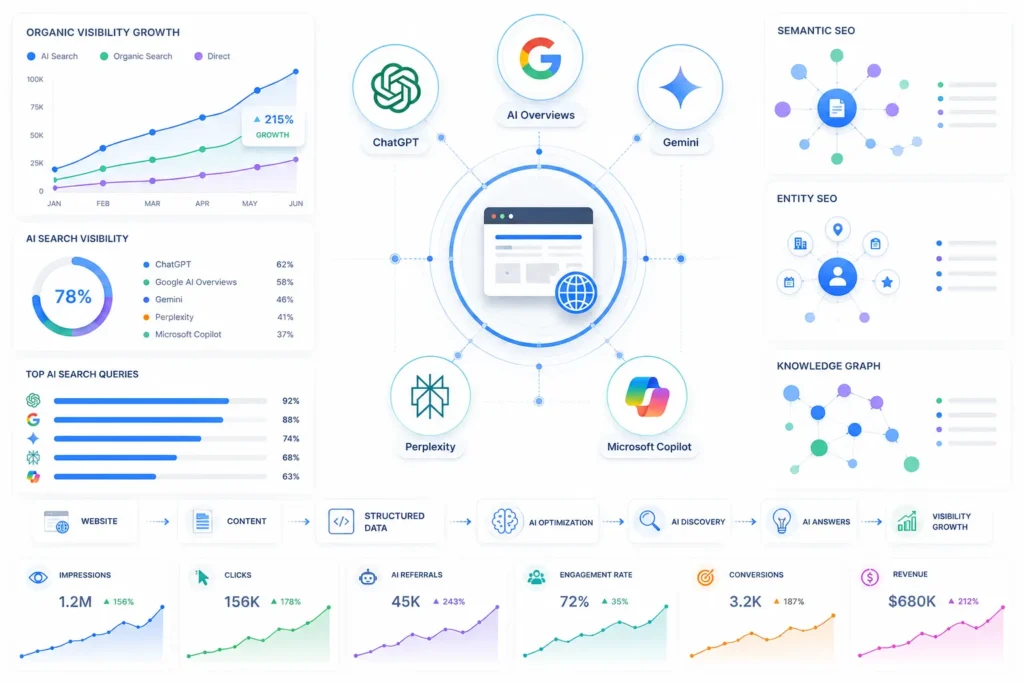
| Targets keywords | Targets entities and topics |
| Earns clicks | Earns mentions and references |
| Prioritizes rankings | Prioritizes trust and authority |
The most successful organizations combine both approaches.
Traditional SEO drives discoverability.
GEO drives AI visibility.
Together, they create a future-proof search strategy.
How AI Systems Choose Sources
One of the biggest competitor content gaps is explaining how AI systems determine which sources to trust.
AI engines typically evaluate:
Content Quality
Content must demonstrate:
- Accuracy
- Completeness
- Expertise
- Relevance
Authority Signals
AI systems favor sources with:
- Strong backlinks
- Brand mentions
- Industry recognition
- Expert authorship
Entity Relationships
Modern AI understands relationships between:
- Brands
- People
- Products
- Services
- Organizations
Strong entity signals improve trust.
Structured Information
Content organized with:
- Headings
- Lists
- FAQs
- Tables
- Schema markup
is easier for AI systems to process.
The Role of EEAT in GEO
Google’s EEAT framework remains highly relevant.
EEAT stands for:
Experience
Demonstrate real-world expertise.
Include:
- Case studies
- First-hand experiences
- Client examples
- Industry insights
Expertise
Show deep knowledge.
Publish:
- Comprehensive guides
- Research
- Original analysis
- Educational content
Authoritativeness
Build authority through:
- Mentions
- Citations
- Thought leadership
- Industry recognition
Trustworthiness
Improve trust through:
- Transparent information
- Contact details
- Privacy policies
- Author credentials
AI systems increasingly favor content that aligns with EEAT principles.
Semantic SEO and GEO
Another major weakness in competitor content is insufficient coverage of semantic SEO.
Semantic SEO focuses on meaning rather than individual keywords.
For example:
Instead of repeatedly targeting:
“Generative Engine Optimization“
you also cover:
- AI Search Optimization
- AI Visibility
- AI Search Results
- Conversational Search
- AI Content Discovery
- Answer Engines
- AI Overviews
- Entity Optimization
This creates stronger topical relevance.
AI systems understand concepts and relationships, not just keywords.
Entity SEO for Generative Search
Entities are becoming one of the most important ranking factors in AI-driven environments.
Examples of entities include:
- Companies
- People
- Products
- Locations
- Technologies
If AI understands your business as a recognized entity, visibility improves significantly.
How to Strengthen Entity Signals
- Use Organization Schema
- Build consistent brand mentions
- Create author profiles
- Earn citations from trusted sources
- Publish original research
- Develop topic clusters
Entity optimization helps AI connect your brand with relevant topics.
Content Strategies for GEO Success
Create Comprehensive Content
Thin content rarely performs well in AI environments.
Instead:
- Cover topics deeply
- Answer related questions
- Include supporting examples
- Address objections
Comprehensive content is more likely to become a trusted reference.
Focus on Question-Based Content
AI platforms are built around questions.
Examples:
- What is Generative Engine Optimization?
- How does GEO work?
- Why is GEO important?
- How is GEO different from SEO?
Answering these questions directly increases visibility.
Use Clear Structure
AI systems prefer organized content.
Include:
- H2 headings
- H3 subheadings
- Bullet points
- Tables
- FAQs
Structured content improves comprehension.
Optimizing for Google AI Overviews
Google AI Overviews represent one of the largest GEO opportunities today.
To improve visibility:
Publish Expert Content
Content should demonstrate expertise and authority.
Use Fact-Based Statements
AI prefers verifiable information.
Add Supporting Evidence
Include:
- Statistics
- Research
- Industry data
- Case studies
Improve Topical Authority
Build multiple interconnected pages around a topic.
Authority increases citation likelihood.
Common GEO Mistakes
Many organizations make critical mistakes.
Publishing Generic AI Content
Generic content rarely earns citations.
Ignoring Technical SEO
Poor technical foundations reduce visibility.
Weak Internal Linking
Topic clusters require strong internal connections.
Lack of Schema Markup
Schema helps AI understand content.
No Entity Strategy
Brands without entity optimization struggle to gain AI trust.
Measuring GEO Success
Unlike traditional SEO, GEO metrics extend beyond rankings.
Track:
AI Mentions
Monitor brand references in AI platforms.
Citation Frequency
Measure how often content appears as a source.
Brand Visibility
Track entity recognition growth.
Organic Traffic
Assess traffic from AI-assisted search experiences.
Conversion Metrics
Measure leads and revenue generated from AI-driven visibility.
The Future of GEO
Generative AI is reshaping search.
Future trends include:
- Personalized AI search
- Multimodal search experiences
- Increased AI citations
- Conversational commerce
- Voice-powered discovery
Businesses investing in GEO today are positioning themselves for long-term success.
As AI systems become more sophisticated, trust, expertise, authority, and entity recognition will become even more important.
Organizations that establish themselves as authoritative sources now will benefit from increased visibility across future AI ecosystems.
Conclusion
Generative Engine Optimization is no longer optional for businesses seeking sustainable online visibility.
As AI-powered search experiences continue to grow, brands must evolve beyond traditional keyword-focused SEO strategies.
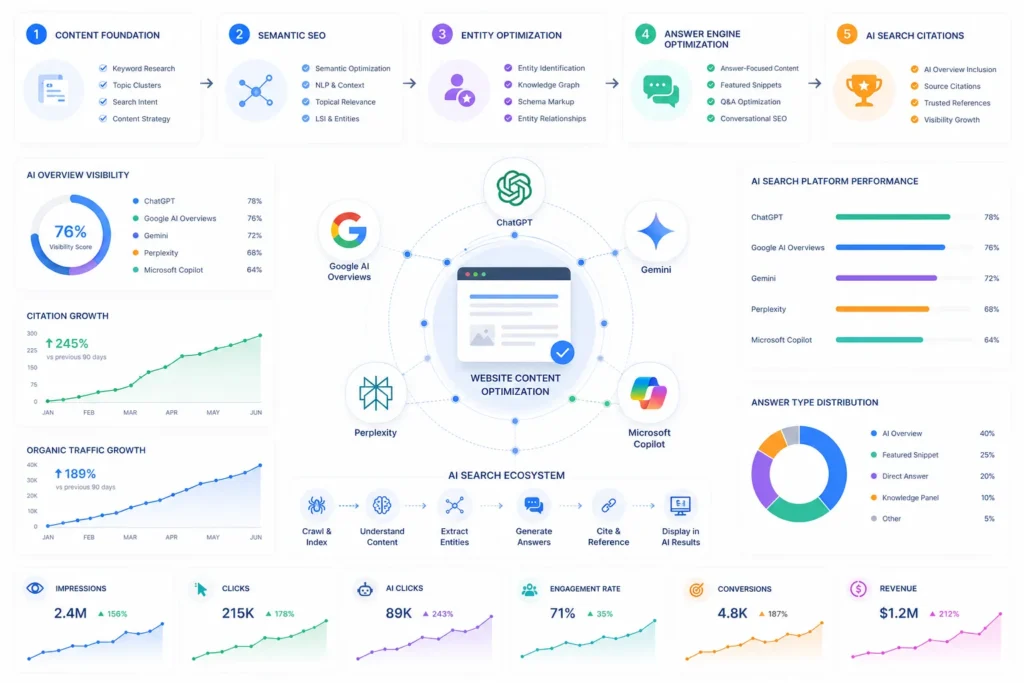
The most successful GEO strategies combine:
- Technical SEO
- Semantic SEO
- Entity Optimization
- EEAT Principles
- Structured Content
- Topic Clusters
- Answer Engine Optimization
- AI-Friendly Information Architecture
Businesses that invest in these areas can improve visibility across Google AI Overviews, ChatGPT Search, Perplexity, Gemini, Copilot, and future AI-powered platforms.
The future of search belongs to brands that are not only discoverable but also trusted enough to become part of the answers themselves.