
For most local businesses, Google Maps has become more important than their website homepage.
When potential customers search for:
- Plumber near me
- Best dentist in Dallas
- HVAC company nearby
- Restaurant near me
- SEO agency in New York
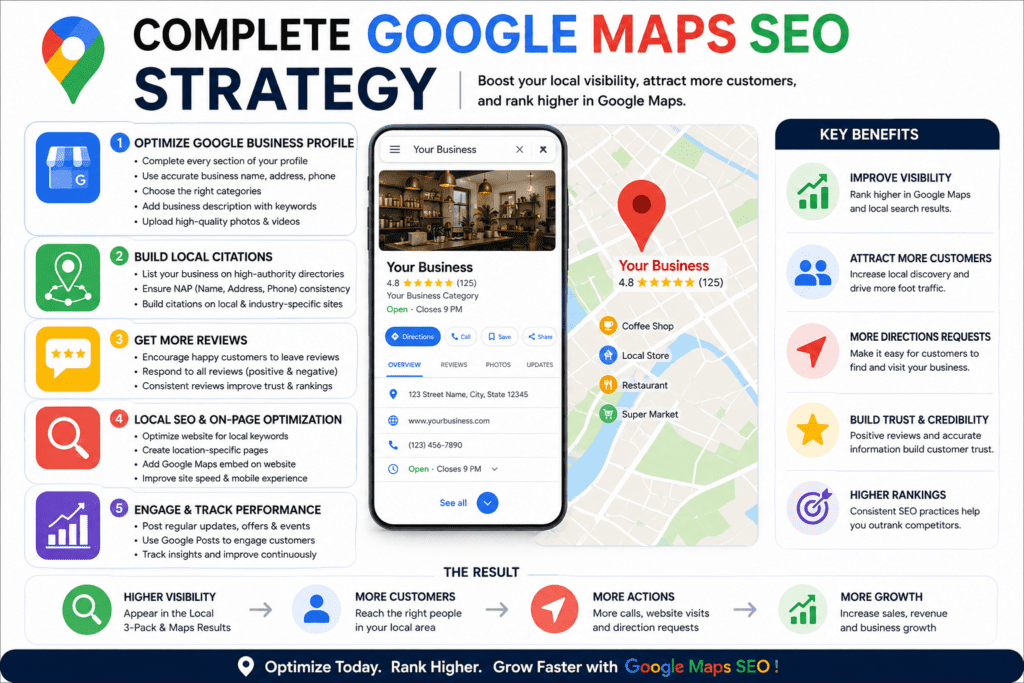
Google often shows Maps results before traditional organic listings. The businesses appearing in Google’s Local Pack and Google Maps receive the majority of calls, direction requests, website visits, and local leads.
This is why Google Maps SEO has become one of the highest-ROI marketing strategies available for local businesses. However, ranking in Google Maps is becoming increasingly competitive.
Google’s local algorithm now evaluates:
- Relevance
- Distance
- Prominence
- Reviews
- Authority
- Behavioral signals
- Entity relationships
- AI-powered local understanding
This Google Maps SEO Checklist provides a complete framework for improving local visibility and dominating Google Maps in 2026.
Why Google Maps SEO Matters More Than Ever
Google Maps is no longer simply a navigation tool. It has become one of the world’s largest local discovery platforms.
Google continues to use three primary factors for local rankings:
- Relevance
- Distance
- Prominence
Modern AI systems now help Google better understand user intent and local business relationships.
For local businesses, Maps visibility directly influences:
- Phone calls
- Appointment bookings
- Walk-in traffic
- Website visits
- Revenue
Businesses that dominate Maps often dominate their local markets.
How Google Maps Rankings Work
Many business owners believe rankings depend only on proximity. That is incorrect.
Google evaluates dozens of signals. The most important include:
Relevance
How closely your business matches a search query.
Distance
How close you are to the searcher.
Prominence
How authoritative and trusted your business appears.
Google publicly emphasizes these three factors, while SEO research shows additional influence from reviews, citations, activity, and website authority.

Google Maps SEO Checklist
Let’s walk through the complete optimization framework.
Step 1: Claim and Verify Your Google Business Profile
This is the foundation of Google Maps SEO. Without a verified profile, your ranking potential is severely limited.
Every business should:
Claim listing
Verify ownership
Secure profile access
Enable notifications
Google Business Profile remains the most important asset in local SEO.

Step 2: Complete Every Section of Your Profile
One of the most common mistakes is leaving profile fields incomplete. Google wants complete business information.
Complete:
- Business name
- Address
- Phone number
- Website URL
- Hours
- Categories
- Services
- Description
- Attributes
Fully completed profiles consistently outperform incomplete listings.
Step 3: Choose the Right Primary Category
Your primary category is one of the strongest ranking signals.
Examples:
- Dentist
- Roofing Contractor
- HVAC Contractor
- Attorney
- SEO Agency
Do not choose categories based on popularity. Choose the category most closely aligned with your core service.
Step 4: Add Secondary Categories Strategically
Most businesses miss this opportunity.
Examples:
Primary Category:
HVAC Contractor
Secondary Categories:
- Air Conditioning Repair Service
- Heating Contractor
- Air Duct Cleaning Service
This expands keyword relevance.
Step 5: Write an Optimized Business Description
Your business description should:
- Explain services
- Mention specialties
- Include service areas
- Highlight experience
Avoid keyword stuffing. Focus on clarity and trust.
Step 6: Optimize Products and Services
Many businesses ignore service optimization.
Add:
- Service descriptions
- Pricing information
- Service categories
- Service photos
Google increasingly uses service information to match search intent.
Step 7: Upload High-Quality Photos
Photos influence both engagement and trust.
Upload:
- Logo
- Exterior photos
- Interior photos
- Team photos
- Service photos
- Before-and-after images
Google favors active profiles with fresh visual content.
Step 8: Add Videos
Videos remain underutilized.
Examples:
- Company introductions
- Customer testimonials
- Service demonstrations
- Project walkthroughs
Video engagement sends positive quality signals.
Step 9: Generate More Reviews
Reviews remain one of the strongest Maps ranking factors.
Google uses reviews to evaluate:
- Trust
- Authority
- Popularity
- Customer satisfaction
Businesses with strong review profiles generally achieve stronger local visibility.
Step 10: Respond to Every Review
This includes:
- Positive reviews
- Neutral reviews
- Negative reviews
Google rewards active profile management. Responding demonstrates business legitimacy and engagement.
Step 11: Build a Review Acquisition System
Do not wait for reviews.
Create processes:
- Email requests
- SMS requests
- QR code cards
- Post-service follow-ups
Consistent review generation creates sustainable growth.
Step 12: Maintain NAP Consistency
NAP stands for:
- Name
- Address
- Phone Number
Consistency across directories helps Google validate business information.
Examples:
- Website
- Yelp
- Apple Maps
- Industry directories
Inconsistencies weaken trust signals.
Step 13: Build Local Citations
Local citations help verify your business.
Examples:
- Chamber of Commerce
- Local directories
- Industry directories
- Local associations
Citation consistency remains a foundational local SEO signal.
Step 14: Optimize Your Website for Local SEO
Your website directly influences Maps rankings.
Key elements:
- Local keywords
- Location pages
- Fast loading speed
- Mobile optimization
- Service pages
Google evaluates website quality alongside profile signals.
Step 15: Create Location Pages
For multi-city businesses:
Examples:
- HVAC Dallas
- HVAC Plano
- HVAC Frisco
Each page should include:
- Unique content
- Local references
- Service information
Avoid duplicate pages.
Step 16: Implement Local Schema Markup
Schema helps Google understand your business.
Recommended schemas:
- LocalBusiness
- Organization
- Service
- Review
- FAQ
Structured data improves machine understanding and local relevance.
Step 17: Publish Google Posts Weekly
Google Posts demonstrate activity.
Post:
- Promotions
- Updates
- News
- Events
- Offers
Active profiles often perform better than inactive profiles.
Step 18: Use Google Q&A Strategically
Many businesses ignore Q&A.
Add common questions:
- Pricing
- Hours
- Service areas
- Booking process
This improves relevance and customer experience.
Step 19: Optimize Service Areas
Service-area businesses should:
- Define service regions
- Add target cities
- Match website location content
Service-area optimization helps Google understand geographic relevance.
Step 20: Earn Local Backlinks
Local backlinks strengthen prominence.
Sources include:
- Local newspapers
- Community organizations
- Sponsorships
- Chambers of Commerce
Backlinks remain powerful authority signals.
Step 21: Improve Behavioral Signals
Behavioral signals are increasingly important.
Examples:
- Click-through rate
- Calls
- Direction requests
- Website visits
- Engagement
Google uses real-world interactions to evaluate business popularity.
Step 22: Fight Google Maps Spam
One competitor gap rarely discussed is spam management.
Common issues:
- Fake listings
- Keyword-stuffed names
- Duplicate listings
Map spam can dramatically affect rankings. Monitoring competitors and reporting spam often creates ranking opportunities.
Step 23: Optimize for AI-Powered Local Search
One of the biggest changes in 2026 is AI-driven discovery.
Users increasingly ask:
- Best dentist near me
- Most trusted roofer in Dallas
- Top HVAC company nearby
AI systems increasingly generate recommendations rather than showing only directories. AI Overviews and conversational search are reshaping local discovery.
Step 24: Build Local Entity Authority
Google increasingly understands businesses as entities.
Strengthen entity signals through:
- Consistent branding
- Local mentions
- Structured data
- Reviews
- Media coverage
Entity SEO is becoming a major Maps ranking factor.
Step 25: Track Performance Monthly
Monitor:
- Maps rankings
- Calls
- Direction requests
- Website clicks
- Review growth
- Profile views
Google Business Profile Insights remains one of the most valuable local SEO measurement tools.
Common Google Maps SEO Mistakes
Avoid:
Fake reviews
Keyword stuffing
Inconsistent NAP
Duplicate listings
Ignoring reviews
Inactive profiles
Missing photos
Poor website optimization
These mistakes often prevent businesses from reaching the Local Pack.
Google Maps SEO Ranking Factors for
Based on industry research, the strongest factors include:
- Google Business Profile Optimization
- Reviews
- Categories
- Website Authority
- NAP Consistency
- Citations
- Local Backlinks
- Behavioral Signals
- Entity Authority
- AI Search Relevance
Google continues emphasizing relevance, distance, and prominence while local SEO research highlights reviews, profile completeness, authority, and engagement as key influences.
Final Thoughts
Google Maps SEO is no longer just about claiming a business listing. It requires a complete local search strategy that combines:
- Google Business Profile optimization
- Reviews
- Citations
- Local SEO
- Website authority
- Entity SEO
- AI search visibility
Businesses that consistently execute this checklist will dramatically improve their chances of ranking in Google’s Local Pack, generating more calls, attracting more customers, and dominating their local markets.
In 2026 and beyond, Google Maps will remain one of the most powerful customer acquisition channels available for local businesses.