
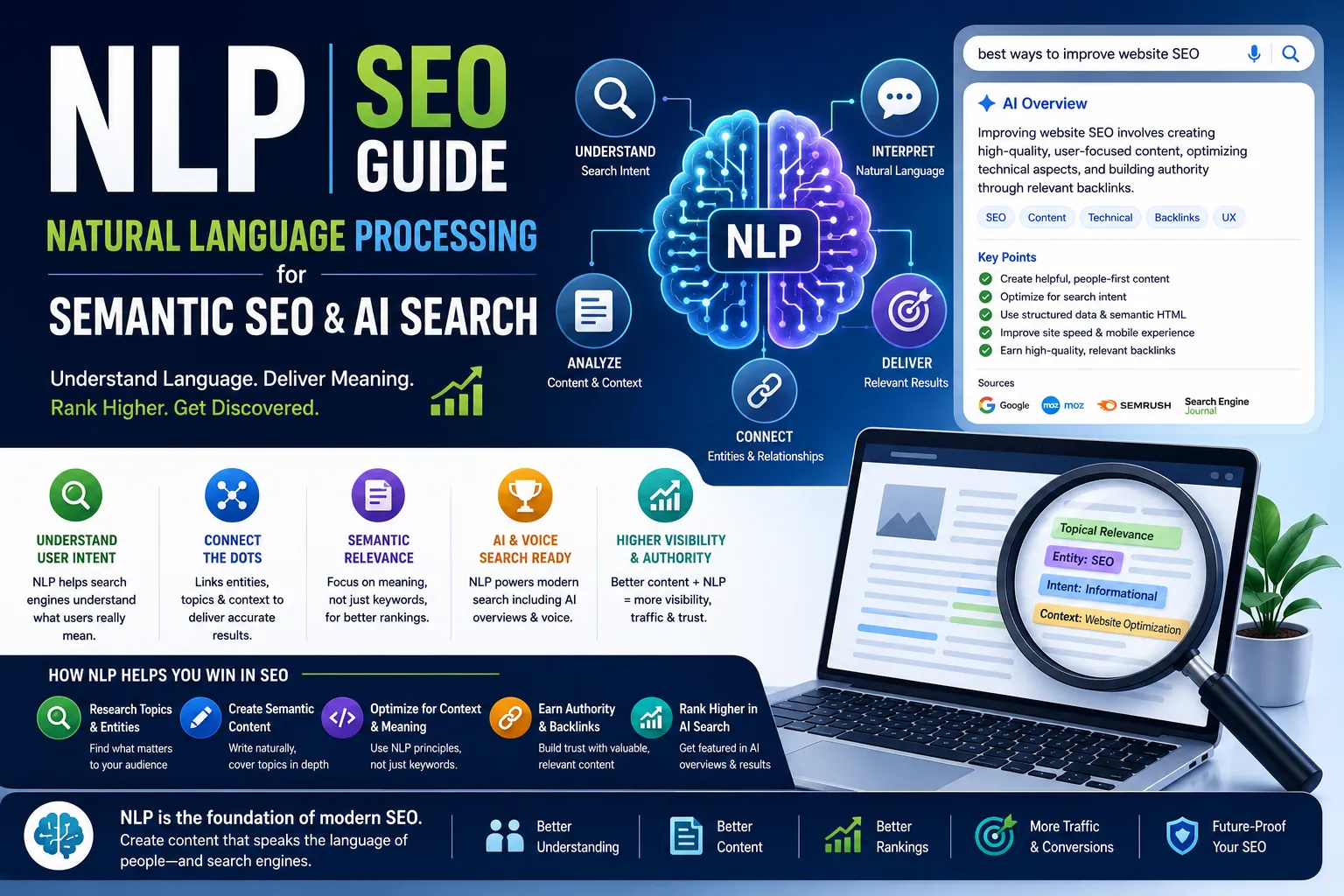
Understand How Search Engines Process Language, Entities, Context, and Search Intent
Search engines no longer depend primarily on exact keyword matching.
Modern search systems attempt to understand what users mean, how concepts relate to one another, which entities are being discussed, and what information is most relevant to the user’s intent.
At the center of this evolution is Natural Language Processing (NLP).
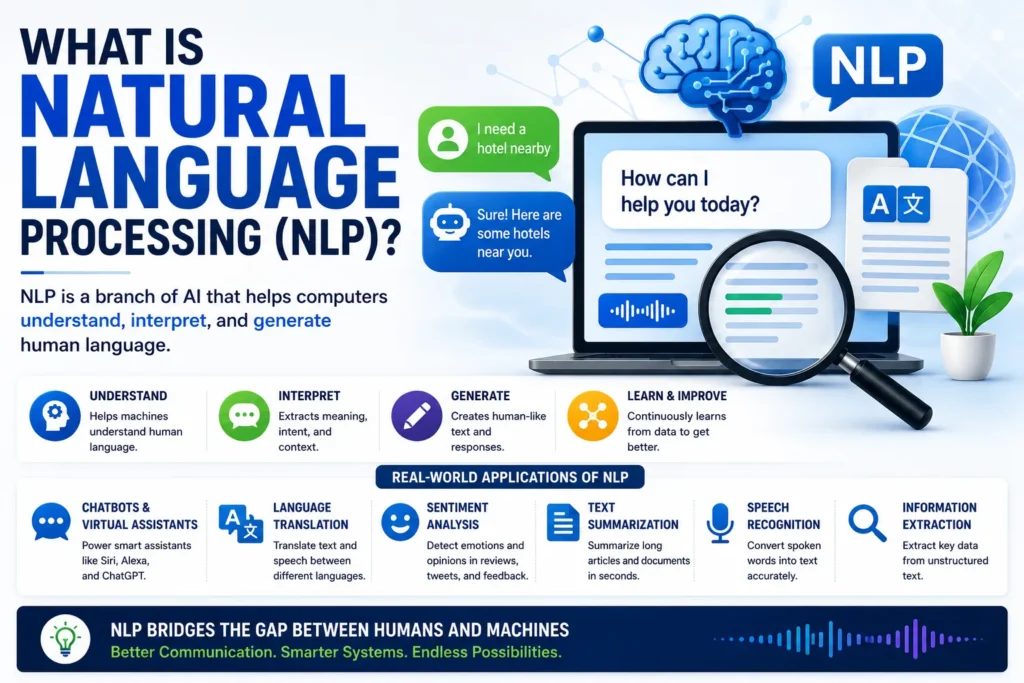
NLP is a field of artificial intelligence and computational linguistics concerned with enabling computers to process, analyze, and generate human language.
For SEO professionals, NLP matters because modern search involves much more than finding pages containing specific words. Search systems must interpret queries, identify entities, resolve ambiguity, understand relationships, and determine which documents best satisfy the user’s needs.
This evolution has contributed to the shift from traditional keyword-focused SEO toward:
- Semantic SEO
- Entity SEO
- Search Intent Optimization
- Knowledge Graph SEO
- Topical Authority
- Answer Engine Optimization (AEO)
- Generative Engine Optimization (GEO)
- AI Search Optimization
Understanding NLP does not mean SEOs need to become machine-learning engineers.
The practical goal is to understand how language, entities, context, and meaning affect search so that content is written for people while remaining clear and interpretable to machines.
This NLP SEO Guide explains those foundations and shows how they connect with modern Google Search and AI-powered discovery.
What Is Natural Language Processing (NLP)?
Natural Language Processing is a branch of artificial intelligence focused on interactions between computers and human language.
Human language is complicated.
The same word can have several meanings. Different words can express similar ideas. A sentence can change meaning depending on context, location, previous conversation, or the entities involved.
Consider the query:
“apple store near me”
The word “apple” could refer to fruit.
But within this query, the surrounding context strongly suggests the user is searching for a retail location associated with the technology company.
Now consider:
“best apple for pie”
The same word appears, but the intended entity and meaning are completely different.
Language-processing systems help machines interpret these differences.
Depending on the task and system, NLP techniques can support:
- Entity recognition
- Language understanding
- Query classification
- Semantic similarity
- Sentiment analysis
- Relationship extraction
- Text classification
- Question answering
- Summarization
- Information extraction
For SEO, the most important lesson is straightforward:
Words cannot always be understood correctly without context.
What Is NLP SEO?
NLP SEO is the application of natural-language and semantic-search principles to search engine optimization.
It focuses on creating content whose:
- Meaning is clear
- Entities are identifiable
- Relationships are logical
- Search intent is satisfied
- Supporting concepts are adequately covered
- Structure is easy to interpret
- Language is natural
NLP SEO is not about inserting a list of “NLP keywords” into an article.
Nor is it about obtaining a perfect score from a third-party content optimization tool.
A better objective is to create content that clearly communicates the subject, context, entities, relationships, and answers users need.
For example, a page about Technical SEO would naturally discuss concepts such as:
- Crawling
- Indexing
- Rendering
- Canonicalization
- XML sitemaps
- Robots.txt
- Internal linking
- Core Web Vitals
- Structured data
- HTTP status codes
These concepts help establish the semantic context of the page.
The objective is not to force every related term into the content.
The objective is to cover the relationships necessary to explain the topic properly.
Why NLP Matters for Modern SEO
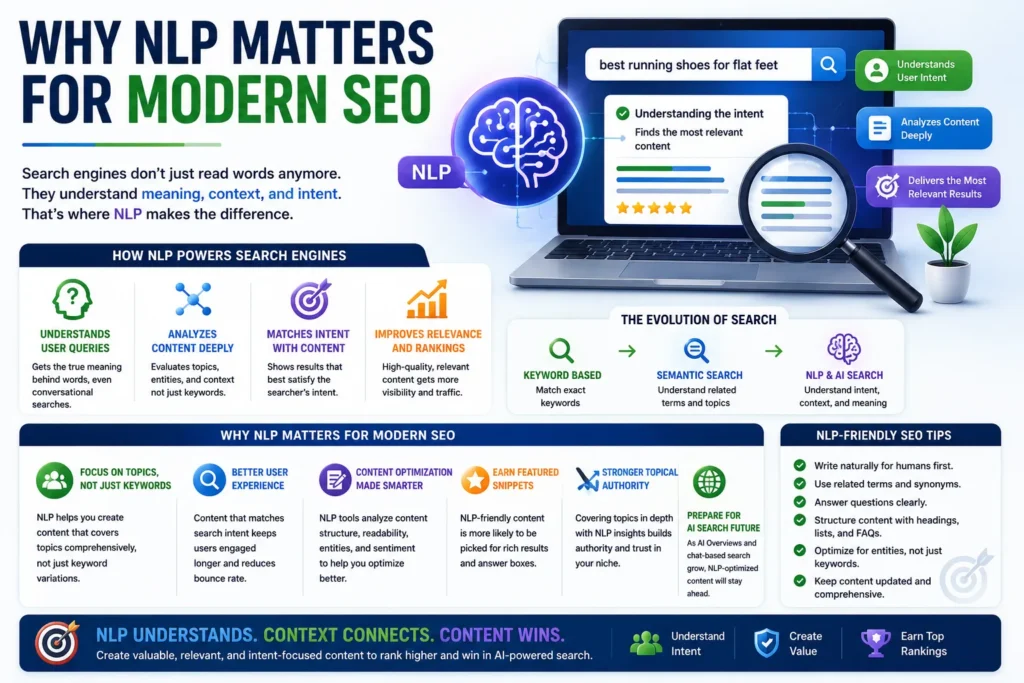
Traditional SEO often treated keywords as the primary unit of optimization.
A page targeting:
“SEO services USA”
might have been optimized by repeatedly inserting that phrase into:
- Title
- H1
- Headings
- Introduction
- Body copy
- Image alt text
- Anchor text
Keyword targeting still matters because queries reveal demand and user language.
However, modern SEO requires considerably more context.
Search engines need to determine:
- What the page is actually about
- Which entities appear
- How those entities relate
- Which questions the content answers
- Which search intent it satisfies
- Whether the information is relevant
- Whether the source appears trustworthy
NLP and related machine-learning techniques help search systems interpret these signals at scale.
This means SEO content should be optimized around meaning, not merely repetition.
How Search Engines Understand Language
Search engines use complex combinations of information retrieval, machine learning, language models, entity systems, link analysis, user context, and other technologies.
It would be misleading to reduce Google’s ranking systems to one NLP algorithm.
However, several language-understanding concepts are particularly useful for SEO.
Query Understanding
Before returning results, a search engine needs to interpret the query.
For example:
“dentist open now near me”
The system can infer:
- Entity/category: Dentist
- Intent: Local service
- Location dependency: High
- Time dependency: High
- Desired action: Find an available provider
Compare that with:
“how long does a root canal take”
This query is primarily informational.
Both queries relate to dentistry, but they require different types of results.
This is why search intent and context are critical.
Document Understanding
Search engines also need to understand webpages.
A page may contain thousands of words, multiple headings, images, links, schema markup, and references to several entities.
The search engine needs to determine:
- Primary topic
- Supporting topics
- Important entities
- Page purpose
- Relationships between sections
- Potential relevance to different queries
Clear content architecture makes this easier for both users and machines.
Semantic Matching
A page does not necessarily need to repeat the exact wording of every query it can answer.
For example, a detailed page about:
“cost of dental implants in Dhaka”
could potentially be relevant to variations such as:
- Dental implant price Dhaka
- Implant tooth cost
- How much is a dental implant in Dhaka?
- Dental implant treatment price
- Cost of replacing missing teeth with implants
The language differs, but the underlying concepts overlap.
Semantic search helps search systems move beyond literal string matching.
NLP SEO vs Traditional Keyword SEO
Traditional keyword optimization and NLP-focused SEO should not be treated as complete opposites.
Keywords remain useful.
The difference lies in how they are used.
| Traditional Keyword SEO | NLP & Semantic SEO |
|---|---|
| Exact keywords | Meaning and context |
| Keyword repetition | Natural language |
| Keyword density | Topic completeness |
| Individual terms | Entities and concepts |
| Exact-match variations | Semantic relationships |
| One query | Query families |
| Isolated pages | Connected topical ecosystems |
Modern optimization should use keyword research to understand demand while using semantic analysis to understand the broader topic.
The goal is not:
Keyword SEO OR NLP SEO
The stronger model is:
Keywords + Search Intent + Entities + Context + Semantic Relationships
NLP SEO vs Semantic SEO
Semantic SEO and NLP are closely related, but they are not identical.
NLP refers broadly to technologies and methods used to process human language.
Semantic SEO is an SEO strategy focused on meaning, context, entities, relationships, and comprehensive topic coverage.
NLP technologies can help search engines interpret semantic information.
Semantic SEO applies that understanding strategically when creating and organizing content.
For example, imagine a website targeting:
Semantic coverage might include:
- Roofing companies
- Local SEO
- Google Business Profile
- Roofing leads
- Service area pages
- Roof replacement
- Local Pack
- Reviews
- Local citations
- Roofing content marketing
These related concepts establish a richer semantic environment around the primary topic.
Entities in NLP and SEO
Entities are fundamental to modern search understanding.
An entity is something that can be distinctly identified.
Examples include:
People
- Business founders
- Authors
- Doctors
- Researchers
- Public figures
Organizations
- Companies
- Universities
- Government agencies
- Nonprofits
Places
- Dhaka
- New York
- California
- Bangladesh
Products
- Smartphones
- Software platforms
- Specific product models
Concepts
- Search Engine Optimization
- Artificial Intelligence
- Semantic Search
Search engines can use entities to distinguish meaning more accurately than keywords alone.
For example:
“Washington”
could refer to:
- Washington state
- Washington, D.C.
- George Washington
- An organization or institution containing Washington in its name
Context helps determine the intended entity.
What Is Named Entity Recognition?
Named Entity Recognition (NER) is an NLP task used to identify and classify entities within text.
A system might analyze:
“Google was founded by Larry Page and Sergey Brin.”
and recognize:
- Google → Organization
- Larry Page → Person
- Sergey Brin → Person
NER becomes valuable because machines can move from processing raw words to understanding identifiable objects.
For SEO, this reinforces the value of clearly identifying:
- Your organization
- Authors
- Services
- Products
- Locations
- Industry concepts
However, SEOs should not write awkward sentences merely to make entities easier for an imagined NER system.
Clear, natural writing is preferable.
Entity Relationships
Recognizing entities is only part of the problem.
Search systems also need to understand relationships.
For example:
→ provides
SEO Services
→ including
Semantic SEO
→ related to
Entity SEO
→ supported by
Knowledge Graph Optimization
→ connected with
AI Search Optimization
This relationship structure provides more meaning than a disconnected list of keywords.
Entity relationships can be reinforced through:
- Contextual content
- Internal links
- Structured data
- Clear site architecture
- Author information
- About pages
- Service pages
- Consistent external profiles
This is one reason Entity SEO, Semantic SEO, Knowledge Graph SEO, and internal linking work so well together.
What Is Entity Salience?
Entity salience generally refers to how prominent or important an entity appears within a piece of content.
This concept became popular in SEO partly because language-analysis tools could assign salience-related values to entities.
However, there is an important distinction:
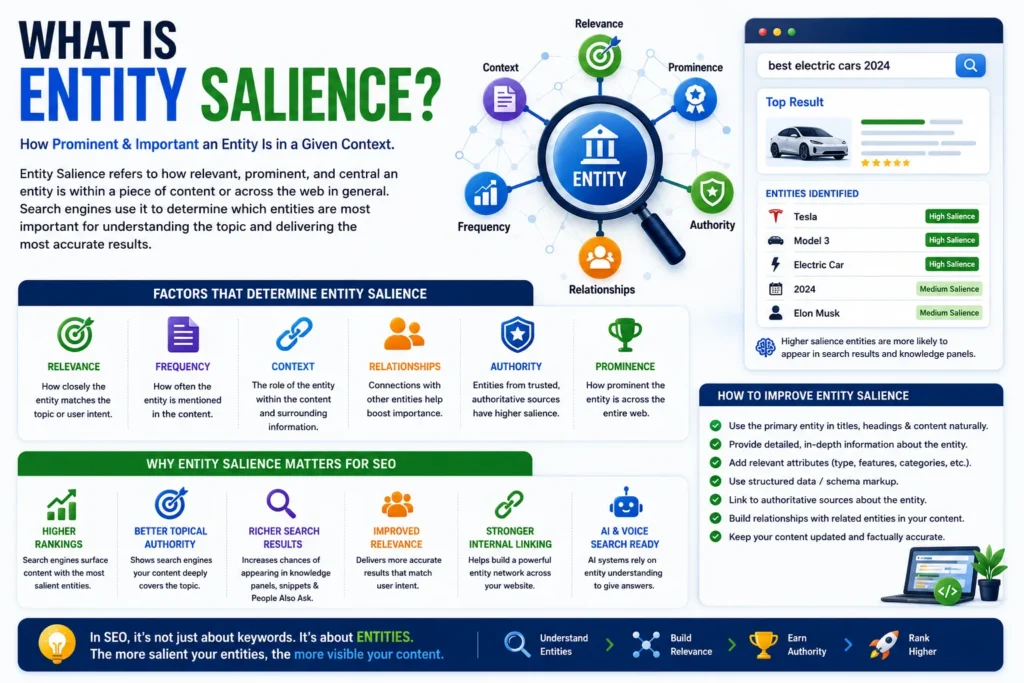
A third-party or NLP API salience score is not a confirmed Google ranking score.
Do not optimize articles simply to increase an arbitrary entity salience number.
Instead, use the underlying principle sensibly.
If a page is about Local SEO, its central concepts should be obvious from the content.
You would expect natural discussion of:
- Local search
- Google Business Profile
- Local Pack
- Reviews
- Citations
- Location pages
- Service areas
- Local intent
If the article spends most of its time discussing unrelated topics, its topical focus becomes weaker for users as well.
The practical objective is clarity and relevance, not salience-score manipulation.
Entity Relationships and Google’s Knowledge Graph
Entity understanding becomes even more powerful when entities are connected within a broader knowledge system.
A Knowledge Graph represents entities and their relationships.
For example:
Company
→ provides
Service
→ serves
Location
→ employs
Person
→ publishes
Article
→ discusses
Topic
This type of structure helps machines understand how information connects.
For SEO, you can reinforce these relationships through:
- Organization Schema
- Person Schema
- Service Schema
- Article Schema
- LocalBusiness Schema
- Internal links
- Author profiles
- Consistent business information
- Topic clusters
Structured data does not automatically create Knowledge Graph authority, but it can make important relationships more explicit.
NLP and Search Intent
Search intent is one of the most important applications of language understanding in SEO.
Users rarely search simply because they want webpages.
They want outcomes.
Consider these queries:
“what is technical SEO”
Intent: Informational
“best technical SEO agencies”
Intent: Commercial investigation
“technical SEO services”
Intent: Commercial/transactional
“Ahrefs login”
Intent: Navigational
The underlying topic may remain similar while the desired result changes dramatically.
This is why one page should not automatically target every keyword containing the same core phrase.
Search intent determines:
- Page type
- Content depth
- CTA
- Format
- Supporting information
- Internal links
NLP and Context
Context determines meaning.
Consider:
“Java”
Without context, this could refer to:
- Programming language
- Indonesian island
- Coffee
Now consider:
“Java dependency injection framework”
The surrounding words clarify the intended meaning.
This principle applies across SEO.
A webpage creates semantic context through its:
- Title
- Headings
- Paragraphs
- Entities
- Internal links
- Images
- Structured data
- Related pages
Strong SEO content creates a coherent context rather than merely repeating the target phrase.
Synonyms, Variations, and Semantic Relationships
Search engines can often recognize that different words and phrases may express closely related ideas.
For example:
SEO agency
may be semantically related to:
- SEO company
- SEO firm
- Search marketing agency
- Search engine optimization company
This does not mean every synonym should be inserted into the page.
Forced synonym usage can make content unnatural.
Instead, write comprehensive content using terminology appropriate to the subject.
Natural variation usually occurs automatically when a knowledgeable writer explains a topic properly.
NLP and Topic Modeling
A topic is broader than a single keyword.
For example:
Technical SEO
contains multiple subtopics:
- Crawling
- Indexing
- Rendering
- Canonicalization
- Redirects
- Sitemaps
- Robots directives
- Site speed
- Structured data
- Website architecture
A comprehensive page may need to address several of these concepts depending on search intent.
Topic modeling and semantic analysis can help identify relationships between these concepts.
For SEO teams, this can improve:
- Content briefs
- Topic clusters
- Keyword clustering
- Content gap analysis
- Internal linking
- Topical maps
The goal is not to cover every remotely related term.
The goal is to cover the concepts necessary to satisfy the topic comprehensively.
NLP and Topical Authority
Topical authority emerges when a website demonstrates substantial expertise across a subject and its important subtopics.
NLP and semantic understanding help explain why isolated keyword pages are often insufficient.
Consider an AI Search SEO ecosystem:
AI Search Optimization
↓
Semantic SEO
↓
Entity SEO
↓
Knowledge Graph SEO
↓
Schema Markup
↓
Topical Authority
↓
Search Intent Optimization
↓
Information Gain SEO
↓
AEO
↓
GEO
Each page addresses a distinct concept while contributing to a broader subject.
Contextual internal linking then reinforces those relationships.
This creates a coherent knowledge ecosystem rather than a collection of disconnected articles.
NLP, Semantic SEO, and Internal Linking
Internal links do more than distribute authority.
They also provide contextual relationships between documents.
For example:
A paragraph discussing how Google identifies businesses can naturally link to an Entity SEO Guide.
A section discussing relationships between entities can link to a Knowledge Graph SEO Guide.
A section explaining machine-readable relationships can link to a Schema Markup Guide.
The surrounding context and anchor text help users and search engines understand why those pages are related.
Avoid using the same exact-match anchor text everywhere.
Use descriptive variations where appropriate.
Examples:
- Learn more about Entity SEO
- Knowledge Graph optimization
- Semantic search strategy
- Structured data implementation
- Search intent optimization
The link should make sense within the sentence.
NLP and AI Search
The importance of language understanding has expanded with generative AI search experiences.
Modern AI systems need to process:
- Conversational questions
- Follow-up questions
- Entities
- Context
- Relationships
- User intent
- Long-form documents
- Multiple sources
A traditional query might be:
“best SEO agency USA”
A conversational AI query could be:
“I’m running a small eCommerce company in the US. What type of SEO agency should I hire if my biggest problems are technical SEO and getting product pages into Google?”
The second query contains substantially more context.
AI systems can use that context to generate a more specific response.
This creates an important shift for SEO.
Businesses should not optimize only for short keyword strings.
They should build comprehensive content ecosystems capable of answering the broader questions users ask throughout their decision journey.
NLP and Google AI Overviews
Google AI Overviews represent another search environment where context and language understanding matter.
Content intended to perform well across modern search should make important information easy to understand.
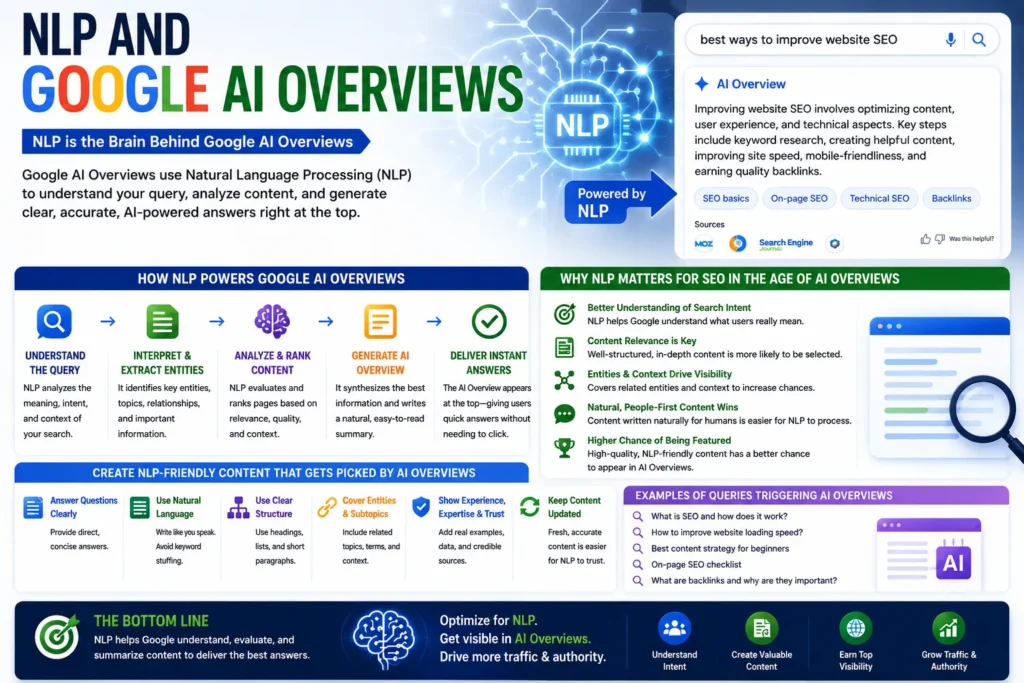
Useful characteristics include:
- Clear answers
- Logical headings
- Accurate terminology
- Strong entity identification
- Supporting evidence
- Direct explanations
- Relevant examples
- Trustworthy sourcing
- Original insights
There is no special “NLP trick” that guarantees inclusion in an AI Overview.
The stronger strategy is to create content that clearly communicates accurate, useful, contextually relevant information.
The Core Principle of NLP SEO
NLP SEO should not become another form of keyword stuffing.
Do not replace:
keyword stuffing
with:
entity stuffing
or:
semantic term stuffing.
The goal is not to mention as many related words as possible.
The goal is to communicate meaning clearly.
Before publishing content, ask:
- Is the primary topic obvious?
- Is search intent satisfied?
- Are important entities clearly identified?
- Are relationships between concepts explained?
- Does the content use natural terminology?
- Are related pages contextually connected?
- Does the page provide enough semantic depth?
- Is unnecessary repetition removed?
Strong NLP-oriented SEO ultimately looks very similar to strong communication.
It is clear, contextual, comprehensive, accurate, entity-aware, and written around the user’s actual need.
That foundation prepares the website for the next stage: applying NLP principles to content optimization, entity mapping, internal linking, structured data, EEAT, Information Gain, AEO, GEO, and AI-powered search.