
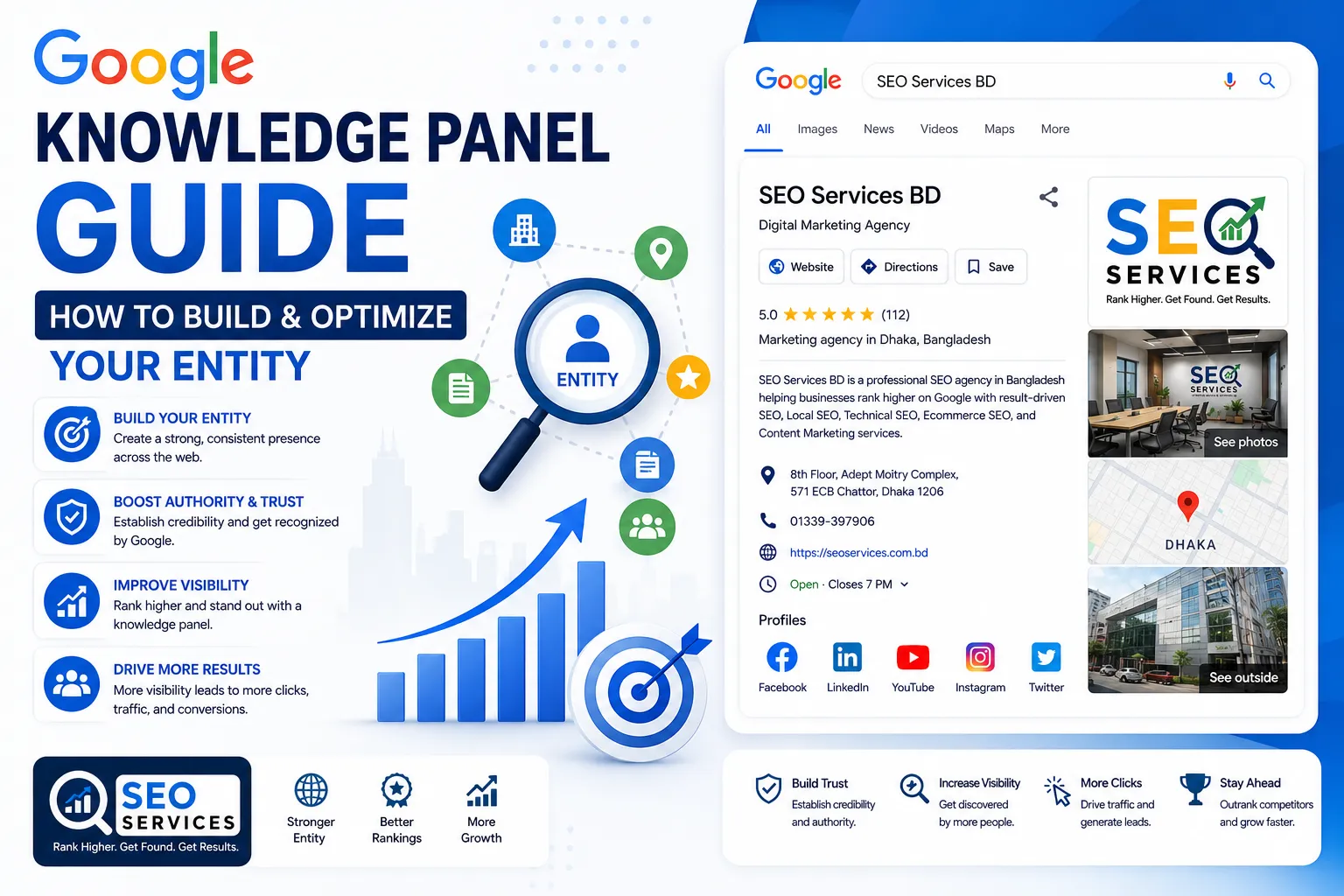
Understanding Google Knowledge Panels, Knowledge Graphs, Entity SEO, and Brand Authority
When someone searches for a well-established person, company, organization, place, or other recognizable entity, Google may display more than a traditional list of blue links.
You may see a dedicated information box containing details such as:
- Entity name
- Logo or image
- Description
- Website
- Social profiles
- Location
- Founders
- People associated with the entity
- Related organizations
- Important dates
- Products or services
- Other factual information
This is commonly known as a Google Knowledge Panel.
Knowledge Panels can significantly influence how users perceive a brand or entity in search. They can reinforce brand recognition, provide important information directly in the SERP, and help users distinguish an established entity from similarly named organizations.
However, getting a Knowledge Panel is not as simple as adding special schema markup or submitting a form.
Google determines Knowledge Panel information using systems designed to understand entities and relationships across the web. Your website, structured data, Google Business Profile, authoritative third-party sources, public databases, mentions, and other signals can all contribute to Google’s understanding of an entity.
This is why Knowledge Panel optimization is closely connected with:
- Entity SEO
- Knowledge Graph SEO
- Semantic SEO
- Structured Data
- E-E-A-T
- Digital PR
- Brand Authority
- Google Business Profile
- AI Search Optimization
The goal should not be to manipulate a Knowledge Panel.
The goal is to make your entity clear, consistent, authoritative, and verifiable across the web.
What Is a Google Knowledge Panel?
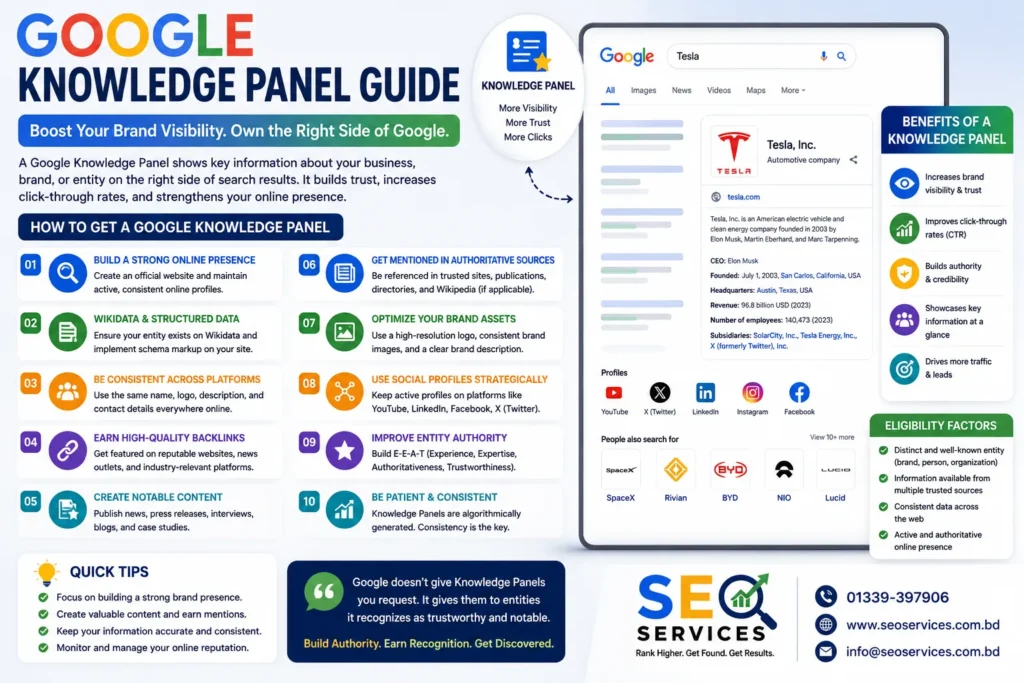
A Google Knowledge Panel is an information display that can appear in Google Search when Google’s systems recognize an entity and have sufficient information to present about it.
An entity can be:
- A person
- Company
- Organization
- Brand
- Place
- Landmark
- Product
- Film
- Musician
- Sports team
- Book
- Concept
- Other identifiable subject
For example, a search for a well-known company may produce a panel containing the company’s:
Name → Logo → Description → Website → Social Profiles → Location → Related Information
The exact information varies depending on the entity.
Knowledge Panels are generated dynamically and can change as Google’s understanding of an entity changes.
This is important because a Knowledge Panel is not simply a webpage embedded inside Google.
It is a search feature generated from information that Google’s systems associate with a particular entity.
How Google Knowledge Panels Work
To understand Knowledge Panels, you first need to understand the concept of an entity.
An entity is a distinct, identifiable person, organization, place, product, or concept.
For example:
can be understood as an organization.
That organization may have relationships with:
- A website
- A founder
- Employees
- SEO services
- Dhaka
- Bangladesh
- Social profiles
- Published articles
- Industry categories
- External mentions
Google can potentially use these relationships to develop a broader understanding of the organization.
Conceptually, an entity system can be represented like this:
Organization ↓SEO Services BD ↓provides ↓SEO Services ↓includes ↓Semantic SEOEntity SEOTechnical SEOAI Search Optimization
The actual systems used by Google are considerably more complex, but this model helps explain why entity relationships matter.
A Knowledge Panel can be one visible result of Google’s broader entity understanding.
Knowledge Panel vs Google Knowledge Graph
These two terms are often confused.
They are related, but they are not the same thing.
Google Knowledge Graph
The Knowledge Graph is Google’s system for organizing information about entities and relationships between them.
It helps Google understand connections such as:
Person → works for → Organization
Organization → located in → City
Company → provides → Service
Person → wrote → Book
The Knowledge Graph is primarily an underlying knowledge system.
Google Knowledge Panel
The Knowledge Panel is a visible search feature that can display information associated with an entity.
In simplified terms:
Knowledge Graph = underlying entity knowledge
Knowledge Panel = visible search presentation
A website can therefore work on its entity clarity and authority without having a guaranteed Knowledge Panel.
Why Knowledge Panels Matter for SEO
Knowledge Panels can provide valuable brand visibility.
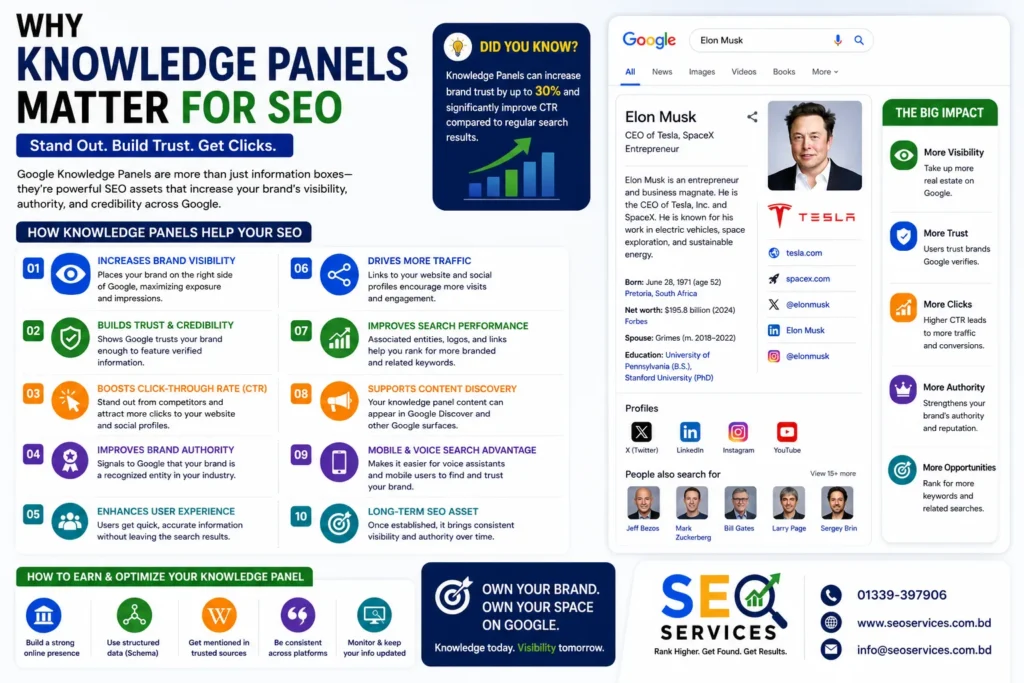
When users search for your organization or personal brand, a Knowledge Panel can place important information directly within the search experience.
Potential benefits include:
Greater Brand Visibility
Your entity can occupy prominent SERP real estate.
Stronger Brand Recognition
Users can immediately see your name, logo, description, and related information.
Better Entity Clarity
A consistent panel can help users distinguish your organization from similarly named entities.
Improved Trust Perception
An established search presence may reinforce credibility, particularly when the displayed information is accurate and supported by authoritative sources.
However, a Knowledge Panel should not be treated as proof that Google considers a company universally authoritative.
Search visibility and business credibility are broader concepts.
Knowledge Panel vs Google Business Profile
Another common misunderstanding is treating a Google Business Profile and Knowledge Panel as the same thing.
They are different Google systems and search features.
Google Business Profile
A Google Business Profile is primarily designed for businesses and organizations that interact with customers at specific locations or service areas.
It can contain:
- Business name
- Address
- Phone
- Opening hours
- Reviews
- Photos
- Services
- Products
- Website
- Directions
It is especially important for Local SEO.
Knowledge Panel
A Knowledge Panel can represent many types of entities, including:
- Companies
- People
- Brands
- Organizations
- Places
- Products
- Other entities
It is primarily about Google’s understanding and presentation of an entity.
A business may have both a Google Business Profile and a Knowledge Panel, but one does not automatically guarantee the other.
Types of Google Knowledge Panels
Knowledge Panels can appear for different types of entities.
Person Knowledge Panels
These may appear for:
- Authors
- Entrepreneurs
- Researchers
- Artists
- Public figures
- Professionals
Information may include:
- Name
- Profession
- Biography
- Education
- Organization
- Social profiles
- Published work
Company Knowledge Panels
Company panels can provide information such as:
- Company name
- Logo
- Website
- Description
- Headquarters
- Founders
- Industry
- Social profiles
The exact information depends on Google’s available sources.
Brand Knowledge Panels
Brands can be represented separately from their parent organizations.
For example:
Parent Company → Brand → Product
Clear entity relationships can help search systems distinguish between these entities.
Local Business Information
Local businesses can appear with rich search information connected to their business entity and Google Business Profile.
This may include:
- Location
- Reviews
- Opening hours
- Phone number
- Website
- Directions
Local search features and Knowledge Panel information can overlap, but they should not be treated as identical systems.
How Google Determines Entities
One of the most important concepts in Knowledge Panel SEO is entity recognition.
Google needs to determine:
What is this thing?
Consider a company website that says:
“ABC Digital is a digital marketing company.”
That alone may not provide enough context.
A stronger entity ecosystem might consistently identify:
- Official company name
- Website
- Organization information
- Founders
- Services
- Location
- Social profiles
- Industry
- Business descriptions
- External references
The information should remain consistent across important sources.
Entity SEO and Knowledge Panels
Entity SEO focuses on helping search engines understand the entities represented by your website and the relationships between those entities.
Instead of optimizing only for:
“SEO agency Bangladesh”
you also establish:
1st Organization → SEO Services BD
2nd Organization → SEO Agency
3rd Organization → Bangladesh
4th Organization → Semantic SEO
5th Organization → AI Search Optimization
6th Organization → Founder
7th Organization → Website
These relationships create a stronger semantic context.
This is why Entity SEO is an important foundation for Knowledge Panel optimization.
What Is Entity Identity?
Entity identity refers to the information that distinguishes one entity from another.
For a business, important identity information may include:
- Official name
- Website
- Logo
- Business location
- Contact information
- Founders
- Social profiles
- Industry
- Services
For an individual, identity may include:
- Full name
- Professional role
- Employer
- Expertise
- Author profiles
- Publications
- Professional profiles
The more consistently this information is represented across authoritative sources, the easier it can be for systems to associate references with the same entity.
Why Entity Consistency Matters
Imagine a company appears online under several different names:
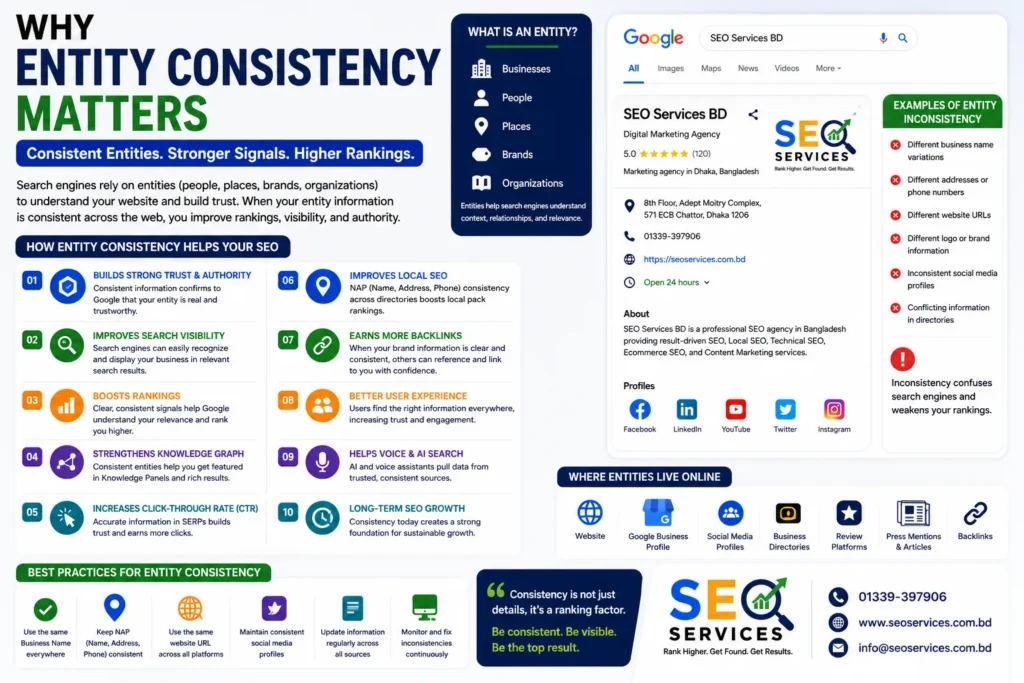
SEO Services BD
Best SEO Services Bangladesh
SEO Services BD Ltd.
SEO Services
If these names refer to the same organization but there is no clear relationship between them, search systems may have more difficulty determining whether they represent one entity or multiple entities.
Consistency is therefore important.
Use a standardized version of your:
- Business name
- Website URL
- Logo
- Address
- Phone
- Social profiles
- Organization description
where appropriate.
Consistency does not mean every platform must use identical wording in every field.
It means important identifying facts should not contradict each other.
Knowledge Graph Relationships
Entities become more meaningful when their relationships are clear.
Consider a professional:
→ works in
SEO
→ specializes in
→ works with
SEO Services BD
→ publishes
SEO Guides
→ covers
Entity SEO
→ related to
These connections help establish context around the person and organization.
The same principle applies to companies.
For example:
SEO Services BD
→ provides
→ supports
→ incorporates
→ strengthens
A connected entity ecosystem is more informative than isolated mentions.
Structured Data and Knowledge Panels
Structured data can help communicate information about entities in a machine-readable format.
Common schema types include:
- Organization
- Person
- LocalBusiness
- Article
- Service
- Product
- BreadcrumbList
For example, Organization Schema can describe:
- Organization name
- URL
- Logo
- Contact information
- Social profiles
The sameAs property can also identify authoritative profiles associated with the same organization.
Conceptually:
Organization ↓Official Website ↓LinkedIn ↓Facebook ↓Other Official Profiles
This can help clarify relationships between an organization and its external profiles.
However, structured data does not guarantee a Knowledge Panel.
Schema communicates information.
Google still determines how it uses that information.
Organization Schema for Entity Optimization
Organization Schema is particularly relevant for businesses and organizations.
Important properties can include:
nameurllogosameAscontactPointaddressdescription
Only provide information that is accurate and supported by the website.
Do not add fake social profiles, misleading relationships, or unsupported claims simply to create a larger entity footprint.
Person Schema and Knowledge Panels
For individuals, Person Schema can provide structured information such as:
- Name
- Job title
- Organization
- URL
- Image
- Social profiles
- Professional information
For authors and experts, this can support broader author-entity clarity.
However, Person Schema does not automatically establish someone as an authoritative public entity.
The underlying identity should exist consistently across relevant sources.
SameAs and Entity Relationships
The sameAs property can identify external URLs that represent the same entity.
For example:
Organization | ├── Official Website ├── LinkedIn ├── Facebook └── YouTube
These relationships should only be declared when the profiles genuinely represent the same organization or person.
Incorrect sameAs implementation can create confusion rather than clarity.
Wikidata and Knowledge Panels
Wiki-data is a collaborative knowledge base containing structured information about entities.
Wikidata can be useful for entity research and knowledge graph analysis.
However, having a Wikidata entry does not guarantee a Google Knowledge Panel.
Likewise, creating a Wikidata entry solely to obtain a Knowledge Panel is not a reliable strategy.
The entity should have legitimate notability and reliable supporting information where applicable.
Wikipedia and Knowledge Panels
Wiki-pedia is another frequently discussed source in Knowledge Panel discussions.
Wikipedia can be influential because it contains structured encyclopedic information about notable entities.
However:
You should never create or manipulate a Wikipedia article simply to obtain a Knowledge Panel.
Wikipedia has its own editorial standards and notability requirements.
A company or person should not assume that purchasing links, creating promotional articles, or adding self-serving content will result in an acceptable Wikipedia presence.
The better strategy is to build genuine authority and earn independent coverage.
Third-Party Sources and Entity Corroboration
Google can encounter information about an entity across many sources.
Potential sources may include:
- Official websites
- News publications
- Industry websites
- Professional organizations
- Business directories
- Government databases
- Social profiles
- Review platforms
- Public databases
The quality and relevance of these sources matter.
Ten low-quality directory listings should not be considered equivalent to one authoritative industry publication.
This is why modern Entity SEO should focus on corroboration and authority, not simply the number of mentions.
Brand Mentions and Entity Authority
Brand mentions can contribute to broader entity recognition when they are legitimate and contextually relevant.
For example, an organization may be mentioned in:
- Industry publications
- Interviews
- News articles
- Expert roundups
- Conferences
- Podcasts
- Professional organizations
A useful mention should clearly identify:
Who → What → Where → Why
For example:
SEO Services BD, a Dhaka-based SEO consultancy, published research on technical SEO and AI search optimization.
This is much more informative than an isolated brand-name mention.
The Entity Optimization Framework
A practical Knowledge Panel strategy can be organized into five stages:
1. Entity Identity
Clearly establish who or what the entity is.
2. Entity Consistency
Maintain accurate information across important platforms.
3. Entity Relationships
Connect the entity to relevant people, organizations, services, products, topics, and locations.
4. Entity Corroboration
Earn legitimate references from trustworthy external sources.
5. Entity Authority
Build genuine expertise, recognition, and reputation over time.
This is a much more sustainable strategy than attempting to trigger a Knowledge Panel through isolated technical tricks.
What You Should Not Do
Avoid tactics such as:
- Fake company profiles
- Fake reviews
- Artificial entity relationships
- Spammy directory submissions
- Fake Wikipedia pages
- Paid editorial claims disguised as independent coverage
- Incorrect
sameAslinks - Fake credentials
- Fabricated media mentions
Knowledge Panel optimization should be based on accurate, verifiable entity information.
Key Takeaways
A Google Knowledge Panel is not simply an SEO widget that can be manually created.
It is the visible result of Google’s broader understanding of an entity.
The strongest foundation is:
Clear Entity Identity
↓
Consistent Information
↓
Structured Data
↓
Entity Relationships
↓
Independent Corroboration
↓
Authority & Reputation
↓
Potential Knowledge Panel Visibility
No individual tactic guarantees a Knowledge Panel.
The goal should be to make your organization, brand, or personal entity easy to identify, understand, distinguish, and verify.
Google Knowledge Panel Guide: How to Build & Optimize Your Entity
How to Build a Strong Entity Foundation
Before focusing on Knowledge Panel visibility, establish a clear entity foundation.
For a business, start with:
- Official business name
- Official website
- Logo
- Business description
- Founding information where applicable
- Contact information
- Physical location or service area
- Core services
- Industry classification
- Official social profiles
- Relevant professional profiles
For an individual expert, establish:
- Full professional name
- Professional title
- Organization
- Areas of expertise
- Author profile
- Published work
- Professional profiles
- Speaking or media appearances
- Relevant credentials
The information should be factual and consistent.
Create a Dedicated About Page
Your About page can play an important role in entity clarification.
A strong About page should explain:
Who are you?
What does the organization do?
Where does it operate?
What expertise does it have?
Who founded or leads it?
What services or products does it provide?
What evidence supports its experience?
For example:
SEO Services BD is an SEO consultancy focused on Technical SEO, Semantic SEO, Entity SEO, Topical Authority, and AI Search Optimization.
The page can then link to:
- Team profiles
- Service pages
- Case studies
- Author pages
- Contact information
- Official social profiles
This creates stronger relationships between your organization’s entities.
Create Author Entity Pages
If your website publishes expert-led content, author pages can help clarify who is responsible for that content.
An author profile can contain:
- Full name
- Professional title
- Biography
- Areas of expertise
- Experience
- Publications
- Relevant credentials
- Social profiles
- Articles
- Professional links
For example:
Munshi Arifuzzaman
SEO Strategist & AI Search Optimization Specialist
Expertise:
- Technical SEO
- Semantic SEO
- Entity SEO
- Knowledge Graph SEO
- Topical Authority
- AEO
- GEO
- AI Search Optimization
Each article written by the author can link back to the author profile.
This creates an entity relationship:
Munshi Arifuzzaman ↓SEO Expertise ↓SEO Services BD ↓Published SEO Content ↓Technical + Semantic + Entity SEO
Optimize Your Google Business Profile
For eligible local businesses, Google Business Profile is an important part of the broader entity ecosystem.
Ensure that your profile has accurate:
- Business name
- Category
- Address
- Phone number
- Website
- Opening hours
- Services
- Business description
- Photos
Maintain consistency between the profile and your official website.
For example:
Business Name → Website → Address → Phone → Services
should not contradict each other across major platforms.
Regularly publish legitimate updates and respond appropriately to customer reviews.
Do not create fake reviews or manipulate ratings.
Build a Consistent Digital Entity Footprint
Your organization should be identifiable across relevant platforms.
Depending on the business, this may include:
- YouTube
- X
- Industry directories
- Professional associations
- Review platforms
- Business databases
Not every business needs profiles on every platform.
Prioritize platforms that are genuinely relevant.
The goal is not profile quantity.
The goal is consistent entity representation.
Use sameAs Correctly
Structured data can connect your official website with authoritative external profiles.
For example:
"sameAs": ["https://www.linkedin.com/company/example/","https://www.facebook.com/example/","https://www.youtube.com/@example"]
Only include URLs that genuinely represent the same organization.
For a person:
"sameAs": ["https://www.linkedin.com/in/example/","https://example.com/author/example/"]
Avoid adding unrelated websites simply because they contain the person’s name.
Build Entity Relationships Across Your Website
Your website should explain relationships between important entities.
For a business:
Organization ↓Founder ↓Services ↓Industries ↓Locations ↓Resources ↓Case Studies
For example:
SEO Services BD
→ provides → Technical SEO Services
provides → Semantic SEO Services
→ provides → Entity SEO
specializes in → AI Search Optimization
→ operates in → Bangladesh
These relationships should appear naturally throughout the site’s content and navigation.
Build Topical Authority Around the Entity
Entity authority is strengthened when a website demonstrates genuine subject expertise.
For an SEO organization, a topical ecosystem could include:
Technical SEO
- Crawl Budget Optimization
- Indexability
- Website Architecture
- Internal Linking
- Schema Markup
Semantic SEO
- Semantic SEO
- NLP SEO
- Entity SEO
- Knowledge Graph SEO
- Information Gain
AI Search
- AEO
- GEO
- AI Search Optimization
- Google AI Overviews
This creates a connected knowledge ecosystem around the organization’s expertise.
Use Content to Reinforce Entity Associations
Every article should have a clear relationship with the website’s primary entity.
For example, an article about Knowledge Graph SEO can naturally reference:
- Entity SEO
- Semantic SEO
- Structured Data
- Knowledge Graphs
- Knowledge Panels
The article can then link to the organization’s relevant services.
This creates a relationship between:
Organization → Expertise → Topic → Service
That is considerably stronger than publishing unrelated articles simply for keyword traffic.
Digital PR and Entity Corroboration
Independent references can strengthen entity recognition.
Potential sources include:
- Industry publications
- News websites
- Podcasts
- Interviews
- Expert roundups
- Conferences
- Webinars
- Professional associations
- Academic publications
The strongest references provide context.
For example:
Munshi Arifuzzaman, an SEO strategist specializing in technical and AI search optimization, discussed entity-based SEO in an industry publication.
This establishes:
Person → Expertise → Topic
Independent corroboration is generally more meaningful than large numbers of low-quality mentions.
Earned Media vs Link Building
Knowledge Panel optimization should not be reduced to backlink acquisition.
A backlink may provide SEO value, but an authoritative mention can also help establish context around an entity.
For example:
Brand mention + description + industry context + authoritative publication
can be more useful for entity understanding than:
Random backlink + exact-match anchor text
Focus on legitimate relationships and useful publicity.
Knowledge Panel Claiming
When a Knowledge Panel is available and eligible for claiming, Google may provide a process for verified representatives to claim it.
The exact process and available options can change.
Typically, verification may involve demonstrating that you represent the entity through an official website or recognized profile.
A claimed panel does not mean you control every piece of information Google displays.
Google still determines much of the information shown.
Correcting Knowledge Panel Information
If a Knowledge Panel contains incorrect information, users or verified representatives may have options to suggest corrections.
Examples include:
- Incorrect description
- Wrong image
- Incorrect social profile
- Incorrect relationship
- Outdated information
- Wrong location
Before requesting a correction, ensure that the correct information is clearly supported by reliable sources.
A correction request is more credible when the official website and authoritative external sources consistently provide the same information.
What If Your Knowledge Panel Has the Wrong Entity?
Entity ambiguity can occur when multiple people, brands, or organizations have similar names.
For example:
ABC DigitalABC Digital Ltd.ABC Digital AgencyABC Digital Software
If these entities operate in the same industry, search systems may have difficulty distinguishing them.
Strengthen differentiation using:
- Unique business descriptions
- Official website
- Location
- Industry
- Founder
- Logo
- Social profiles
- Organization relationships
The objective is to make your entity unmistakable.
Knowledge Panel SEO Audit
A practical entity audit should examine the following areas.
1. Entity Identity
Check:
- Official name
- Website
- Logo
- Description
- Location
- Contact information
2. Website Entity Signals
Check:
- About page
- Organization Schema
- Person Schema
- Author profiles
- Contact page
- SameAs references
3. External Profiles
Check:
- YouTube
- Industry profiles
- Professional organizations
4. Entity Relationships
Check whether the website clearly establishes:
- Founder
- Employees
- Services
- Products
- Locations
- Industries
- Brands
5. Corroboration
Look for legitimate mentions from:
- News
- Industry publications
- Professional websites
- Associations
- Interviews
6. Content Authority
Evaluate:
- Topic coverage
- Original research
- Case studies
- Expert authorship
- Experience
7. Local Entity Signals
For local businesses:
- Google Business Profile
- NAP consistency
- Reviews
- Local citations
- Location pages
Knowledge Panel Optimization Checklist
Use this checklist before considering your entity optimization complete.
Entity
- Official entity name is consistent
- Entity has a clear description
- Official website is established
- Logo is consistent
- Important relationships are documented
Website
- About page exists
- Contact page exists
- Author pages exist where appropriate
- Organization Schema is implemented
- Person Schema is implemented where relevant
sameAsreferences are accurate
Content
- Core expertise is clearly established
- Supporting topics are covered
- Content is internally linked
- Authors are identifiable
- Original information is included
External Presence
- Official social profiles are consistent
- Relevant business profiles are accurate
- Professional profiles are complete
- Legitimate third-party mentions exist
Authority
- Expert contributions exist
- Digital PR opportunities are pursued
- Case studies demonstrate experience
- Industry relationships are established
Common Knowledge Panel SEO Mistakes
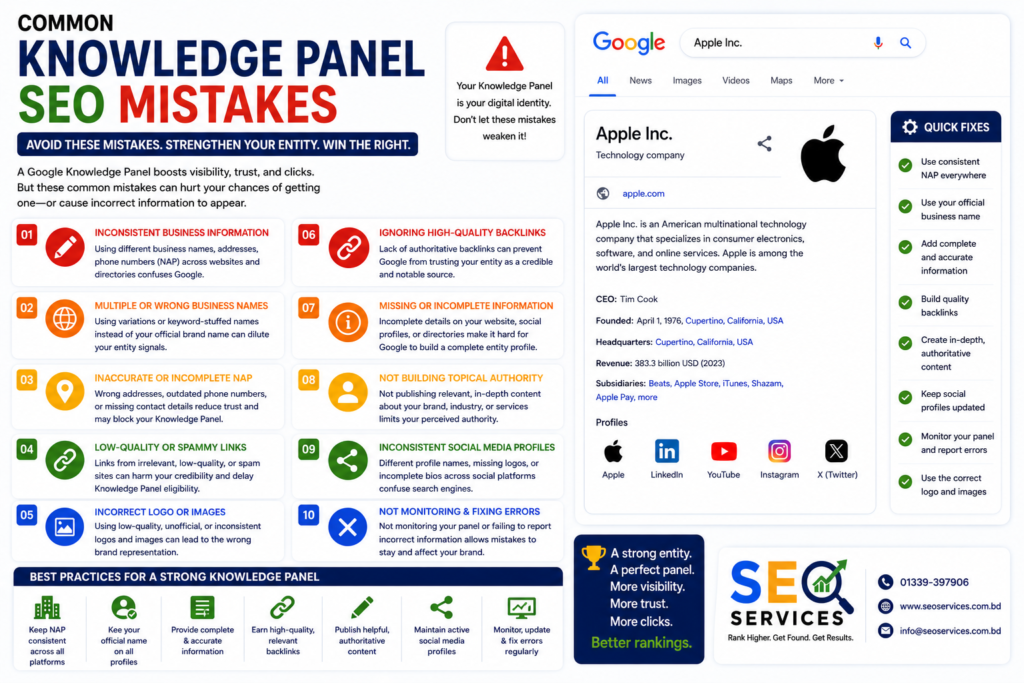
1st Mistake: Expecting Schema to Create a Panel
Schema helps communicate information.
It does not guarantee a Knowledge Panel.
2nd Mistake: Creating Fake Entity Profiles
Creating fake social accounts or directories can create conflicting information.
Build genuine profiles instead.
3rd Mistake: Manipulating Wikipedia
Wikipedia is not an SEO directory.
Do not create promotional pages simply to influence Google.
4th Mistake: Buying Fake Media Coverage
Low-quality paid mentions can create weak or misleading entity signals.
Prioritize legitimate editorial coverage.
5th Mistake: Inconsistent Business Information
Different names, addresses, phone numbers, or descriptions across major platforms can create ambiguity.
6th Mistake: Keyword Stuffing Entity Descriptions
Your company description should explain what the organization actually does.
Do not write unnatural descriptions designed solely around search keywords.
7th Mistake: Creating Too Many Low-Quality Profiles
Ten irrelevant profiles are not necessarily better than three authoritative, accurate profiles.
Knowledge Panel and E-E-A-T
Knowledge Panel optimization and E-E-A-T have an important relationship.
E-E-A-T stands for:
Experience
Expertise
Authoritativeness
Trustworthiness
For example, an expert’s entity profile can be supported by:
- Professional experience
- Published work
- Case studies
- Industry contributions
- Expert commentary
- Relevant credentials
A business can demonstrate authority through:
- Successful projects
- Client results
- Industry recognition
- Expert content
- Independent mentions
- Transparent business information
Entity SEO should therefore be treated as part of a larger trust ecosystem.
Google Knowledge Panels and AI Search
Knowledge Panels are particularly interesting in the era of AI-powered search.
Modern search systems increasingly need to understand:
- Who created the content?
- Which organization operates the website?
- What does the organization specialize in?
- Which services does it provide?
- Which people are associated with it?
- Which entities are related?
- Which sources corroborate those relationships?
This makes entity clarity increasingly important.
A strong entity ecosystem can support broader visibility across:
- Google Search
- AI Overviews
- Conversational search
- Answer engines
- Generative search systems
However, Knowledge Panel optimization should not be presented as a guaranteed shortcut to AI visibility.
It is one component of a broader Entity SEO and AI Search strategy.
Knowledge Panel + AEO
Answer Engine Optimization focuses on making content useful for systems that provide direct answers.
Entity clarity supports AEO because answers often depend on understanding:
Who → What → Where → When → Relationship
For example:
Who is Munshi Arifuzzaman?
A strong entity ecosystem should make it clear:
Munshi Arifuzzaman → SEO Strategist → SEO Services BD → Technical SEO & AI Search Optimization
This gives answer systems more contextual information to work with.
Knowledge Panel + GEO
Generative Engine Optimization focuses on improving the likelihood that a website’s information is accurately represented within generative search experiences.
GEO benefits from:
- Clear entities
- Consistent facts
- Authoritative sources
- Strong topical coverage
- Original information
- Structured content
- Clear relationships
Knowledge Graph optimization therefore complements GEO.
The broader strategy becomes:
Entity SEO → Knowledge Graph → Search Visibility → AI Search Context
Knowledge Panel Case Study Framework
When publishing a case study, avoid claiming:
“We created a Knowledge Panel in 30 days.”
Such claims are difficult to guarantee and may misrepresent Google’s processes.
Instead, document measurable entity improvements.
For example:
Initial Situation
A company had:
- Inconsistent brand naming
- Weak About page
- Missing Organization Schema
- Poor social profile connections
- Limited third-party mentions
Optimization
The SEO team:
- Standardized entity information
- Improved Organization Schema
- Connected official profiles
- Created an expert author page
- Strengthened internal entity relationships
- Built relevant content clusters
- Earned legitimate industry mentions
Result
The company developed a stronger and more consistent digital entity footprint.
If a Knowledge Panel subsequently appeared or improved, document the change as an outcome rather than claiming it was guaranteed by one specific tactic.
How Long Does Knowledge Panel Optimization Take?
There is no fixed timeline.
Entity recognition depends on factors such as:
- Entity type
- Existing authority
- Search demand
- Independent corroboration
- Website quality
- Brand recognition
- Content depth
- Consistency
- Google’s own systems
Some established entities may already have strong recognition.
New or obscure entities may require substantially more time and independent evidence.
Therefore, avoid promises such as:
“Get a Knowledge Panel in 7 days.”
A professional SEO strategy should focus on building durable entity signals instead.
Frequently Asked Questions About Google Knowledge Panels
1. What is a Google Knowledge Panel?
A Google Knowledge Panel is a search feature that displays information about a recognized entity, such as a person, company, organization, place, product, or brand.
2. How do I get a Google Knowledge Panel?
There is no guaranteed submission process for creating a Knowledge Panel. The best approach is to establish a clear, authoritative, and consistently represented entity across your website and relevant independent sources.
3. Does Schema Markup create a Knowledge Panel?
No. Structured data can help communicate entity information, but it does not guarantee that Google will create or display a Knowledge Panel.
4. Does Wikipedia guarantee a Knowledge Panel?
No. Wikipedia may provide useful corroborating information for notable entities, but having a Wikipedia article does not guarantee a Google Knowledge Panel.
5. Does Wikidata create a Knowledge Panel?
No. A Wikidata entry alone does not guarantee a Knowledge Panel.
6. What is the difference between Knowledge Graph and Knowledge Panel?
The Knowledge Graph is Google’s broader system for organizing information about entities and relationships. A Knowledge Panel is a visible search feature that may display information associated with an entity.
7. Can a small business get a Knowledge Panel?
Potentially, but there is no guarantee. Eligibility and visibility depend on Google’s understanding of the entity and available information.
8. Can an individual get a Knowledge Panel?
Potentially. Established public figures and other recognized entities may receive Knowledge Panels when Google’s systems have sufficient information.
9. How does Entity SEO help Knowledge Panels?
Entity SEO improves the clarity of an organization’s, person’s, product’s, or brand’s identity and relationships across the web.
10. Does Google Business Profile create a Knowledge Panel?
No. Google Business Profile and Knowledge Panels are different systems, although local business information can contribute to Google’s understanding of a business.
11. How can I correct a Knowledge Panel?
If correction options are available, verified representatives may be able to suggest changes. Corrections should be supported by accurate information from authoritative sources.
12. Why does Google show the wrong information?
Google may have conflicting, outdated, incomplete, or ambiguous information about an entity. Improving consistency and corroboration can help clarify the correct information.
13. Does a Knowledge Panel improve rankings?
A Knowledge Panel itself should not be treated as a direct ranking factor. It is primarily a search visibility and entity-information feature.
14. Does a Knowledge Panel help AI Search?
A clear entity presence can support broader search understanding, but a Knowledge Panel alone does not guarantee visibility in AI-generated search results.
15. What is the most important Knowledge Panel SEO strategy?
Build a genuine entity ecosystem with consistent information, clear relationships, authoritative content, structured data, and legitimate independent corroboration.
Final Knowledge Panel SEO Framework
A sustainable strategy can be summarized as:
ENTITY IDENTITY ↓CONSISTENT INFORMATION ↓STRUCTURED DATA ↓ENTITY RELATIONSHIPS ↓TOPICAL AUTHORITY ↓INDEPENDENT CORROBORATION ↓E-E-A-T ↓ENTITY AUTHORITY ↓KNOWLEDGE GRAPH UNDERSTANDING ↓POTENTIAL KNOWLEDGE PANEL VISIBILITY
The key word is potential.
No ethical SEO strategy can guarantee that Google will create a Knowledge Panel for a particular entity.
Conclusion
Google Knowledge Panel optimization is fundamentally an entity optimization problem, not a keyword optimization trick.
The strongest approach is to make your entity:
- Clearly identifiable
- Consistently represented
- Properly connected to relevant entities
- Supported by authoritative sources
- Demonstrated through genuine expertise
- Structured with accurate Schema Markup
- Supported by high-quality content
- Reinforced through legitimate external references
For businesses and professionals, the goal should be bigger than simply obtaining a Knowledge Panel.
The real objective is to establish a strong digital entity footprint that helps Google and modern AI-powered search systems understand who you are, what you do, what you are known for, and how you relate to other entities.