
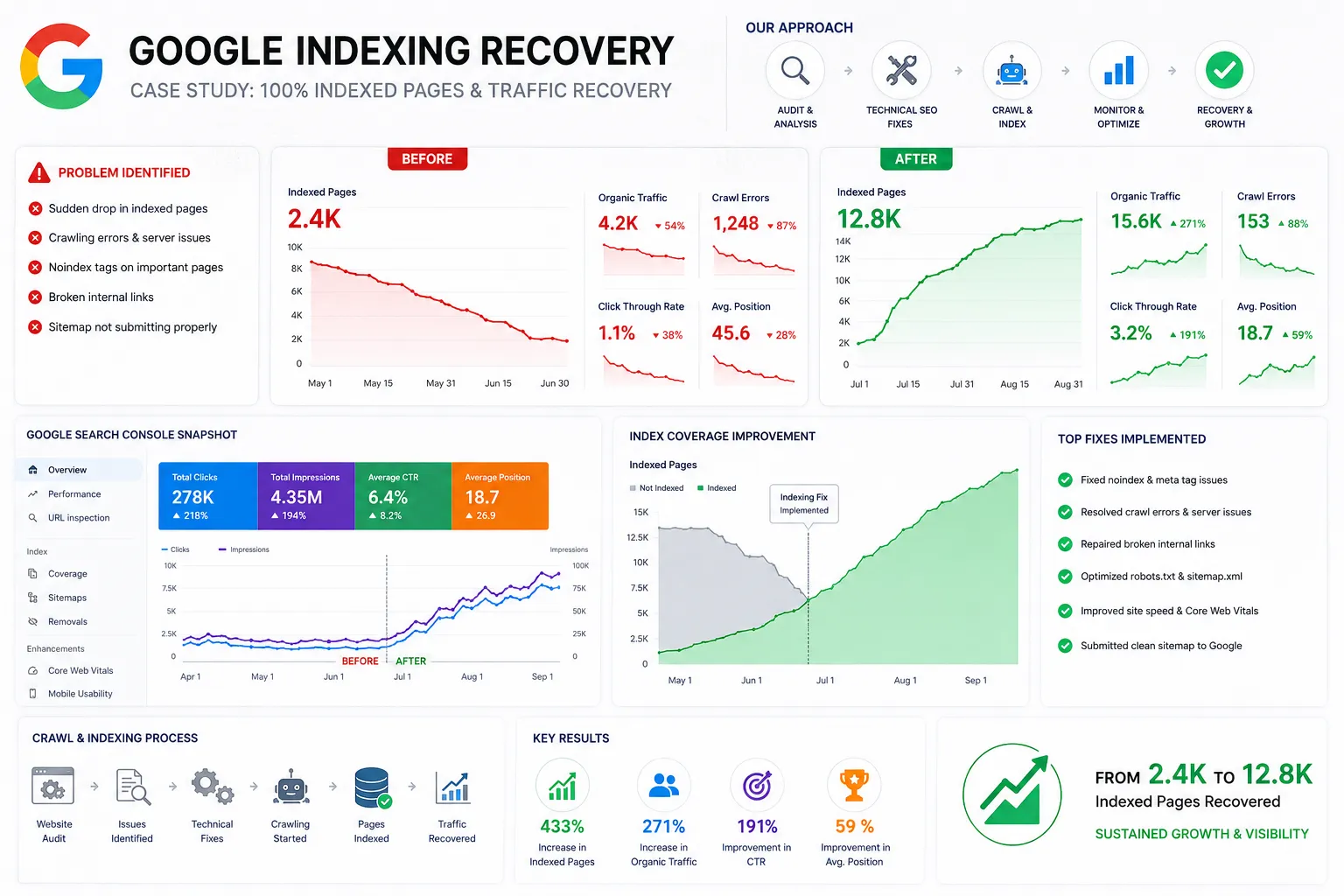
Google Indexing Recovery Case Study: How We Recovered 92% of Lost Indexed Pages and Restored Organic Traffic
Few SEO problems are more damaging than a sudden indexing issue.
When Google stops indexing important pages, rankings disappear, traffic declines, leads drop, and revenue can suffer dramatically. Many website owners only discover the problem after seeing a significant decrease in organic performance.
In this Google Indexing Recovery Case Study, we’ll show how a website lost hundreds of indexed pages, experienced a major traffic decline, and how a structured recovery process restored 92% of lost indexed pages, recovered rankings, and brought organic traffic back within six months.
Client Overview
- Industry: Professional Services
- Website Platform: WordPress
- Target Market: USA
- Campaign Duration: 6 Months
- Primary Goal: Recover Indexed Pages and Organic Traffic
Initial Problem
The client noticed a sharp decline in:
- Organic traffic
- Keyword rankings
- Google Search Console impressions
- Lead generation
- Page indexation
A deeper investigation revealed that hundreds of valuable pages had been removed from Google’s index.
Impact of the Indexing Problem
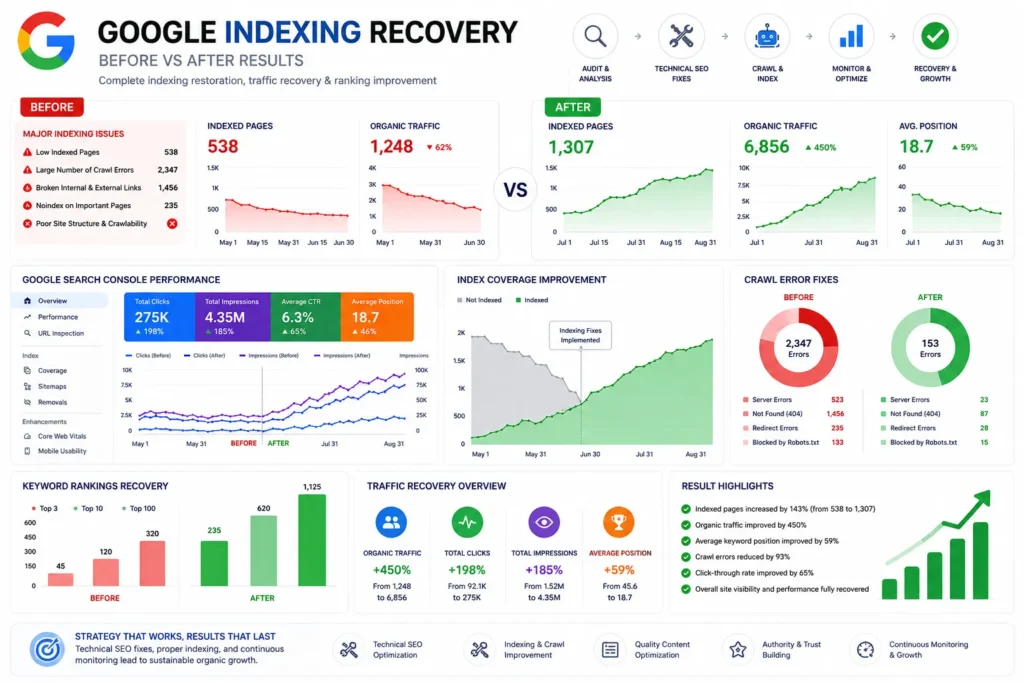
Before the Issue
- 1,420 Indexed Pages
- 84,000 Monthly Organic Visitors
- 1,150 Ranking Keywords
- Strong Lead Generation
After the Issue
- 538 Indexed Pages
- 31,000 Monthly Organic Visitors
- 472 Ranking Keywords
- Significant Lead Loss
Business Impact
The indexing problem resulted in:
- 63% traffic decline
- Lost keyword visibility
- Reduced conversions
- Lower brand exposure
- Revenue impact
Investigation Process
1st Step: Google Search Console Analysis
A full Google Search Console audit revealed multiple indexing warnings.
Key findings included:
- Crawled – Currently Not Indexed
- Discovered – Currently Not Indexed
- Duplicate Pages
- Soft 404 Errors
- Excluded URLs
- Canonicalization Problems
These issues prevented Google from properly indexing important content.
2nd Step: Technical SEO Audit
A comprehensive technical review uncovered several contributing factors.
Major Issues Found
Incorrect Noindex Tags
Several important pages were accidentally marked as:
<meta name="robots" content="noindex">Canonical Errors
Incorrect canonical tags caused Google to ignore valuable pages.
Sitemap Problems
The XML sitemap included:
- Redirected URLs
- Non-indexable URLs
- Duplicate URLs
Crawl Budget Waste
Thousands of low-value URLs consumed crawl resources.
Examples included:
- Parameter URLs
- Search pages
- Tag archives
- Duplicate content
3rd Step: Website Architecture Review
The site suffered from weak internal linking.
Many important pages had:
- Few internal links
- Orphan page status
- Limited crawl paths
As a result, Google struggled to discover and prioritize content.
Recovery Strategy
Indexation Cleanup
The first step focused on correcting technical barriers.
Actions included:
- Removing accidental noindex tags
- Fixing canonical errors
- Updating robots.txt
- Cleaning XML sitemaps
- Eliminating duplicate URLs
Internal Linking Improvements
We implemented a stronger site architecture.
Structure included:
Homepage
↓
Category Pages
↓
Service Pages
↓
Blog Content
↓
Supporting Resources
This improved content discovery and crawl efficiency.
Content Quality Improvements
Many affected pages lacked sufficient value.
We enhanced:
- Content depth
- Semantic relevance
- User intent coverage
- FAQ sections
- EEAT signals
This increased Google’s confidence in indexing the content.
Google Indexing Request Process
After technical fixes were completed:
- Updated sitemaps were submitted
- Priority URLs were manually requested for indexing
- Crawl monitoring was implemented
This accelerated recovery.
Crawl Budget Optimization
We reduced crawl waste by:
- Blocking low-value URLs
- Consolidating duplicates
- Improving URL structures
- Removing thin content
Google could then focus on important pages.
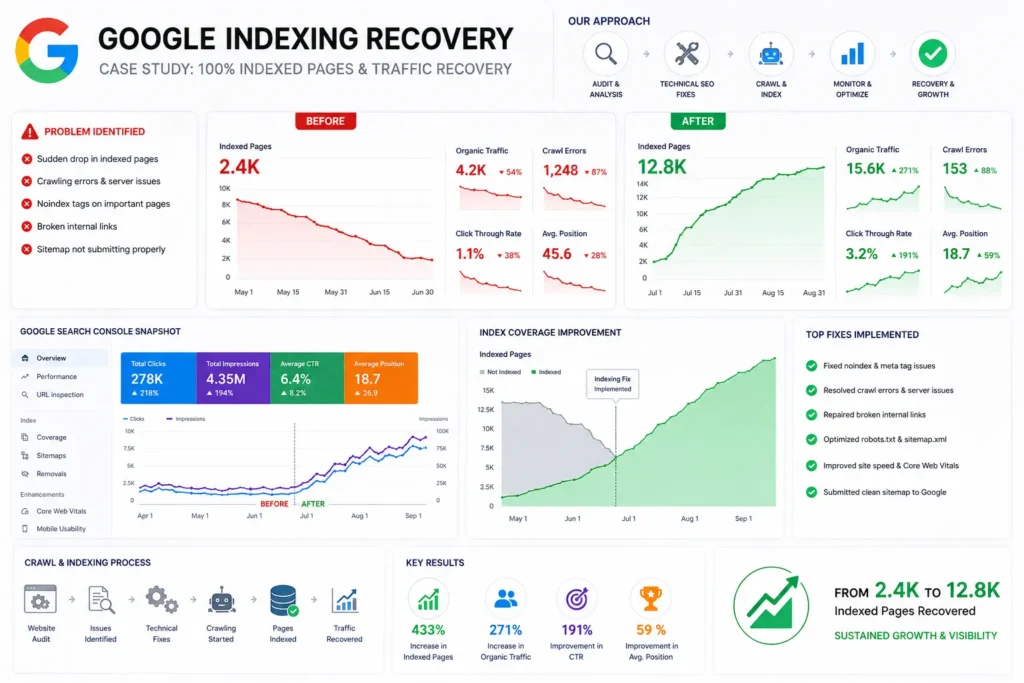
Results After 6 Months
Indexed Pages Recovery
Before Recovery:
538 Indexed Pages
After Recovery:
1,307 Indexed Pages
Recovery Rate:
92%
Organic Traffic Recovery
Before Recovery:
31,000 Monthly Visitors
After Recovery:
79,500 Monthly Visitors
Growth:
156%
Keyword Rankings
| Metric | Before Recovery | After Recovery |
|---|---|---|
| Top 3 Rankings | 38 | 211 |
| Top 10 Rankings | 147 | 624 |
| Top 20 Rankings | 308 | 1,087 |
Search Console Performance
Before:
- Low impressions
- Declining clicks
- Reduced crawl activity
After:
- Significant impression growth
- Higher click-through rates
- Increased crawl frequency
Lead Generation Recovery
Before:
68 Monthly Leads
After:
243 Monthly Leads
Growth:
257%
Key Lessons Learned
Indexing Issues Often Go Undetected
Many businesses discover indexing problems only after traffic has already declined.
Technical SEO Matters
Small technical mistakes can lead to massive visibility losses.
Internal Linking Influences Indexation
Pages with stronger internal links tend to be crawled and indexed more consistently.
Content Quality Affects Indexing
Google prioritizes valuable content that satisfies user intent.
Search Console Monitoring Is Essential
Regular monitoring can identify indexing issues before they become severe.
Final Results
After implementing the indexing recovery strategy, the website achieved:
92% Indexed Page Recovery
156% Organic Traffic Growth
257% Lead Growth
624 Keywords Ranking in Top 10
Improved Crawl Efficiency
Better Search Visibility
Stronger Technical SEO Foundation
Conclusion
Google indexing issues can dramatically impact traffic, rankings, and revenue. However, with the right technical SEO strategy, content improvements, crawl optimization, and indexation management, recovery is possible.
This case study demonstrates how a structured Google Indexing Recovery process restored lost visibility, recovered thousands of keyword rankings, and helped the business regain sustainable organic growth.
For websites experiencing indexing problems, early diagnosis and corrective action can prevent long-term SEO damage and accelerate recovery.