
The healthcare industry has changed dramatically.
A decade ago, patients relied heavily on referrals, insurance directories, hospital recommendations, and word-of-mouth when choosing healthcare providers.

Today, the patient journey starts online.
Whether someone needs a primary care physician, dentist, dermatologist, orthopedic surgeon, mental health provider, urgent care center, or specialty clinic, their first action is usually a search engine query.
Patients search:
- Best cardiologist near me
- Dentist accepting new patients
- Pediatric clinic in Dallas
- Orthopedic surgeon reviews
- Dermatologist appointment near me
If your healthcare organization doesn’t appear when patients search, your competitors are capturing those appointments.
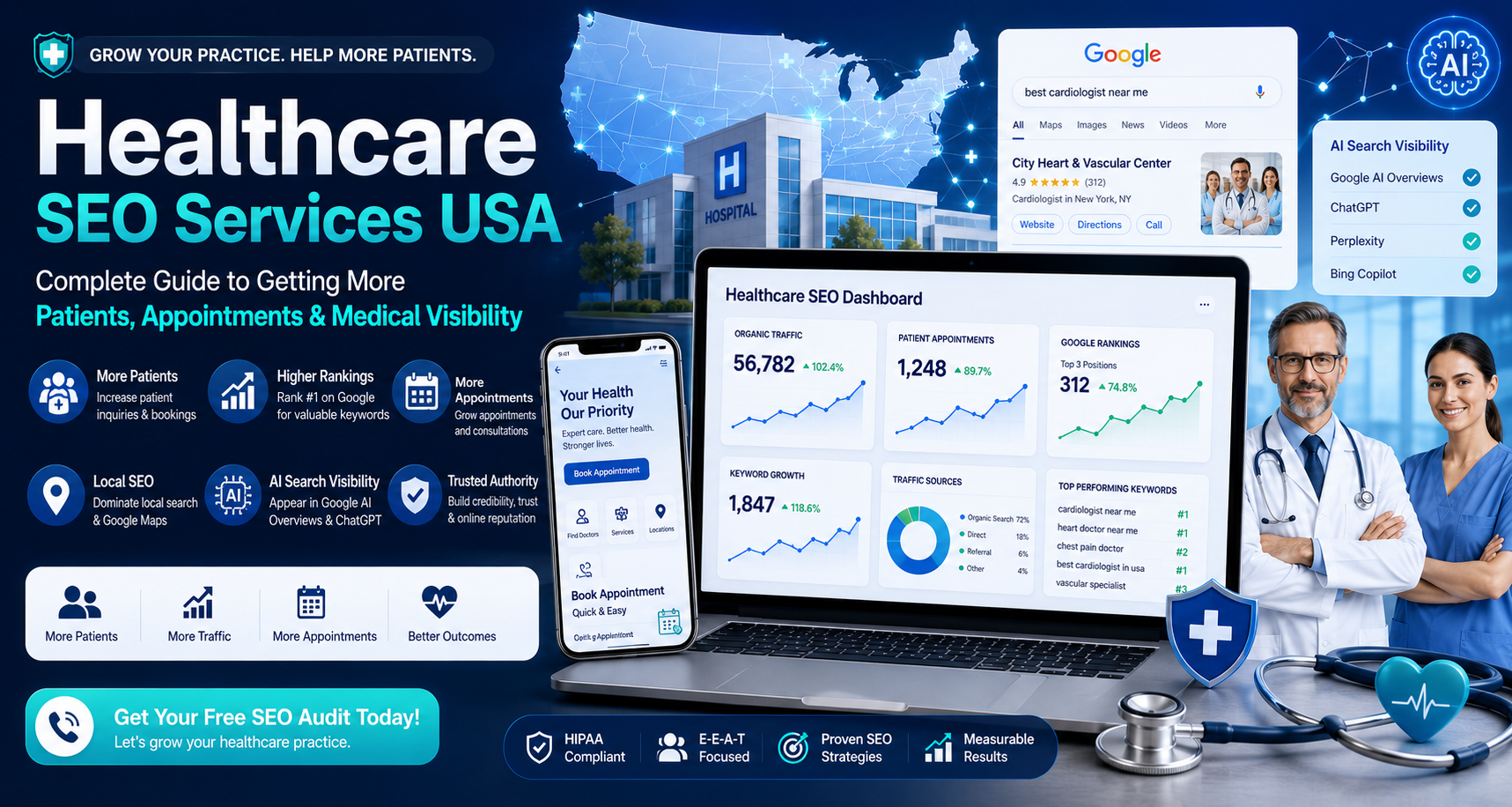
This is why Healthcare SEO Services have become one of the most important growth channels for hospitals, medical practices, healthcare systems, clinics, and healthcare brands throughout the United States.
Unlike paid advertising, SEO helps healthcare organizations generate patient inquiries, appointment requests, and brand visibility long after content is published.
In this guide, you’ll learn how healthcare SEO works, why it differs from traditional SEO, and how medical organizations can build a sustainable patient acquisition system through search.
Why Healthcare SEO Is More Important Than Ever
Healthcare is one of the most search-driven industries in the world.
Before booking an appointment, patients typically:
- Search symptoms
- Research treatments
- Compare providers
- Read reviews
- Verify credentials
- Check insurance acceptance
- Evaluate hospital reputation
Search engines have become the first touchpoint in the healthcare decision-making process.
Patients no longer simply choose the nearest provider.
They choose the provider they trust.
Healthcare SEO helps medical organizations become visible during every stage of the patient journey.
The benefits include:
- More patient appointments
- Increased brand trust
- Lower acquisition costs
- Stronger local visibility
- Long-term traffic growth
- Improved healthcare authority
For many healthcare organizations, SEO becomes one of the highest ROI marketing channels because rankings continue generating patient inquiries month after month.
Understanding the Modern Patient Journey
One of the biggest mistakes healthcare marketers make is focusing only on appointment-related keywords.
Patients move through multiple research stages before making healthcare decisions.
Stage 1: Symptom Research
Patients begin with informational searches.
Examples:
- Causes of knee pain
- Signs of diabetes
- Why do migraines occur
- Symptoms of sleep apnea
Stage 2: Treatment Research
Now, patients evaluate solutions.
Examples:
- Knee replacement options
- Diabetes treatment programs
- Migraine specialists
- Sleep apnea treatment centers
Stage 3: Provider Research
Patients compare providers.
Examples:
- Best orthopedic surgeon near me
- Top neurologist in Chicago
- Diabetes specialist Dallas
Stage 4: Appointment Intent
Patients are ready to schedule.
Examples:
- Book a dermatologist appointment
- Urgent care is open now
- Dentist accepting new patients
A successful healthcare SEO strategy creates content and visibility across every stage of this journey.
What Makes Healthcare SEO Different?
Healthcare SEO is fundamentally different from traditional SEO because healthcare websites fall under Google’s YMYL (Your Money or Your Life) category.
Google applies higher standards to medical content because inaccurate information can directly impact a person’s health and well-being.
Healthcare organizations must demonstrate:
Experience
Real-world medical experience.
Expertise
Qualified healthcare professionals.
Authoritativeness
Recognition from trusted healthcare sources.
Trustworthiness
Accurate, transparent, medically reviewed content.
This E-E-A-T framework has become one of the most important ranking factors for healthcare websites.
Core Healthcare SEO Services
Healthcare SEO Audits
A healthcare SEO audit evaluates:
- Technical SEO issues
- Patient acquisition opportunities
- Content gaps
- Provider visibility
- Local SEO performance
- AI search visibility
The audit creates the roadmap for long-term growth.
Medical Keyword Research
Healthcare keyword research goes beyond search volume.
It identifies:
- Patient intent
- Treatment searches
- Condition searches
- Provider searches
- Local healthcare searches
A successful campaign targets patients at every stage of their healthcare journey.
Technical Healthcare SEO
Healthcare websites often become complex.
Technical optimization includes:
- Site speed improvements
- Mobile usability
- Indexing optimization
- Crawlability improvements
- HTTPS security
- Structured data implementation
Technical SEO creates the foundation for higher rankings.
Local SEO for Healthcare Organizations
Local SEO is often the most valuable component of healthcare SEO.
Most patients search for nearby providers.
Examples include:
- Dentist near me
- Family physician Dallas
- Urgent care Chicago
- Pediatric clinic Houston
Local SEO helps healthcare providers appear in:
- Google Maps
- Local Pack listings
- Mobile searches
- Voice search results
Strong local visibility directly influences appointment volume.
Google Business Profile Optimization
Your Google Business Profile is often the first interaction a patient has with your organization.
Optimization includes:
- Accurate NAP information
- Provider categories
- Photos
- Services
- Appointment links
- Patient reviews
An optimized profile can significantly increase calls, appointments, and website visits.
Healthcare Content Marketing
Healthcare content serves two purposes:
- Educate patients
- Build search visibility
High-performing healthcare content includes:
Condition Pages
Explain symptoms, causes, and treatment options.
Treatment Pages
Describe procedures and services.
Provider Pages
Highlight physician expertise.
Patient Resources
Answer frequently asked healthcare questions.
Medical Guides
Build topical authority and trust.
Healthcare content should always prioritize accuracy and medical review.
Provider Profile SEO
Most healthcare websites overlook provider pages.
This is a major mistake.
Provider profiles should include:
- Credentials
- Certifications
- Experience
- Specialties
- Publications
- Professional affiliations
Optimized provider pages strengthen both E-E-A-T and patient trust.
Healthcare Entity SEO & Knowledge Graph Optimization
Modern search engines increasingly understand healthcare organizations as entities rather than keywords.
Entities include:
- Hospitals
- Clinics
- Physicians
- Medical specialties
- Healthcare systems
Entity SEO helps search engines understand relationships between providers, services, locations, and specialties.
This improves visibility across:
- Google Search
- Google Knowledge Panels
- AI Search Engines
- Voice Search
Medical Schema Markup Strategy
Schema markup helps search engines better understand healthcare content.
Healthcare organizations should implement:
- Physician Schema
- Medical Clinic Schema
- Hospital Schema
- FAQ Schema
- Review Schema
- Organization Schema
Structured data improves visibility and eligibility for rich search features.
Multi-Location Healthcare SEO
Healthcare systems often operate multiple locations.
Each location should have:
- Unique location pages
- Individual provider listings
- Location-specific content
- Local reviews
- Local schema markup
This helps healthcare organizations rank in multiple markets simultaneously.
Healthcare Reputation SEO
Online reputation strongly influences patient decisions.
Healthcare organizations should actively manage:
- Google Reviews
- Healthgrades profiles
- Vitals profiles
- RateMDs profiles
- Yelp reviews
Strong reviews improve both rankings and conversions.
How Healthcare Organizations Can Rank in AI Search
AI-powered search is changing healthcare discovery.
Patients increasingly ask:
- Best cardiologist near me
- Most trusted dermatologist in Houston
- Top orthopedic clinic in Dallas
AI platforms generate recommendations directly.
To improve AI visibility:
- Build strong entity signals
- Publish expert medical content
- Earn healthcare citations
- Strengthen E-E-A-T
- Implement schema markup
- Develop topical authority
Healthcare organizations that optimize for AI search today will gain a significant competitive advantage.
Common Healthcare SEO Mistakes
Many healthcare organizations struggle because they:
- Ignore E-E-A-T
- Publish unreviewed content
- Have weak provider pages
- Neglect local SEO
- Fail to collect reviews
- Ignore structured data
- Lack medical authority signals
Avoiding these mistakes can dramatically improve performance.
Healthcare SEO Pricing
Pricing varies depending on organization size and competition.
Small Practices
$1,000–$3,000/month
Multi-Provider Clinics
$3,000–$8,000/month
Regional Healthcare Groups
$5,000–$15,000/month
Hospitals & Health Systems
$10,000–$25,000+/month
The focus should always be on patient acquisition ROI rather than rankings alone.
Measuring Healthcare SEO ROI
Healthcare organizations should track:
- Appointment requests
- Phone calls
- Form submissions
- Provider bookings
- Organic traffic
- Revenue generated
- Patient acquisition cost
The ultimate goal of healthcare SEO is not traffic.
The goal is for more patients to receive care through your organization.
The Future of Healthcare SEO
Search is evolving rapidly.
Google AI Overviews, ChatGPT, Gemini, Perplexity, and other AI-powered platforms are changing how patients discover healthcare providers.
The future of healthcare SEO includes:
- Traditional SEO
- Local SEO
- GEO (Generative Engine Optimization)
- AEO (Answer Engine Optimization)
- Entity SEO
- AI visibility optimization
Healthcare organizations that adapt early will dominate future patient acquisition channels.
Final Thoughts
Healthcare SEO Services are no longer optional.
Patients begin their healthcare journey online, and the organizations that appear during that journey earn more trust, more appointments, and more long-term growth.
Whether you operate a private practice, dental office, specialty clinic, healthcare group, or hospital system, a strategic healthcare SEO campaign can increase visibility, strengthen authority, and generate a consistent flow of new patients.
In 2026 and beyond, the healthcare organizations that invest in SEO, AI search visibility, and patient-focused content will be the organizations that lead their markets.