
Learn How Entity SEO Improves Google Rankings, AI Search Visibility, and Topical Authority
Search engine optimization has changed dramatically over the last decade. Ranking a website is no longer about repeating a keyword throughout a page or building as many backlinks as possible. Modern search engines understand the meaning behind content, the relationships between concepts, and the credibility of brands through entities.
With advancements such as Google’s Knowledge Graph, Hummingbird, RankBrain, BERT, MUM, and Google AI Overviews, search engines now evaluate websites based on context, topical authority, and entity relationships instead of simple keyword matching.
This shift has made Entity SEO one of the most important strategies for businesses that want to improve their visibility in Google Search and AI-powered search platforms like ChatGPT Search, Google Gemini, Perplexity AI, Claude, and Microsoft Copilot.
Whether you operate a local business, SaaS company, healthcare practice, law firm, eCommerce store, or enterprise website, understanding Entity SEO can help you build stronger authority, improve search visibility, and future-proof your digital marketing strategy.
In this complete guide, you’ll learn what Entity SEO is, how Google understands entities, why entity relationships matter, and how to optimize your website for both traditional search engines and AI-driven search experiences.
What Is Entity SEO?
Entity SEO is the process of optimizing your website so search engines clearly understand the people, businesses, products, services, locations, and concepts associated with your brand.
Unlike traditional SEO, which focuses heavily on keywords, Entity SEO helps search engines understand who, what, where, and how different pieces of information are connected.
An entity is anything that is unique, identifiable, and distinguishable.
Examples of entities include:
- A business
- A doctor
- A law firm
- A product
- A city
- A medical condition
- A software platform
- A university
- A service
- A person
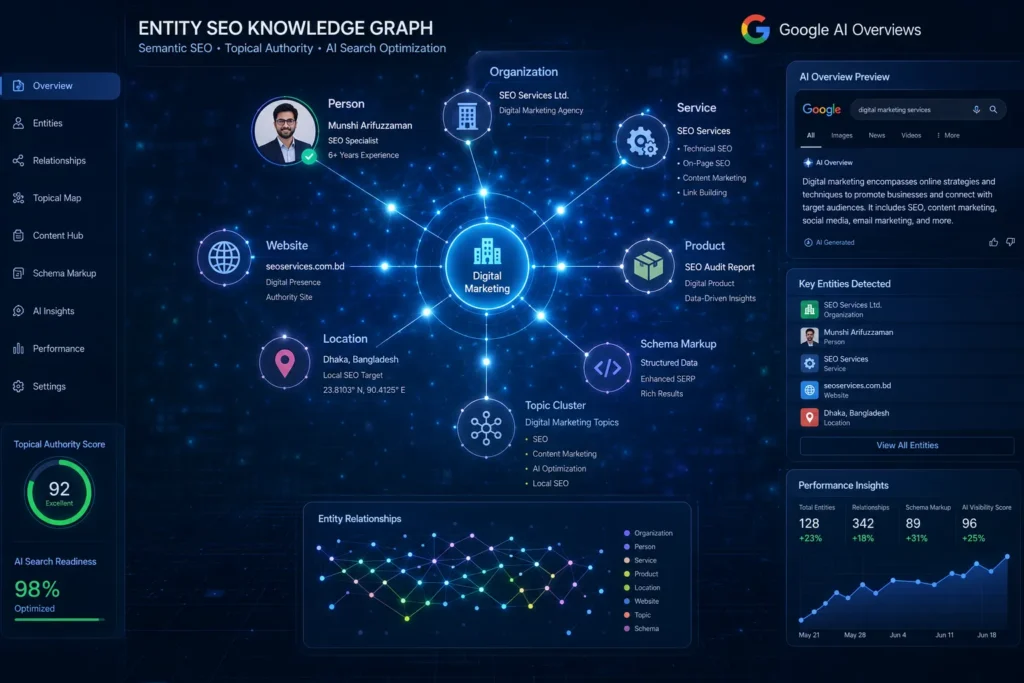
For example, when Google recognizes “Apple,” it understands whether the content refers to the technology company or the fruit by analyzing the surrounding entities and context.
The same principle applies to businesses.
When your website consistently connects your company with specific services, industries, locations, and expertise, Google becomes more confident about what your business represents.
That confidence often leads to improved rankings, stronger topical authority, and increased visibility across both traditional and AI-powered search.
Why Entity SEO Matters in 2026
Search engines are becoming increasingly intelligent.
Instead of matching keywords, Google’s algorithms evaluate:
- Relationships between topics
- User intent
- Brand authority
- Knowledge Graph connections
- Structured data
- Semantic relevance
- Contextual understanding
This evolution means that businesses focusing only on keyword optimization risk falling behind.
Entity SEO offers several significant advantages.
Better Search Understanding
Google understands your business more accurately.
Instead of seeing isolated keywords, it recognizes your organization as an established entity connected to specific industries, services, and expertise.
Improved Topical Authority
Strong entity relationships reinforce your authority across an entire subject rather than a single keyword.
For example, an SEO agency that consistently publishes content about Technical SEO, Local SEO, Semantic SEO, Entity SEO, AI SEO, Google AI Overviews, and website architecture demonstrates broader expertise than one that targets only “SEO Services.”
Higher AI Search Visibility
AI-powered search platforms rely heavily on entities and contextual understanding.
Optimizing entity relationships increases the likelihood of being referenced within AI-generated answers.
Stronger Brand Recognition
Entity optimization strengthens your digital identity across search engines, business directories, social profiles, and structured data.
This consistency builds trust with both users and search engines.
Future-Proof SEO Strategy
As AI continues reshaping search behavior, websites with strong entity optimization will be better positioned to compete in evolving search environments.
How Google Understands Entities
Google’s mission is to organize the world’s information.
To achieve this, it must understand not only words but also the real-world things those words represent.
Google accomplishes this through entities.
Instead of analyzing individual keywords, Google’s algorithms identify:
- People
- Organizations
- Places
- Products
- Services
- Events
- Concepts
Then they determine how these entities relate to one another.
For example:
A roofing company may be connected to:
- Roof Replacement
- Roof Repair
- Dallas
- Texas
- Asphalt Shingles
- Insurance Claims
- Storm Damage
- Residential Roofing
- Commercial Roofing
The stronger these relationships become, the easier it is for Google to understand the business.
Google’s Knowledge Graph
One of the most important components of Entity SEO is Google’s Knowledge Graph.
The Knowledge Graph is Google’s massive database of interconnected entities and relationships.
Rather than storing only webpages, Google stores information about:
- Businesses
- Organizations
- Products
- People
- Places
- Services
- Books
- Movies
- Medical conditions
- Brands
Each entity contains attributes and relationships.
For example:
Business
↓
SEO Services BD
↓
Provides
↓
Semantic SEO Services
↓
Entity SEO Services
↓
Technical SEO Services
↓
Serves
↓
Worldwide
↓
Industry
↓
Search Engine Optimization
When your website clearly reinforces these relationships through structured data, content, internal links, and brand consistency, Google gains greater confidence in your expertise.

Entity SEO vs Traditional Keyword SEO
Many website owners still believe SEO is primarily about keywords.
While keywords remain important, Entity SEO expands far beyond keyword targeting.
| Traditional SEO | Entity SEO |
|---|---|
| Focuses on keywords | Focuses on entities |
| Exact-match phrases | Context and meaning |
| Individual pages | Entire knowledge ecosystem |
| Keyword density | Entity relationships |
| Basic on-page optimization | Semantic understanding |
| Rankings | Authority and relevance |
| Search engines | Search engines + AI systems |
Modern SEO combines both strategies.
Keywords help users find your content, while entities help search engines understand your business.
Understanding Entity Relationships
Entities rarely exist independently.
Search engines evaluate how entities connect.
For example, a healthcare website may connect:
Healthcare Provider
↓
↓
↓
Sports Injuries
↓
Physical Therapy
↓
Rehabilitation
↓
Dallas
↓
Texas
These relationships help Google understand the clinic’s specialty and geographic relevance.
The more accurate and comprehensive these relationships become, the stronger the website’s topical authority.
Core Entity SEO Ranking Factors
Several factors contribute to successful Entity SEO.
Structured Data
Schema markup helps search engines identify important entities on your website.
Common schema types include:
- Organization
- LocalBusiness
- Person
- Service
- Product
- Article
- FAQ
- Review
- Breadcrumb
Structured data provides explicit information rather than forcing Google to infer meaning.
Brand Consistency
Your business information should remain consistent across:
- Website
- Google Business Profile
- Social media
- Business directories
- Industry listings
- Press mentions
Consistent branding strengthens entity recognition.
Semantic Content
Your content should naturally cover related concepts, services, industries, and questions rather than focusing narrowly on one keyword.
Comprehensive content helps establish meaningful entity relationships.
Internal Linking
Contextual internal links connect related entities throughout your website.
For example:
Technical SEO
↓
Semantic SEO
↓
Entity SEO
↓
↓
Generative Engine Optimization
↓
↓
This interconnected structure reinforces topical expertise.
High-Quality Backlinks
Backlinks from authoritative, industry-relevant websites strengthen your entity’s reputation.
Quality matters far more than quantity.
EEAT Signals
Experience, Expertise, Authoritativeness, and Trustworthiness remain fundamental ranking factors.
Strong entity optimization should include:
- Author profiles
- Organization details
- Contact information
- Certifications
- Awards
- Case studies
- Testimonials
- Transparent business information
These signals improve both search visibility and user trust.
Entity SEO and Topical Authority
Entity SEO and Topical Authority work together to strengthen your website’s expertise.
Instead of creating isolated articles, successful websites build interconnected content ecosystems centered around related entities.
For example, an SEO agency might organize its content like this:
SEO Services
↓
Technical SEO
↓
Semantic SEO
↓
Entity SEO
↓
Local SEO
↓
AI SEO
↓
Generative Engine Optimization
↓
Answer Engine Optimization
↓
Google AI Overviews
↓
↓
Each page supports the others through contextual internal links, semantic relevance, and shared entities.
Over time, Google recognizes the website as a trusted authority across the entire SEO domain rather than a collection of unrelated pages.
As search engines continue shifting toward AI-driven understanding, businesses that invest in Entity SEO and topical authority will be better positioned to earn higher rankings, stronger Knowledge Graph associations, and greater visibility in both traditional search results and AI-generated answers.
How to Implement an Effective Entity SEO Strategy
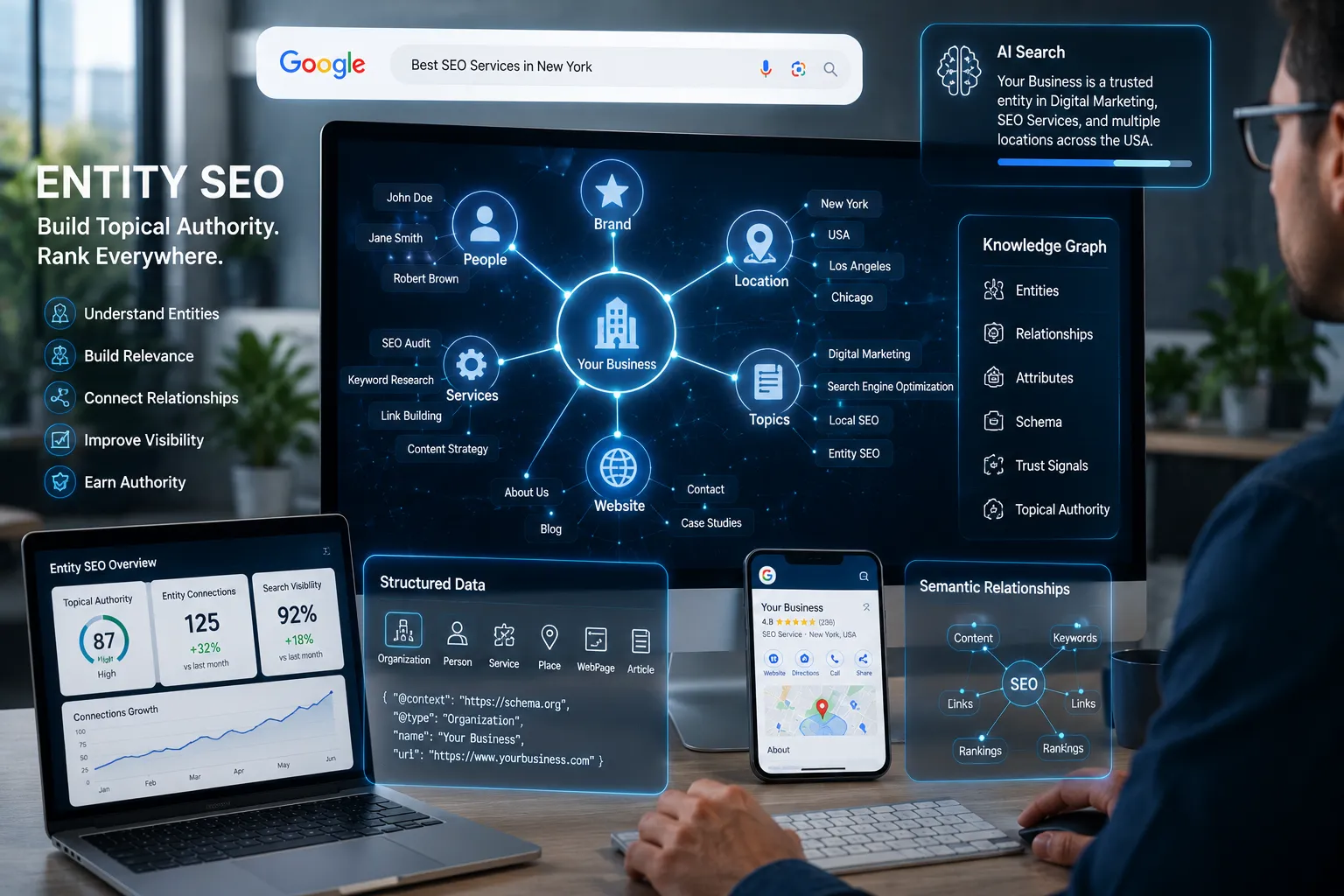
A successful Entity SEO strategy goes beyond adding schema markup or mentioning your brand name repeatedly. It requires building a consistent, interconnected digital presence that helps search engines understand your business, services, expertise, and relationships.
Below is the framework we use to build strong entity signals.
Step 1: Define Your Core Entities
Start by identifying the most important entities associated with your business.
These typically include:
- Organization
- Brand
- Founder
- Services
- Products
- Locations
- Industry
- Target audience
For example, an SEO agency might define these primary entities:
- SEO Services
- Technical SEO
- Local SEO
- Semantic SEO
- Entity SEO
- Topical Authority
- AI SEO
- Generative Engine Optimization
- Answer Engine Optimization
Every page should reinforce these relationships.
Step 2: Build Topic Clusters Around Entities
Instead of publishing unrelated articles, organize your content into semantic clusters.
Example:
Pillar Page
Entity SEO
↓
Supporting Pages
- Semantic SEO
- Knowledge Graph
- Schema Markup
- Google AI Overviews
- Topical Authority
- Internal Linking
- Technical SEO
- AI Search Optimization
This structure demonstrates expertise across an entire subject rather than a single keyword.
Step 3: Use Structured Data
Schema markup is one of the clearest ways to communicate entity information to search engines.
Important schema types include:
- Organization
- Person
- Service
- Article
- FAQ
- Breadcrumb
- LocalBusiness
- Product
- Review
- WebSite
Schema helps Google connect your content with the appropriate entities in its Knowledge Graph.
Step 4: Optimize Internal Linking
Every important entity should connect naturally with related pages.
For example:
Entity SEO
↓
Semantic SEO
↓
Topical Authority
↓
AI SEO
↓
Generative Engine Optimization
↓
Answer Engine Optimization
↓
Technical SEO
↓
Website Architecture
These contextual links strengthen semantic relationships and improve crawlability.
Step 5: Strengthen Brand Signals
Google evaluates your brand across multiple platforms.
Maintain consistent information across:
- Website
- Google Business Profile
- X (Twitter)
- YouTube
- Business directories
- Industry associations
- Press mentions
Consistent branding reinforces your entity identity.
Step 6: Publish Helpful Content Regularly
Strong entities continuously demonstrate expertise.
Publish content such as:
- Guides
- Tutorials
- Case Studies
- Research
- Industry Trends
- FAQs
- Checklists
- Comparisons
Every article should contribute to your overall topical authority.
Entity SEO Best Practices
Successful websites share several common characteristics.
Create Comprehensive Content
Instead of writing short articles targeting individual keywords, produce complete resources that answer every important question about a topic.
Optimize Search Intent
Understand why users search before creating content.
Content should satisfy informational, commercial, transactional, or navigational intent.
Use Natural Language
Write for people first.
Avoid keyword stuffing and instead use related entities and semantic variations naturally throughout your content.
Build Semantic Relationships
Connect related services, products, industries, and concepts through meaningful internal links.
Keep Information Updated
Google favors accurate and current information.
Regularly review:
- Statistics
- Industry trends
- Service information
- FAQs
- Case studies
- Pricing (where applicable)
Fresh content strengthens trust.
Entity SEO for AI Search (AEO & GEO)
AI-powered search platforms rely heavily on entities when generating answers.
Instead of simply matching keywords, AI systems analyze:
- Context
- Relationships
- Authority
- Structured information
- Trustworthiness
Entity SEO therefore plays a critical role in modern AI Search Optimization.
Entity SEO + Answer Engine Optimization (AEO)
Answer Engine Optimization focuses on creating content that directly answers user questions.
When combined with Entity SEO, AI systems can better identify:
- Who provides the service
- What the service includes
- Where it is available
- Why it is trustworthy
This improves the chances of appearing in featured snippets and AI-generated responses.
Entity SEO + Generative Engine Optimization (GEO)
Generative Engine Optimization prepares content for AI-powered search experiences.
Entity-rich content helps platforms like:
- Google AI Overviews
- ChatGPT Search
- Google Gemini
- Perplexity AI
- Claude
- Microsoft Copilot
understand your expertise and reference your website more confidently.
Entity SEO Case Study
Client Overview
Industry: Professional Digital Marketing Agency
Target Market: United States
Campaign Duration: 9 Months
Challenges
The client faced several issues:
- Weak brand recognition
- Poor topical authority
- Limited semantic content
- Inconsistent business information
- Minimal structured data
- Low organic visibility
Our Strategy
We implemented:
- Entity mapping
- Organization schema
- Person schema
- Service schema
- Topic cluster development
- Semantic content optimization
- Internal linking
- Knowledge Graph optimization
- EEAT improvements
- AI Search Optimization
Results
Organic Traffic
Before:
5,400 Monthly Visitors
After:
38,700 Monthly Visitors
Growth: 617%
Ranking Keywords
Before:
112 Keywords
After:
928 Keywords
Top 10 Rankings
Before:
21 Keywords
After:
294 Keywords
AI Search Visibility
The website experienced stronger visibility in Google AI Overviews and improved discoverability across AI-powered search platforms due to enhanced entity relationships and comprehensive topical coverage.
Common Entity SEO Mistakes
Many websites struggle because they focus on outdated SEO practices.
Avoid these common mistakes:
Keyword Stuffing
Repeating exact-match keywords without adding context provides little value and can reduce content quality.
Ignoring Structured Data
Without schema markup, search engines have fewer explicit signals about your business and services.
Weak Internal Linking
Disconnected pages reduce topical authority and make it harder for search engines to understand relationships.
Thin Content
Short pages with limited information rarely demonstrate expertise.
Create comprehensive resources that fully answer user questions.
Inconsistent Brand Information
Different business names, addresses, phone numbers, or descriptions across platforms weaken entity recognition.
Publishing Without Strategy
Random blog posts rarely build authority.
Organize content into logical topic clusters.
Conclusion
Entity SEO has become one of the most important pillars of modern search optimization. As Google and AI-powered search engines continue moving beyond keywords toward understanding meaning, relationships, and trust, businesses that invest in entity optimization gain a significant competitive advantage.
A successful Entity SEO strategy combines semantic content, structured data, internal linking, Knowledge Graph optimization, EEAT, and topical authority into one unified framework. Rather than optimizing isolated pages, it creates a connected ecosystem that helps search engines understand your expertise across an entire subject.
When integrated with Semantic SEO, Technical SEO, Answer Engine Optimization (AEO), and Generative Engine Optimization (GEO), Entity SEO positions your website for sustainable growth across Google Search, Google AI Overviews, ChatGPT Search, Gemini, Perplexity, Claude, and future AI-driven search experiences.
Whether you run a local business, healthcare practice, law firm, SaaS company, eCommerce store, or enterprise website, building strong entities today will strengthen your authority, improve organic visibility, attract more qualified traffic, and help future-proof your SEO strategy.
Frequently Asked Questions
What is an entity in SEO?
An entity is a uniquely identifiable person, organization, product, place, service, or concept that search engines recognize and connect through relationships.
How is Entity SEO different from keyword SEO?
Keyword SEO focuses on matching search terms, while Entity SEO helps search engines understand meaning, context, and relationships between concepts.
Why is Google’s Knowledge Graph important?
The Knowledge Graph helps Google understand entities and their relationships, improving the accuracy of search results and AI-generated answers.
Does Entity SEO improve Google rankings?
Yes. Strong entity optimization supports better semantic understanding, topical authority, and trust, which can improve search visibility.
Can Entity SEO help with Google AI Overviews?
Yes. Entity-rich content with clear structure and strong EEAT signals has a greater chance of being referenced in Google AI Overviews.
Is schema markup enough for Entity SEO?
No. Schema is important, but it should be combined with semantic content, internal linking, consistent branding, topical authority, and high-quality backlinks.
Which businesses benefit from Entity SEO?
Almost every business can benefit, including SaaS companies, healthcare providers, law firms, eCommerce brands, local businesses, financial services, educational organizations, and enterprise websites.
How long does Entity SEO take?
Most websites begin seeing measurable improvements within 3 to 6 months, while stronger authority typically develops over 6 to 12 months through consistent optimization.