
SaaS SEO Case Study: How We Increased Organic Signups by 782% for a B2B SaaS Company
Introduction
For SaaS companies, sustainable growth depends on consistently generating qualified users, demo requests, and free trial signups. While paid advertising can accelerate growth, customer acquisition costs often become expensive as competition increases.
Search Engine Optimization offers SaaS businesses a scalable and long-term growth channel. By targeting high-intent keywords throughout the customer journey, SaaS companies can attract decision-makers actively looking for solutions.
In this SaaS SEO Case Study, you’ll learn how a B2B SaaS company increased organic signups by 782%, improved keyword rankings, and built a predictable inbound acquisition channel through strategic SEO.
Client Overview
- Industry: B2B SaaS
- Product Type: Project Management Software
- Target Market: United States, Canada, UK
- Campaign Duration: 12 Months
- Primary Goal: Increase Free Trial Signups
Initial Challenges
The company faced several obstacles:
- High dependency on paid advertising
- Limited organic traffic
- Weak topical authority
- Poor content coverage
- Low non-branded keyword visibility
- Technical SEO issues
- Low conversion rates
Most organic traffic came from branded searches rather than high-intent SaaS keywords.
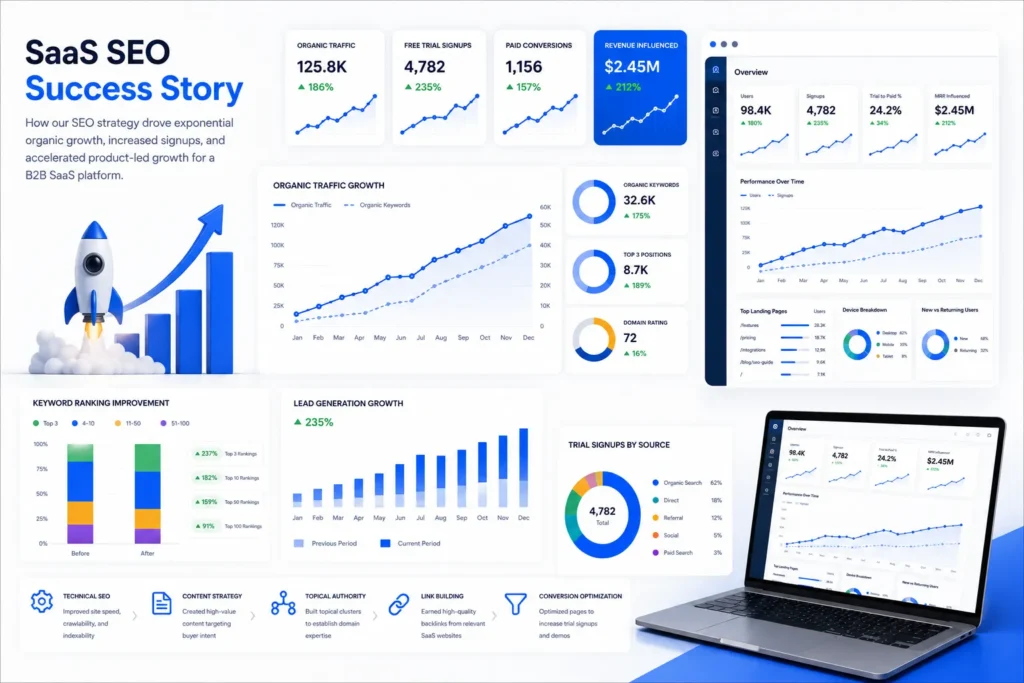
SaaS SEO Strategy
Phase 1: Technical SEO Audit
A complete technical audit identified critical issues affecting search performance.
Key Improvements
- Crawl optimization
- Core Web Vitals improvements
- Internal linking fixes
- Schema implementation
- XML sitemap optimization
- Indexation improvements
These changes created a strong technical foundation.
Phase 2: SaaS Keyword Research
Unlike traditional SEO campaigns, SaaS SEO requires targeting keywords throughout the entire buying journey.
Funnel-Based Keyword Mapping
Top of Funnel (TOFU)
Examples:
- What is project management software?
- Best project management tools
- Project management guide
Middle of Funnel (MOFU)
Examples:
- Asana alternatives
- Trello vs Monday
- Best software for remote teams
Bottom of Funnel (BOFU)
Examples:
- Project management software pricing
- Best project management software for startups
- Project management software demo
This strategy captured users at every stage of the funnel.
Phase 3: Content Cluster Development
Topical authority became the core growth strategy.
Topic Cluster Example
Project Management Software
↓
Project Planning
↓
Task Management
↓
Team Collaboration
↓
Remote Work
↓
Productivity
↓
Software Comparisons
↓
Case Studies
This structure helped Google understand expertise within the niche.
Phase 4: Commercial Content Optimization
Many competitors focused only on blog content.
We prioritized revenue-generating pages such as:
Comparison Pages
- Competitor alternatives
- Feature comparisons
- Software comparisons
Solution Pages
- Industry-specific solutions
- Use-case pages
- Team-focused landing pages
Pricing Pages
Optimized for commercial intent and conversions.
These pages generated some of the highest-converting traffic.
Phase 5: Content Marketing
A comprehensive content strategy included:
Educational Content
- Guides
- Tutorials
- Industry insights
Commercial Content
- Alternatives pages
- Comparison pages
- Product comparisons
Bottom Funnel Content
- Demo pages
- Feature pages
- Pricing-related content
This balanced approach improved both traffic and conversions.
Phase 6: Conversion Rate Optimization
Traffic alone was not enough.
We improved:
- CTA placement
- Free trial forms
- Demo requests
- Landing page structure
- Trust signals
This increased signup conversion rates significantly.
Results After 12 Months
Organic Traffic Growth
Before SEO:
9,500 Monthly Visitors
After SEO:
68,000 Monthly Visitors
Growth:
616%
Free Trial Signups
Before SEO:
64 Monthly Signups
After SEO:
565 Monthly Signups
Growth:
782%
Keyword Rankings
| Metric | Before | After |
|---|---|---|
| Top 3 Rankings | 11 | 103 |
| Top 10 Rankings | 37 | 418 |
| Top 20 Rankings | 91 | 827 |
Demo Requests
Before:
18 Monthly Demo Requests
After:
162 Monthly Demo Requests
Growth:
800%
Conversion Rate
| Metric | Before | After |
|---|---|---|
| Trial Signup Rate | 0.67% | 2.84% |
| Demo Conversion Rate | 0.19% | 0.81% |
Revenue Impact
Before:
Heavy dependence on paid acquisition.
After:
Organic search became one of the largest acquisition channels, reducing customer acquisition costs and improving marketing ROI.
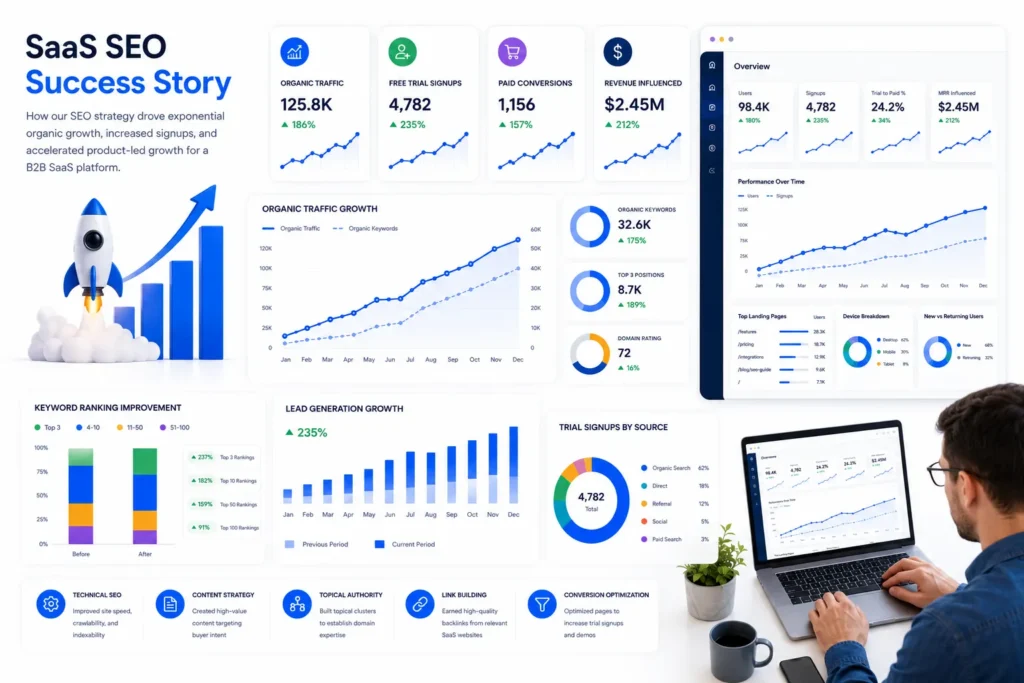
Why This SaaS SEO Campaign Worked
Topic Clusters Built Authority
Comprehensive content coverage improved trust and relevance.
Commercial Pages Drove Conversions
Comparison and alternative pages generated highly qualified traffic.
Funnel-Based Strategy Increased Signups
Targeting every stage of the buyer journey maximized opportunities.
Technical SEO Improved Visibility
Better crawlability and performance supported rankings.
CRO Improved Business Results
Traffic growth translated directly into more users and revenue.
Key Lessons for SaaS Companies
SEO Is a Revenue Channel
SEO should be measured by signups and revenue, not just traffic.
Commercial Intent Keywords Matter
High-converting keywords often produce better ROI than informational keywords.
Topic Authority Wins
Comprehensive content ecosystems outperform isolated articles.
Product-Led Content Works
Feature pages and use-case content can drive substantial conversions.
Technical SEO Supports Growth
Strong technical foundations improve scalability.
Final Results
After twelve months, the SaaS company achieved:
616% Increase in Organic Traffic
782% Increase in Free Trial Signups
418 Keywords Ranking in Top 10
800% Increase in Demo Requests
Lower Customer Acquisition Costs
Stronger Brand Authority
Sustainable Long-Term Growth
Conclusion
SaaS SEO is more than ranking for keywords. Successful SaaS SEO combines technical optimization, content marketing, topical authority, commercial intent targeting, and conversion optimization.
This case study demonstrates how a structured SaaS SEO strategy transformed organic search into a predictable customer acquisition engine, generating significant growth in traffic, signups, and revenue.