
Artificial Intelligence is fundamentally changing how people search for information.
For more than two decades, SEO professionals focused on ranking websites in Google’s traditional search results. The objective was simple: achieve higher rankings, generate more clicks, and drive more traffic.
Today, the search landscape looks very different.
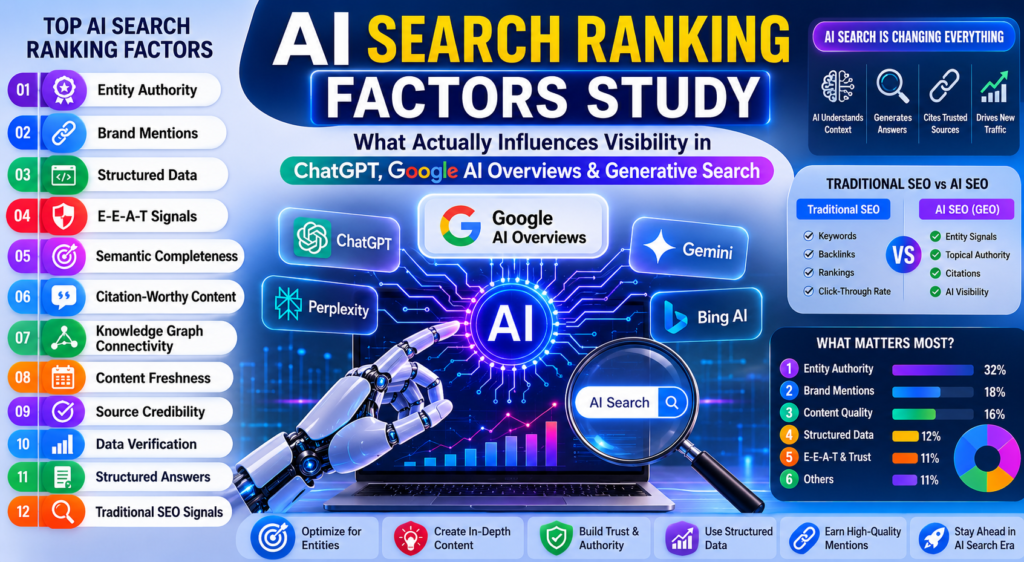
Users increasingly rely on:
- ChatGPT
- Google AI Overviews
- Gemini
- Perplexity
- Claude
- AI-powered assistants
Instead of presenting ten blue links, these systems generate direct answers. As a result, businesses are asking a new question:
What actually determines rankings in AI search?
This AI Search Ranking Factors Study examines emerging evidence, industry research, platform behavior, and search experiments to identify the most important factors influencing visibility across generative search systems.
The findings reveal that while traditional SEO remains important, AI search introduces entirely new visibility signals that marketers must understand to remain competitive.
The Evolution from SEO to AI Search
Traditional search engines ranked web pages. AI search engines rank information. This distinction is critical.
In traditional SEO:
- Pages rank.
- Keywords rank.
- URLs rank.
In AI search:
- Entities rank.
- Sources rank.
- Facts rank.
- Authority ranks.
- Citations rank.
Google itself has confirmed that AI search experiences are still built upon core search systems, meaning traditional SEO remains relevant. However, AI retrieval, synthesis, and citation introduce additional layers that influence visibility.
How AI Search Engines Actually Work
Most AI search systems follow three stages:
Stage 1: Retrieval
The AI identifies potentially relevant sources.
Stage 2: Evaluation
The system evaluates trustworthiness, authority, relevance, and factual consistency.
Stage 3: Synthesis
The AI generates a final answer and may cite sources.
Research indicates AI systems increasingly retrieve sources through semantic understanding rather than keyword matching alone. This means ranking factors are evolving from keyword-focused signals toward meaning-focused signals.
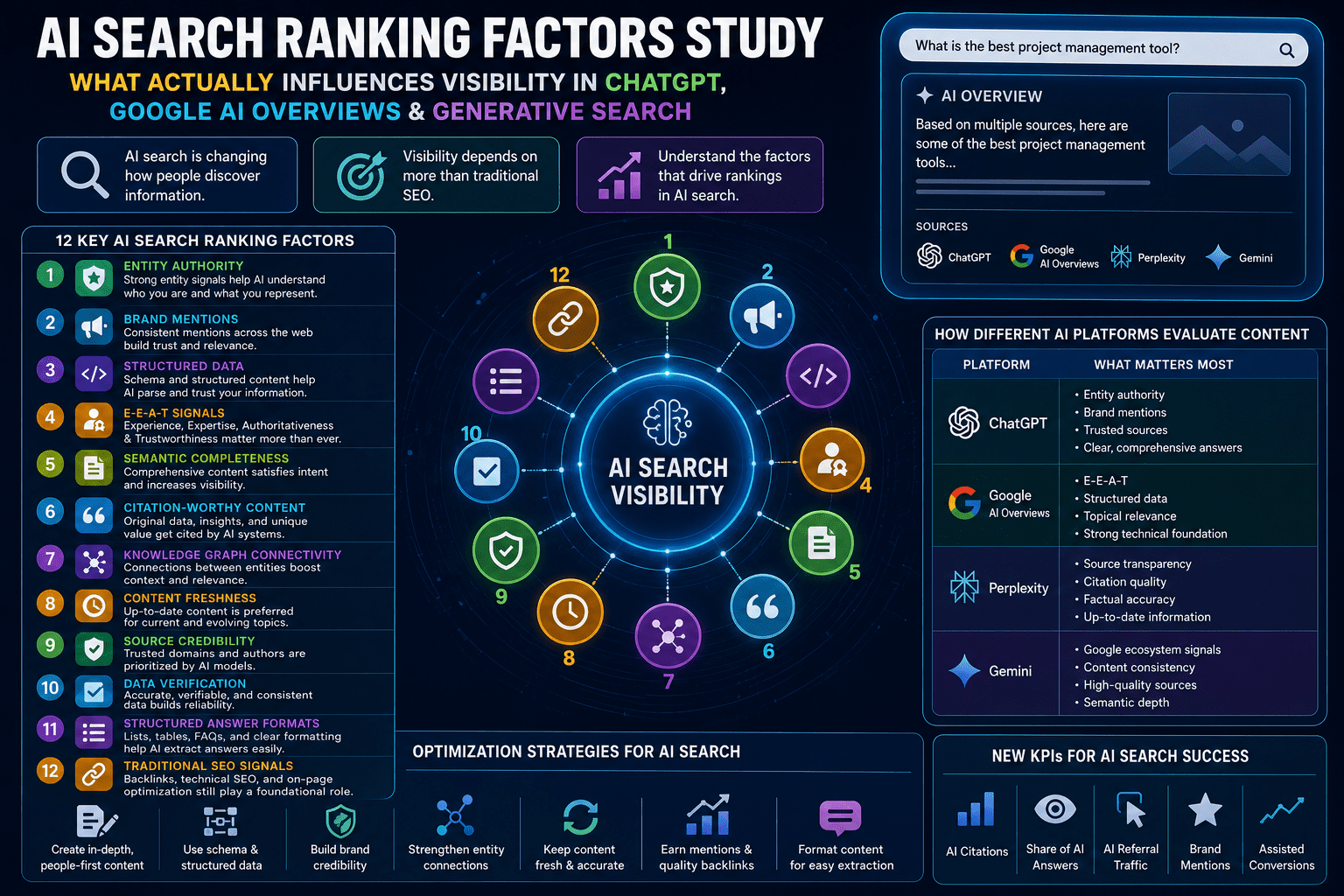
The 12 Most Important AI Search Ranking Factors
Based on available studies, experiments, and platform guidance, these are the factors most likely to influence AI visibility.

Ranking Factor #1: Entity Authority
Entity authority appears to be one of the strongest AI visibility signals.
An entity may be:
- A company
- A person
- A product
- A service
- A location
AI systems increasingly rely on entity understanding to determine credibility.
For example:
Google understands:
- OpenAI
- HubSpot
- Salesforce
- Microsoft
as entities rather than simple keywords.
Strong entity signals improve retrieval probability.
Research increasingly identifies entity optimization as a foundational GEO strategy.
How to Improve Entity Authority
- Consistent brand information
- Knowledge Graph presence
- Structured data
- Third-party mentions
- Industry recognition
- Author entities
Ranking Factor #2: Brand Mentions
Traditional SEO emphasized backlinks. AI search increasingly values mentions. Why? Because AI models learn relationships through language.
If authoritative websites repeatedly mention your brand in connection with a topic, AI systems learn those associations.
Example:
“Company X is a leading SEO agency.”
Repeated mentions strengthen topical authority. Several GEO studies suggest brand mentions may become nearly as influential as links for AI visibility.
Ranking Factor #3: Structured Data
Structured data helps machines understand information.
Schema markup clarifies:
- Organizations
- Services
- Authors
- Products
- FAQs
- Reviews
Research indicates that pages using robust structured data are cited more frequently in AI-generated answers.

Recommended Schema Types
- Organization
- Person
- Article
- FAQ
- Product
- Review
- LocalBusiness
Ranking Factor #4: E-E-A-T Signals
Experience, Expertise, Authoritativeness, and Trustworthiness remain critical. Studies of AI-cited sources consistently show a preference for trusted and institutional sources.
AI systems appear to prioritize:
- Expert authors
- Verified credentials
- Recognized organizations
- Editorial standards
Ranking Factor #5: Semantic Completeness
One of the most significant differences between traditional SEO and AI search is semantic completeness. AI systems favor content that answers an entire topic rather than a single keyword. Research on AI Overview citations highlights semantic completeness as a major selection factor.
Example
Weak answer: “What is SEO?”
Strong answer: Definition + benefits + process + tools + costs + future trends.
Comprehensive content provides AI systems with more usable information.
Ranking Factor #6: Citation-Worthy Content
AI engines prioritize content that can be quoted, referenced, or summarized.
Characteristics include:
- Clear answers
- Original research
- Statistics
- Expert insights
- Frameworks
- Definitions
AI systems are citation engines. Content that provides unique value receives more citations.
Ranking Factor #7: Knowledge Graph Connectivity
Knowledge Graph relationships influence machine understanding. Strong entity networks improve discoverability.
Examples:
- Company → Founder
- Company → Service
- Service → Industry
- Industry → Topic
Research increasingly points toward entity graph density as an AI ranking advantage.
Ranking Factor #8: Content Freshness
Fresh content continues influencing visibility.
AI systems frequently seek:
- Recent studies
- Updated statistics
- Current industry information
Regular content updates improve citation potential.
Ranking Factor #9: Source Credibility
AI systems prefer credible sources. Research examining AI citations found a strong preference for institutional and authoritative domains.
Examples:
- Government websites
- Universities
- Industry associations
- Established publishers
Authority remains a fundamental trust signal.
Ranking Factor #10: Data Verification
One emerging AI ranking factor is verifiability. AI systems increasingly prioritize information that can be confirmed through multiple sources. Recent industry research suggests data provenance and consistency are becoming major visibility signals.
Examples
- Original studies
- Verified data
- Referenced statistics
- Expert interviews
Ranking Factor #11: Structured Answer Formats
AI engines prefer extractable content.
Examples include:
- Lists
- Tables
- FAQs
- Definitions
- Step-by-step guides
Structured content improves retrieval efficiency. Research shows structured answers significantly increase citation rates.
Ranking Factor #12: Traditional SEO Signals
Contrary to some claims, traditional SEO is not dead. Google explicitly states that foundational SEO best practices remain important for AI visibility.
Important factors include:
- Crawlability
- Indexation
- Internal linking
- Backlinks
- Technical SEO
AI search builds upon traditional search infrastructure.
AI Search Ranking Factors by Platform
ChatGPT
Appears to favor:
- Entity authority
- Trusted sources
- Brand mentions
- Expert content
Google AI Overviews
Strongly connected to Google’s existing search systems.
Key factors include:
- Search visibility
- Structured data
- E-E-A-T
- Semantic coverage
Perplexity
Places significant emphasis on citations and source transparency.
Gemini
Often relies heavily on Google’s ecosystem and indexed content.
Studies show source overlap between platforms remains surprisingly low, meaning optimization must extend beyond Google rankings alone.
What Matters Less in AI Search
Many traditional tactics appear to have reduced influence.
Examples:
- Exact-match keyword density
- Excessive backlink quantity
- Thin content
- Low-value guest posting
AI systems focus more on authority, relevance, and usefulness.
AI Search KPI Framework
Traditional SEO KPIs:
- Rankings
- Traffic
- Clicks
AI Search KPIs:
- Citation frequency
- Share of synthesis
- Entity visibility
- Brand mentions
- AI referral traffic
- AI-assisted conversions
Experts increasingly recommend measuring “share of citation” rather than only “share of voice.”
The Future of AI Search Rankings
Over the next few years, AI ranking systems will likely become even more dependent on:
- Entity authority
- Data verification
- Structured information
- Brand trust
- Knowledge Graph relationships
- Multi-source validation
Brands that become recognized entities will outperform those that rely solely on traditional SEO tactics.
Final Thoughts
The biggest finding from this AI Search Ranking Factors Study is simple: AI search is not replacing SEO.
It is expanding SEO. Traditional SEO remains the foundation. But visibility in ChatGPT, Google AI Overviews, Gemini, and Perplexity increasingly depends on additional signals:
- Entity authority
- Brand mentions
- Structured data
- E-E-A-T
- Semantic completeness
- Knowledge Graph connectivity
- Citation-worthy content
Organizations that optimize for these factors today will be best positioned to dominate the next generation of search.
The future belongs to brands that are not only discoverable but also trusted, understood, and cited by AI systems.