
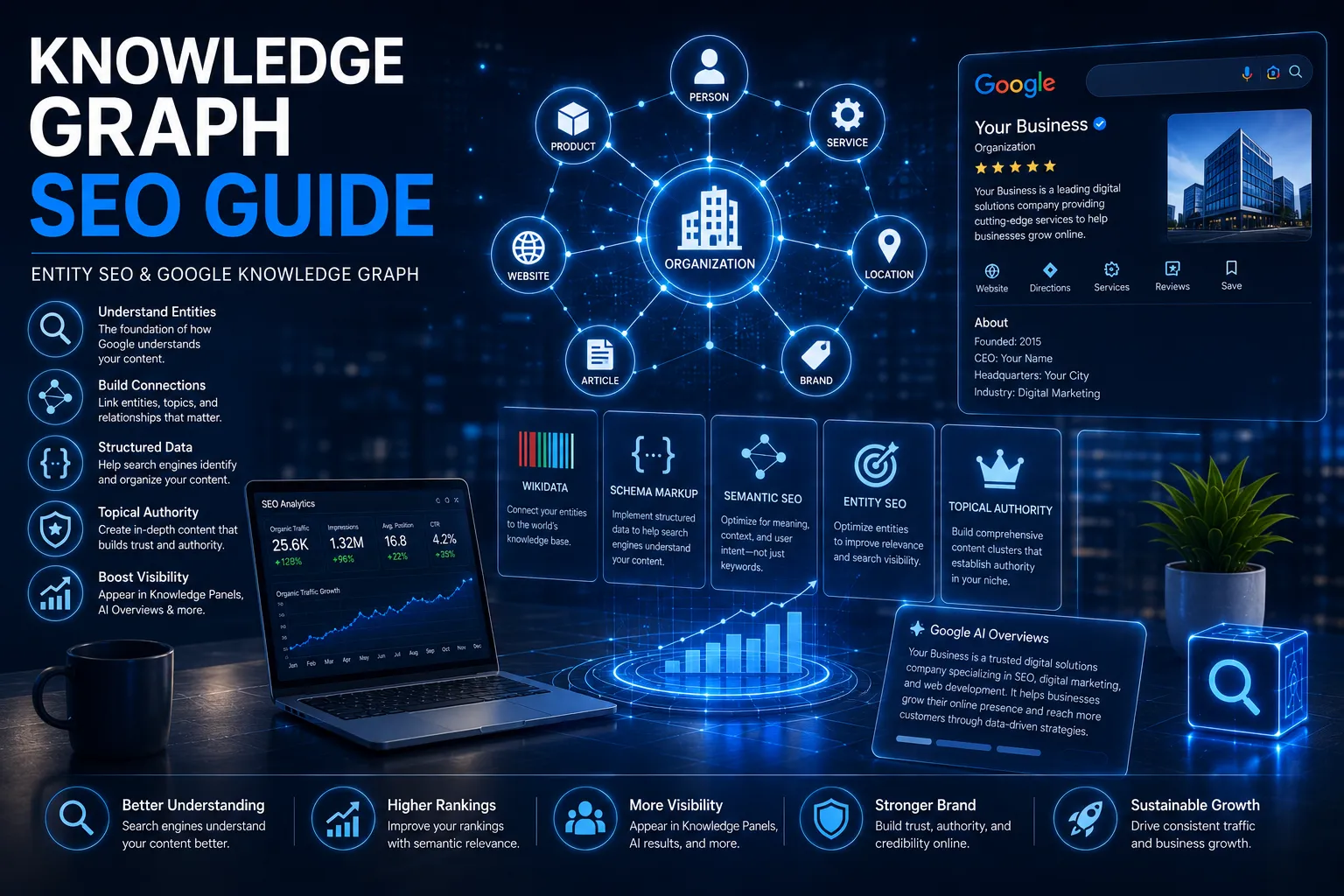
Knowledge Graph SEO Guide: How to Build Entity Authority for Google & AI Search
Master Knowledge Graph SEO to Improve Google Rankings, AI Search Visibility, and Brand Authority
Search engine optimization has evolved beyond keywords and backlinks. Today, Google understands the web through entities, relationships, and contextual meaning rather than simply matching search terms.
One of the most significant innovations behind this transformation is the Google Knowledge Graph.
Introduced to help Google understand real-world people, businesses, places, products, organizations, and concepts, the Knowledge Graph enables search engines to connect information across billions of webpages. Instead of treating every page as isolated content, Google builds relationships between entities and uses those relationships to deliver more accurate search results.
This technology also powers many of Google’s most visible search features, including:
- Knowledge Panels
- Google AI Overviews
- Featured Snippets
- People Also Ask
- Local Knowledge Panels
- Entity-based search results
Today, the Knowledge Graph plays an even greater role as AI-powered search platforms such as Google AI Overviews, ChatGPT Search, Google Gemini, Perplexity AI, Claude, and Microsoft Copilot rely heavily on entity understanding to generate accurate answers.
For businesses, this means traditional keyword optimization alone is no longer enough.
To remain competitive, your website must help search engines understand:
- Who you are
- What you do
- Where you operate
- Which services you provide
- How your brand relates to other entities
- Why users should trust your expertise
This is where Knowledge Graph SEO becomes essential.
In this comprehensive guide, you’ll learn how Google’s Knowledge Graph works, why it matters for SEO, how entities influence rankings, and how to optimize your website for both traditional search engines and AI-powered search experiences.
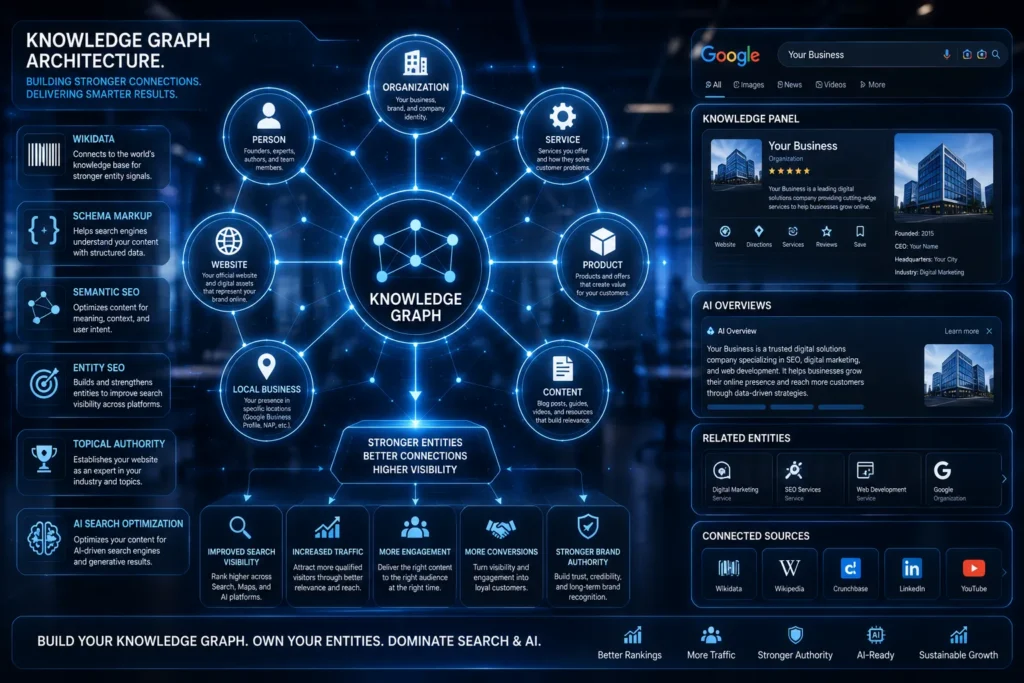
What Is the Google Knowledge Graph?
The Google Knowledge Graph is Google’s database of entities and the relationships between them.
Instead of storing only webpages, Google stores structured information about real-world objects and how they connect.
An entity can be:
- A person
- A company
- A location
- A service
- A product
- A medical condition
- A software platform
- A university
- A city
- A brand
For example, Google understands that:
Apple Inc.
is connected to
- Tim Cook
- iPhone
- macOS
- Cupertino
- NASDAQ
- Steve Jobs
Likewise, Google can understand that an SEO agency is related to:
- Search Engine Optimization
- Technical SEO
- Semantic SEO
- Entity SEO
- Local SEO
- Content Marketing
- AI Search Optimization
- Google Search Console
Rather than relying on repeated keywords, Google identifies relationships between these entities to understand expertise and relevance.
Why the Knowledge Graph Matters for SEO
The Knowledge Graph fundamentally changes how search engines evaluate websites.
Google is no longer asking:
“Does this page contain the keyword?”
Instead, it asks:
“Does this website demonstrate expertise about this subject?”
Knowledge Graph SEO helps answer that question.
Better Entity Recognition
When Google clearly understands your business and services, it becomes easier to associate your website with relevant search topics.
Improved Search Relevance
Entity relationships allow Google to understand context instead of relying on exact keyword matches.
This enables one page to rank for hundreds of related search queries.
Stronger Topical Authority
Websites covering an entire subject through interconnected entities appear more authoritative than websites publishing isolated articles.
Improved AI Search Visibility
AI-powered search platforms depend heavily on entity relationships.
Strong entity optimization increases the likelihood of being referenced within AI-generated answers.
Long-Term Brand Authority
As your entity becomes more established across the web, your brand gains stronger recognition within Google’s ecosystem.
How Google Builds the Knowledge Graph
Google gathers information from multiple trusted sources to build entity relationships.
These include:
Your Website
Google analyzes:
- Content
- Internal links
- Headings
- Structured data
- Navigation
- Service pages
- About page
- Author profiles
Structured Data
Schema markup explicitly tells Google about:
- Organization
- Person
- Service
- Product
- Article
- FAQ
- Review
- Breadcrumb
Structured data provides machine-readable information that strengthens entity understanding.
Google Business Profile
For local businesses, Google Business Profile supplies critical information including:
- Business name
- Categories
- Reviews
- Service areas
- Business hours
- Photos
- Website
Trusted Third-Party Sources
Google also references information from:
- Wikidata
- Wikipedia (where applicable)
- Industry associations
- Government databases
- Professional organizations
- High-authority publications
- Business directories
Consistency across these sources strengthens entity confidence.
Understanding Entities
An entity is anything uniquely identifiable.
Unlike keywords, entities have meaning independent of language.
Examples include:
People
- Elon Musk
- Sundar Pichai
Organizations
- Microsoft
- OpenAI
Locations
- New York
- London
- California
Services
- Technical SEO
- Local SEO
- Dental Implants
Products
- iPhone
- Microsoft 365
Concepts
- Artificial Intelligence
- Search Engine Optimization
- Machine Learning
Google connects these entities to build a deeper understanding of information.
Entity Relationships
The real power of the Knowledge Graph comes from relationships.
Consider an SEO agency.
Organization
↓
↓
Provides
↓
↓
↓
↓
Generative Engine Optimization
↓
↓
Serves
↓
Worldwide
↓
Industry
↓
Digital Marketing
These connections strengthen Google’s understanding of your business.
The more clearly you establish these relationships, the stronger your authority becomes.
Knowledge Graph vs Knowledge Panel
These terms are often confused.
They are not the same.
Knowledge Graph
Google’s internal database of entities and relationships.
Users cannot directly see it.
Knowledge Panel
The visible information box displayed in search results.
Knowledge Panels are generated using information from the Knowledge Graph and other trusted sources.
Not every entity receives a public Knowledge Panel.
However, every strong entity contributes to Google’s broader understanding of your business.
Knowledge Graph vs Traditional SEO
| Traditional SEO | Knowledge Graph SEO |
|---|---|
| Keywords | Entities |
| Individual pages | Connected information |
| Exact-match optimization | Contextual understanding |
| Rankings | Authority & relationships |
| Content relevance | Entity relevance |
| Search engines | Search engines + AI systems |
| Keyword density | Knowledge ecosystem |
Modern SEO combines both approaches for maximum visibility.
Semantic SEO and the Knowledge Graph
Semantic SEO complements Knowledge Graph optimization by helping Google understand the meaning behind content.
Instead of targeting only one keyword like Knowledge Graph SEO, comprehensive content naturally covers related concepts including:
- Entity SEO
- Semantic SEO
- Structured Data
- Schema Markup
- Google AI Overviews
- Topical Authority
- Knowledge Panels
- NLP
- Internal Linking
- AI Search
This broader coverage helps Google connect entities more accurately.

Entity SEO and the Knowledge Graph
Entity SEO provides the foundation for Knowledge Graph optimization.
It strengthens Google’s understanding of:
- Your business
- Your services
- Your authors
- Your products
- Your locations
- Your expertise
Entity optimization includes:
- Organization Schema
- Person Schema
- Service Schema
- Brand consistency
- Internal linking
- Semantic content
- Structured data
Together, these signals strengthen your entity within Google’s ecosystem.
Topical Authority and the Knowledge Graph
Google prefers websites demonstrating comprehensive expertise.
Instead of creating disconnected pages, successful websites build topic clusters.
Example:
Search Engine Optimization
↓
Technical SEO
↓
Semantic SEO
↓
Entity SEO
↓
Knowledge Graph SEO
↓
Topical Authority
↓
Generative Engine Optimization
↓
Answer Engine Optimization
↓
Google AI Overviews
↓
↓
Every page reinforces the authority of the others.
Over time, Google recognizes your website as a trusted source across the entire subject.
Core Knowledge Graph Ranking Signals
Several factors influence how Google understands entities and relationships.
Strong Structured Data
Well-implemented schema provides explicit information about your organization and services.
Consistent Brand Information
Maintain identical business details across:
- Website
- Google Business Profile
- Social profiles
- Business directories
- Industry websites
Comprehensive Semantic Content
Publish in-depth content that covers entire topics rather than isolated keywords.
High-Quality Internal Linking
Contextual internal links help Google connect entities across your website.
EEAT Signals
Demonstrate:
- Experience
- Expertise
- Authoritativeness
- Trustworthiness
through author profiles, case studies, certifications, testimonials, awards, and transparent business information.
Authoritative Mentions
Brand mentions and citations from trusted industry websites reinforce your entity’s credibility.
Information Gain
Publish original insights, research, case studies, data, and expert analysis rather than repeating existing information.
Unique content helps your entity stand out within Google’s Knowledge Graph and AI-powered search ecosystem.
How to Optimize for the Google Knowledge Graph
Building a strong Knowledge Graph presence requires more than adding schema markup. Google evaluates hundreds of signals to determine whether a business, person, product, or organization deserves recognition as a trusted entity.
Below is the framework we use to improve Knowledge Graph visibility and strengthen entity authority.
Step 1: Define Your Primary Entity
Before optimizing your website, identify the primary entity you want Google to understand.
Examples include:
- Business
- Brand
- Organization
- Local Business
- Person
- Product
- Service
Every page should reinforce that entity through consistent messaging, structured data, and contextual content.
Step 2: Build Entity Relationships
Google connects entities together.
For example, an SEO agency should naturally connect with:
Organization
↓
SEO Services
↓
Technical SEO
↓
Semantic SEO
↓
Entity SEO
↓
Knowledge Graph SEO
↓
Topical Authority
↓
Google AI Overviews
↓
Generative Engine Optimization
↓
Answer Engine Optimization
↓
The stronger these relationships become, the easier it is for Google to understand your expertise.
Step 3: Implement Schema Markup
Schema markup provides structured information that helps search engines interpret your website correctly.
Essential schema types include:
- Organization
- Person
- Service
- Article
- FAQ
- Breadcrumb
- LocalBusiness
- WebSite
- Review
- Product
Schema is one of the strongest technical signals for Knowledge Graph optimization.
Step 4: Strengthen Your Brand Entity
Google evaluates your brand beyond your website.
Maintain consistent information across:
- Google Business Profile
- X (Twitter)
- YouTube
- Business directories
- Industry associations
- Professional profiles
Your business name, description, website, logo, and contact information should remain consistent across all platforms.
Step 5: Create Comprehensive Topic Clusters
Google trusts websites that cover entire subjects.
Instead of isolated articles, organize your content into interconnected topic clusters.
Example:
Knowledge Graph SEO
↓
Entity SEO Guide
↓
Semantic SEO
↓
Topical Authority
↓
↓
Schema Markup
↓
Google AI Overviews
↓
AI SEO
↓
Website Architecture
↓
Internal Linking
This approach strengthens topical authority while reinforcing entity relationships.
Step 6: Optimize Internal Linking
Every important entity should connect naturally with related content.
Example:
Entity SEO
↓
Knowledge Graph
↓
Semantic SEO
↓
Structured Data
↓
Topical Authority
↓
AI SEO
↓
AEO
↓
GEO
↓
Technical SEO
Internal linking distributes authority and helps Google understand the hierarchy of your content.
Wikidata and Knowledge Graph SEO
Many people assume that appearing in Google’s Knowledge Graph requires a Wikipedia page.
This is incorrect.
Google collects entity information from many trusted sources.
One of the most important is Wikidata.
Wikidata is an open, structured knowledge base that stores information about people, organizations, products, locations, and concepts.
Unlike Wikipedia, Wikidata focuses on structured facts rather than long-form articles.
Although inclusion in Wikidata does not guarantee a Knowledge Panel, it can strengthen entity recognition when supported by other trust signals.
For businesses with established authority, maintaining accurate information across reputable sources helps reinforce Google’s understanding of your brand.
Organization Entity Optimization
Your organization is often the most important entity on your website.
To strengthen it:
- Publish a detailed About page
- Display business contact information
- Add Organization Schema
- Use a consistent logo
- Create author profiles
- Link to social media profiles
- Showcase awards and certifications
- Publish case studies
- Feature customer testimonials
- Highlight years of experience
These elements help Google connect your brand with expertise and trust.
Person Entity Optimization
Author entities play a significant role in EEAT.
Each expert contributing to your website should have:
- Dedicated author page
- Professional biography
- Qualifications
- Certifications
- Industry experience
- Published articles
- Social profiles
- Professional memberships
Strong author entities improve credibility, particularly in industries such as healthcare, finance, legal services, and SEO.
Knowledge Graph SEO for AI Search
Entity understanding is becoming even more important as AI-powered search continues to evolve.
Large language models rely on structured information and entity relationships when generating answers.
Google AI Overviews
Google AI Overviews summarize information from trusted sources.
Websites with:
- Strong entities
- Comprehensive content
- Structured data
- EEAT
- Topical authority
have a better chance of being referenced.
ChatGPT Search
ChatGPT Search relies on authoritative web content and trusted sources to answer user questions.
Entity-rich websites with clear topical expertise are more likely to be recognized.
Google Gemini
Gemini uses Google’s understanding of entities, semantic relationships, and context.
Well-optimized entity signals improve discoverability across Google’s AI ecosystem.
Perplexity AI
Perplexity cites trusted websites directly.
Clear entity relationships and structured content improve the likelihood of citation.
Claude & Microsoft Copilot
These AI platforms also benefit from content that demonstrates:
- Expertise
- Authority
- Context
- Well-defined entities
- Logical structure
Knowledge Graph SEO supports all of these requirements.
Knowledge Graph SEO Case Study
Client Overview
Industry: Professional Services
Target Market: United States
Campaign Duration: 10 Months
Challenges
The client experienced:
- Weak brand recognition
- Limited entity signals
- Thin content
- Minimal structured data
- Poor internal linking
- Declining keyword rankings
Our Strategy
We implemented:
- Entity mapping
- Organization Schema
- Person Schema
- Service Schema
- Semantic SEO
- Topic cluster development
- Internal linking
- Knowledge Graph optimization
- EEAT improvements
- AI Search Optimization
Results
Organic Traffic
Before:
7,100 Monthly Visitors
After:
46,900 Monthly Visitors
Growth: 561%
Ranking Keywords
Before:
194 Keywords
After:
1,382 Keywords
Top 10 Rankings
Before:
36 Keywords
After:
418 Keywords
AI Search Visibility
The website gained stronger visibility across Google AI Overviews and AI-powered search platforms due to improved entity relationships, structured data, and comprehensive topical coverage.
Competitor Content Gaps Most Websites Miss
Many Knowledge Graph articles explain the concept but fail to provide actionable optimization strategies.
To outperform competitors, focus on:
Entity Mapping
Clearly define relationships between your organization, services, products, authors, and locations.
Information Gain
Publish original research, practical examples, frameworks, and case studies instead of repeating generic SEO advice.
EEAT Optimization
Highlight expertise with author biographies, certifications, awards, testimonials, and transparent business information.
Semantic Content
Cover related concepts naturally instead of relying on exact-match keywords.
Topic Clusters
Build interconnected content ecosystems that reinforce topical authority.
AI Search Optimization
Prepare your content for Google AI Overviews, ChatGPT Search, Gemini, Perplexity, Claude, and Microsoft Copilot.
Structured Data Strategy
Implement Organization, Person, Service, Article, FAQ, and Breadcrumb schema consistently across your website.
Internal Linking Architecture
Create logical connections between every related topic to strengthen semantic understanding.
Conclusion
Knowledge Graph SEO has become a foundational component of modern search optimization. Google’s algorithms no longer rely solely on keywords. They evaluate entities, relationships, structured data, topical authority, and trust signals to understand the real meaning behind content.
Businesses that invest in Knowledge Graph optimization create a stronger digital identity, improve semantic relevance, and increase their visibility across both traditional search engines and AI-powered search experiences.
By combining Entity SEO, Semantic SEO, Topical Authority, Structured Data, Technical SEO, Answer Engine Optimization (AEO), and Generative Engine Optimization (GEO), you can build a website that search engines and AI platforms recognize as an authoritative source.
Whether your goal is to rank higher in Google Search, earn a Knowledge Panel, appear in Google AI Overviews, or strengthen your brand across AI-powered search, Knowledge Graph SEO provides the framework for long-term, sustainable growth.
Ready to Build Your Brand Authority?
If you want your business to become a trusted entity in Google’s Knowledge Graph and improve visibility across Google Search, Google AI Overviews, ChatGPT Search, Gemini, Perplexity, and other AI-driven search platforms, our team can help.
SEO Services BD provides expert Knowledge Graph SEO, Entity SEO, Semantic SEO, Topical Authority, AEO, and GEO services designed to strengthen your digital presence and drive long-term organic growth.
Contact us today for a comprehensive Knowledge Graph SEO Audit and discover how we can help your business become a recognized authority in your industry.
Frequently Asked Questions
What is the Google Knowledge Graph?
The Google Knowledge Graph is Google’s database of entities and their relationships. It helps Google understand people, businesses, places, products, and concepts beyond simple keyword matching.
Is a Knowledge Graph the same as a Knowledge Panel?
No. The Knowledge Graph is Google’s internal database, while a Knowledge Panel is the visible information box that may appear in search results using Knowledge Graph data.
What is an entity in SEO?
An entity is a uniquely identifiable person, organization, product, service, location, or concept that search engines can recognize and connect to related information.
Does schema markup improve Knowledge Graph SEO?
Yes. Schema markup helps search engines understand your entities, relationships, and website structure more accurately.
Is Wikipedia required for the Google Knowledge Graph?
No. While Wikipedia can be one source of information, Google also uses structured data, Wikidata, official websites, Google Business Profile, authoritative publications, and many other trusted sources.
Can Knowledge Graph SEO improve Google AI Overviews?
Yes. Strong entities, semantic content, structured data, and topical authority improve the chances of being referenced in Google AI Overviews.
Which businesses benefit from Knowledge Graph SEO?
Knowledge Graph SEO benefits local businesses, SaaS companies, healthcare providers, law firms, eCommerce brands, financial organizations, educational institutions, and enterprise websites.
How long does Knowledge Graph optimization take?
Most websites begin strengthening entity signals within 3 to 6 months, while more significant improvements in authority and visibility often develop over 6 to 12 months through consistent optimization.