
SEO Content Optimization Guide: How to Create Content That Ranks, Satisfies Search Intent & Performs in AI Search
Search engine optimization is no longer about repeating a target keyword a specific number of times.
Modern SEO content must communicate meaning, relevance, expertise, context, entities, relationships, and useful information clearly enough for both people and search systems to understand.
A page can contain the exact keyword a hundred times and still fail to perform if it does not satisfy search intent.
Likewise, a well-written article can struggle if it has weak topical coverage, poor internal linking, unclear structure, insufficient authority, or no meaningful information beyond what competitors already provide.
This is why SEO content optimization has evolved from simple keyword placement into a much broader process.
A modern content optimization strategy combines:
Search Intent + Keyword Research + Semantic SEO + Entity SEO + Topical Authority + Information Gain + E-E-A-T + Internal Linking + AEO + GEO
This guide explains how to optimize content from initial research through publication, updating, internal linking, conversion optimization, and AI search readiness.
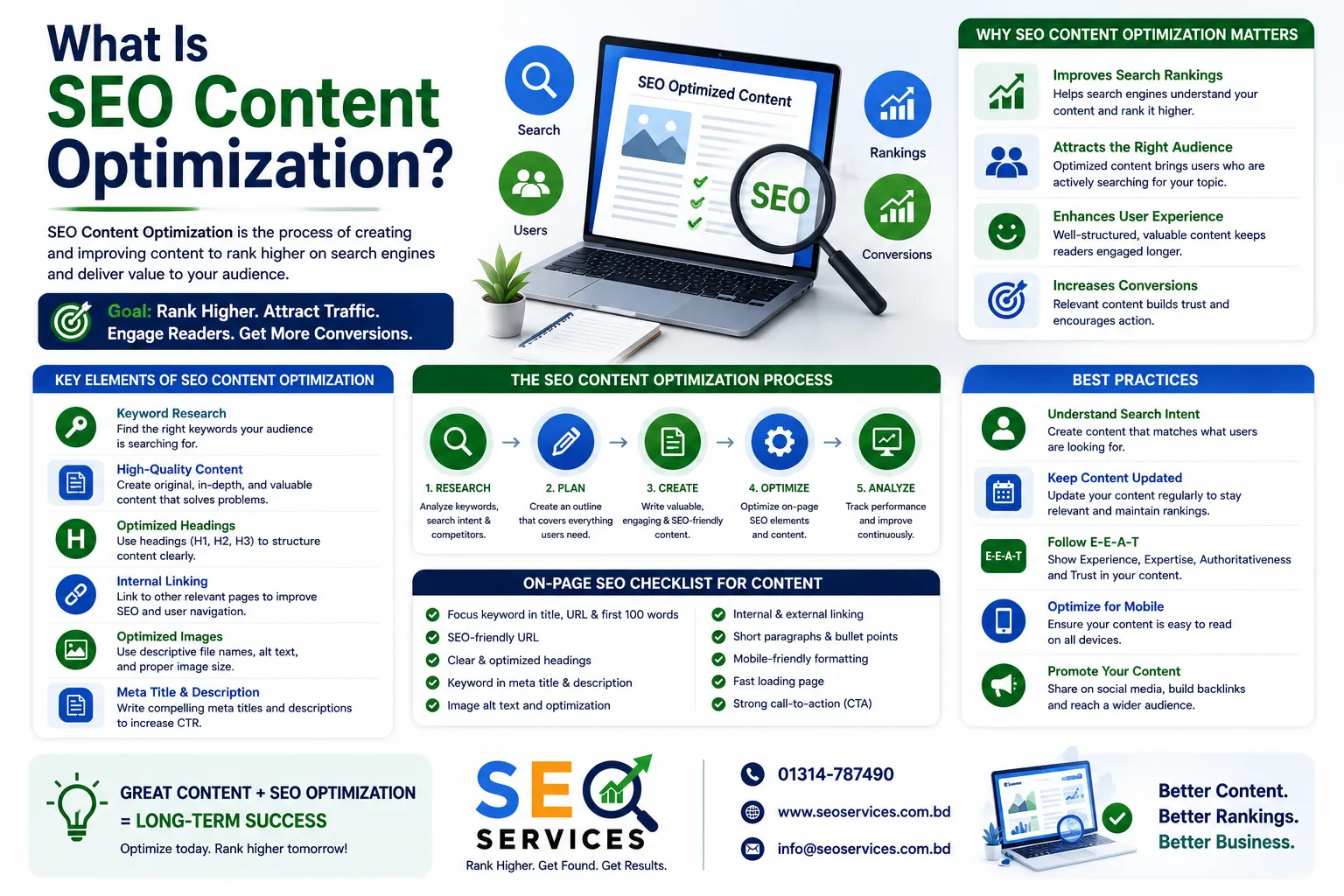
What Is SEO Content Optimization?
SEO content optimization is the process of improving a webpage so that it is more useful to the target audience and easier for search engines to understand, evaluate, and retrieve for relevant searches.
It includes optimizing:
- Search intent
- Topic coverage
- Keywords
- Entities
- Headings
- Content structure
- Internal links
- Images
- Metadata
- Structured data
- E-E-A-T
- Original information
- Conversion elements
The objective is not simply to rank for one keyword.
The objective is to create the best useful resource for a specific search need.
A strong SEO content workflow looks like this:
Search Intent
      ↓
Keyword Research
      ↓
Topic & Entity Mapping
      ↓
Competitor Analysis
      ↓
Content Gap Analysis
      ↓
Information Gain
      ↓
Content Creation
      ↓
Semantic Optimization
      ↓
Internal Linking
      ↓
E-E-A-T
      ↓
AEO + GEO
      ↓
Performance Monitoring
      ↓
Content Refresh
Why SEO Content Optimization Matters
Search engines need to determine whether a page is relevant to a user’s query.
Users also need to decide whether your page is worth reading.
These two objectives overlap.
Poorly optimized content may suffer from:
- Low organic visibility
- Poor engagement
- Weak topical relevance
- Unclear search intent
- Low conversion rates
- Weak internal linking
- Poor AI-search representation
Effective optimization improves the relationship between:
Query → Content → User Need → Search System Understanding
For example, someone searching:
“how much does dental implant treatment cost?”
does not necessarily want a generic article about dental implants.
They may want:
- Price ranges
- Factors affecting cost
- Treatment stages
- Additional procedures
- Insurance considerations
- Questions to ask a dentist
If your page only defines dental implants, it does not fully satisfy the search intent.
SEO Content vs Regular Content
Regular content can be written primarily for human readers.
SEO content needs to satisfy both user needs and search discoverability.
This does not mean writing robotic content.
It means making the subject clear.
Consider two introductions.
Weak
SEO is very important for businesses today. There are many ways to improve SEO, and content is one of them.
Stronger
SEO content optimization is the process of improving webpages so they satisfy search intent, cover relevant concepts, demonstrate expertise, and communicate their subject clearly to search engines and users.
The second introduction immediately establishes:
- Topic
- Definition
- Context
- Search relevance
Start With Search Intent
Search intent should come before content creation.
Ask:
Why did the user perform this search?
Common intent categories include:
Informational Intent
The user wants information.
Examples:
Navigational Intent
The user wants a specific website, brand, or page.
Examples:
- SEO Services BD
- Google Search Console
- Ahrefs login
Commercial Investigation
The user is researching before making a decision.
Examples:
- Best SEO agency in Bangladesh
- SEO tools comparison
- Technical SEO services
Transactional Intent
The user is ready to take an action.
Examples:
- Buy SEO software
- Hire an SEO agency
- Book SEO consultation
Local Intent
The user wants a local business or service.
Examples:
- SEO agency near me
- dentist in Dhaka
- pest control service near me
Match Content Format to Search Intent
Different intents require different content formats.
| Search Intent | Suitable Content |
|---|---|
| Informational | Guide, tutorial, explanation |
| Commercial | Comparison, review, service page |
| Transactional | Product/service landing page |
| Navigational | Brand or destination page |
| Local | Location/service page |
| Mixed | Comprehensive guide with multiple sections |
Do not force every keyword into a blog post.
Sometimes the correct SEO asset is a service page, category page, comparison page, tool page, or location page.
Keyword Research for Content Optimization
Keywords remain useful because they reveal how people describe their needs.
But modern SEO should not treat keywords as isolated strings.
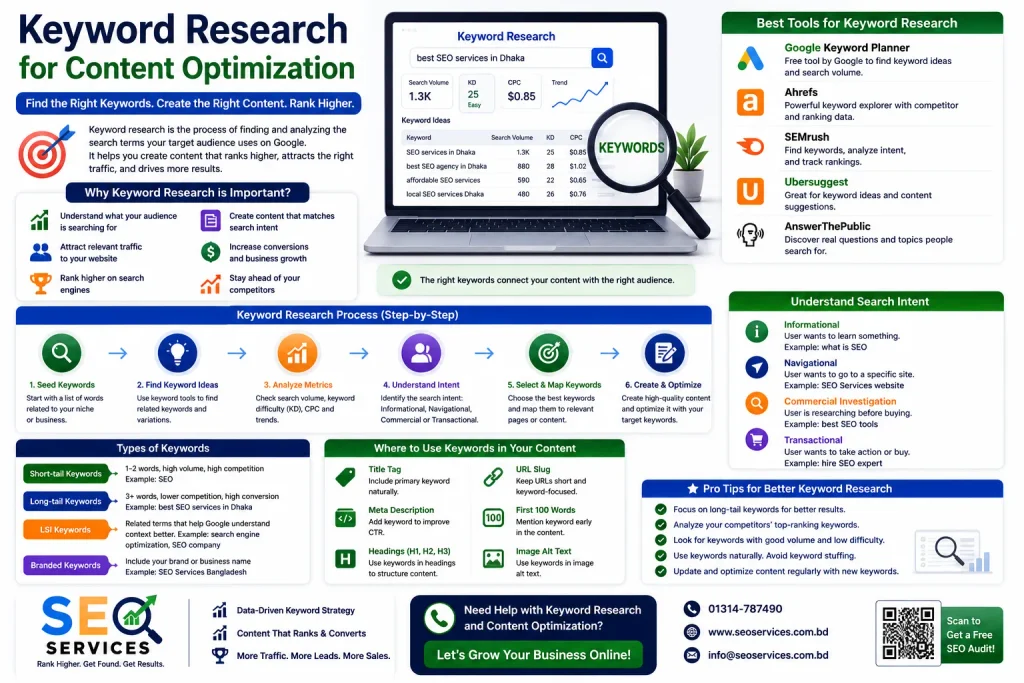
Start with:
Primary Keyword
The central search phrase.
Example:
SEO content optimization
Then identify supporting terminology:
- SEO content strategy
- content optimization
- content SEO
- semantic SEO
- search intent
- content structure
- internal linking
- E-E-A-T
The objective is not to insert every phrase.
The objective is to understand the topic vocabulary and user needs.
Primary, Secondary and Related Keywords
A useful content map can look like this:
Primary
SEO Content Optimization
Secondary
- SEO content strategy
- Content optimization for SEO
- SEO content writing
Related Concepts
- Search intent
- Semantic SEO
- Entity SEO
- Topical authority
- Information gain
- Internal linking
- E-E-A-T
This structure prevents keyword research from becoming keyword stuffing.
Keyword Mapping
Each important keyword should have an appropriate page.
For example:
| Keyword | Recommended Page |
|---|---|
| SEO content optimization | Main guide |
| Semantic SEO services | Service page |
| Entity SEO | Entity SEO guide |
| Search intent optimization | Supporting guide |
| Content cluster SEO | Supporting guide |
| Information Gain SEO | Supporting guide |
This prevents multiple pages from competing against each other for the same intent.
Semantic SEO and Content Optimization
Semantic SEO focuses on meaning rather than exact keyword repetition.
Suppose your topic is:
Crawl Budget Optimization
A semantically complete article may naturally discuss:
- Googlebot
- Crawling
- Crawl capacity
- Crawl demand
- XML sitemaps
- Robots.txt
- Internal linking
- Crawl depth
- Duplicate URLs
- Faceted navigation
- Canonicalization
- Log files
These concepts are related to the subject.
You do not need to force them into the article.
Cover them when they genuinely help the reader understand the topic.
Entity Optimization
Entities are identifiable people, organizations, places, products, services, concepts, and other distinct subjects.
For example, an article about SEO may naturally reference:
- Google Search Console
- Googlebot
- Schema.org
- SEO
- Semantic SEO
- Entity SEO
- Knowledge Graph
Entity optimization means making these subjects and their relationships clear.
For example:
Google Search Console → provides → search performance data
Googlebot → crawls → webpages
Schema.org → defines → structured data vocabulary
Clear relationships provide more context than isolated keyword mentions.
Build an Entity Map
Before writing a comprehensive article, identify:
Primary Entity
The main subject.
Supporting Entities
People, companies, platforms, technologies, products, locations, and concepts directly related to the subject.
Relationships
How those entities connect.
For example:
SEO Content Optimization
        ↓
Search Intent
        ↓
Semantic SEO
        ↓
Entity SEO
        ↓
Topical Authority
        ↓
Information Gain
        ↓
AEO
        ↓
GEO
This creates a logical content framework.
Topical Coverage
A page should cover the information required to satisfy its target intent.
This does not mean making every article extremely long.
A 1,000-word article can be more useful than a 5,000-word article if it answers the question more effectively.
Topical coverage should be determined by:
- Search intent
- Subject complexity
- User expectations
- Competitive landscape
- Required supporting concepts
Avoid adding sections simply to increase word count.
Content Structure
Good structure improves both usability and comprehension.
A strong article generally includes:
H1 → Introduction → H2 → H3 → Examples → Lists/Tables → FAQs → Conclusion
Use headings to represent logical relationships.
For example:
SEO Content Optimization Guide
What Is SEO Content Optimization?
How Search Intent Affects Content
Informational Intent
Commercial Intent
Transactional Intent
This is better than generic headings such as:
- Introduction
- More Information
- Benefits
- Conclusion
Descriptive headings communicate meaning.
Optimize the Introduction
The introduction should answer three questions quickly:
- What is this page about?
- Why does it matter?
- What will the reader learn?
A useful introduction can:
- Define the topic
- Establish context
- Identify the problem
- Preview the solution
Avoid spending several paragraphs on generic statements before reaching the subject.
Optimize Headings
Use the primary topic naturally in the H1.
Use related concepts in H2 and H3 headings where appropriate.
For example:
H1: SEO Content Optimization Guide
H2: What Is SEO Content Optimization?
H2: How to Optimize Content for Search Intent
Semantic SEO and Content Optimization
H2: How E-E-A-T Improves SEO Content
Headings should describe actual content.
Do not create headings solely to place keywords.
Write for Humans First
Search optimization should never make content unnatural.
Avoid:
SEO content optimization services optimize SEO content through SEO content optimization for SEO.
Instead:
Effective SEO content optimization aligns each page with search intent, improves topical coverage, strengthens internal linking, and provides information users can actually apply.
Natural language is easier to read and easier to maintain.
NLP and Natural Language Optimization
Natural Language Processing has become an important part of modern search technology.
However, NLP SEO should not be confused with inserting a list of “NLP keywords.”
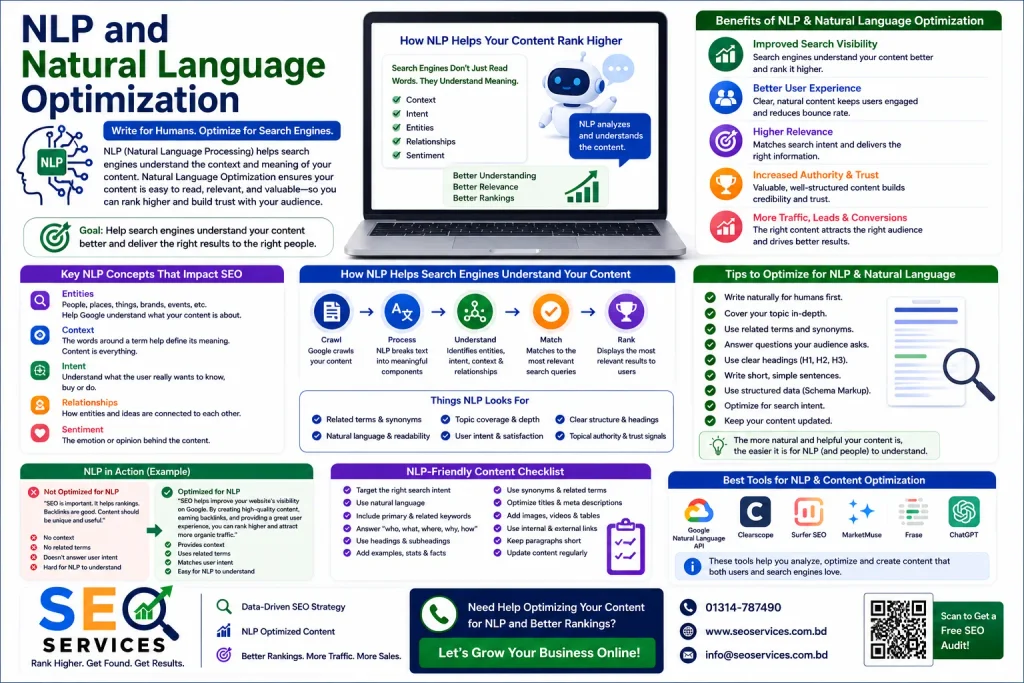
Good natural-language optimization means:
- Clear sentences
- Explicit subjects
- Logical relationships
- Relevant terminology
- Useful definitions
- Contextual explanations
For example:
Googlebot is Google’s web crawler, while Google Search Console provides website owners with data about crawling, indexing, and search performance.
This establishes clear relationships between entities.
Information Gain: The Differentiation Layer
Semantic completeness is not enough.
If ten competitors publish nearly identical articles covering the same concepts, your page needs something more.
That is where Information Gain becomes important.
Ask:
What useful information does this page provide that competing pages do not?
Potential sources include:
- Original research
- First-hand experience
- Proprietary data
- Expert interviews
- Case studies
- Original frameworks
- Real examples
- Unique analysis
Information Gain transforms:
“We covered everything.”
into:
“We contributed something useful.”
Competitor Content Gap Analysis
Before publishing, analyze competing pages.
Look for:
Topics They Cover
Identify the common subject areas.
Questions They Answer
Find recurring user questions.
Missing Topics
Look for relevant subjects competitors overlook.
Weak Explanations
Find sections that are technically correct but poorly explained.
Missing Evidence
Identify claims that lack examples, data, or sources.
Missing Experience
Look for opportunities to add first-hand insights.
Your goal should not be to copy competitors.
Your goal is to understand the baseline and then create something better.
E-E-A-T for SEO Content
E-E-A-T stands for:
Experience
Expertise
Authoritativeness
Trustworthiness
Strong content should make it clear:
- Who wrote it
- Why they are qualified
- What experience they have
- Where important claims come from
- Who operates the website
For high-stakes subjects, reliable sources and qualified authors are particularly important.
Demonstrate Experience
Experience is more convincing when it is specific.
Instead of:
We have extensive SEO experience.
Explain:
During a technical SEO audit, we identified thousands of parameter URLs being crawled despite having little standalone search value. We consolidated the URL structure and improved internal linking around the site’s primary category pages.
Specific experience is difficult to replicate with generic content.
Author Optimization
Where appropriate, include an author profile containing:
- Full name
- Role
- Expertise
- Experience
- Relevant publications
- Professional profiles
For expert-led content, connect the author to their published articles.
This establishes:
Author → Expertise → Content
Internal Linking
Internal links help users navigate and help search engines discover relationships between pages.
For your SEO content ecosystem, this article can naturally link to:
- Semantic SEO
- Entity SEO
- Search Intent Optimization
- Information Gain SEO
- Content Cluster SEO
- NLP SEO
- Topical Authority
- Knowledge Graph SEO
- Internal Linking Strategy
Use descriptive anchors.
For example:
Learn how Information Gain SEO can differentiate your content from competing pages.
Avoid excessive generic anchors such as “click here.”
Build Content Clusters
A content cluster connects a broad pillar topic with supporting pages.
For example:
SEO Content Optimization
        ↓
Search Intent
        ↓
Semantic SEO
        ↓
Entity SEO
        ↓
Content Clusters
        ↓
Information Gain
        ↓
NLP SEO
        ↓
Topical Authority
The pillar page should link to relevant supporting pages.
Supporting pages should link back to the pillar where appropriate.
This creates a connected content architecture.
Optimize Anchor Text
Anchor text should accurately describe the destination.
Good examples:
- Semantic SEO guide
- Search intent optimization
- Entity SEO guide
- Information Gain SEO
- Internal linking strategy
Avoid forcing exact-match anchors into every link.
Natural variation is appropriate.
Image SEO
Images can support content comprehension and search visibility.
Optimize:
- File names
- Alt text
- Image relevance
- Compression
- Dimensions
- Format
Example filename:
seo-content-optimization-process.webp
Better alt text:
SEO content optimization process from search intent research to content publishing
Avoid keyword-stuffed alt text.
Alt text should describe the image when appropriate.
Metadata Optimization
Every important page should have a relevant:
- SEO title
- Meta description
- URL
- H1
The title should accurately describe the page.
The meta description should explain the value of the page and encourage qualified clicks.
Do not treat metadata as a place to repeat the same keyword repeatedly.
URL Optimization
Keep URLs:
- Short
- Descriptive
- Stable
- Lowercase
- Easy to understand
For example:
/seo-content-optimization-guide/
is preferable to a URL containing unnecessary parameters or meaningless IDs.
Schema Markup
Structured data can help search engines understand page information and entities.
Depending on the page, relevant Schema types may include:
- Article
- Organization
- Person
- BreadcrumbList
- Service
- Product
- LocalBusiness
Only use schema that accurately represents the visible content and follows search engine guidelines.
Schema is not a substitute for useful content.
Featured Snippet Optimization
For questions with clear answers, provide concise responses.
Example:
What Is SEO Content Optimization?
SEO content optimization is the process of improving a webpage’s relevance, structure, clarity, semantic coverage, and usefulness so it can better satisfy search intent and perform in organic search.
Then expand with details.
This structure can help users quickly find the answer.
However, featured snippet placement is not guaranteed.
AEO: Answer Engine Optimization
Answer Engine Optimization focuses on making information easy for answer systems to understand and use.
AEO-friendly content often includes:
- Direct answers
- Question-based headings
- Definitions
- Lists
- Tables
- Step-by-step processes
- FAQs
- Clear entity relationships
For example:
Question: What is content optimization?
Answer: Content optimization is the process of improving a webpage so it better satisfies search intent, communicates its topic clearly, and provides useful information to users.
The answer should then be supported by deeper explanation.
GEO: Generative Engine Optimization
Generative Engine Optimization focuses on making content useful and understandable within generative search experiences.
GEO benefits from:
- Original information
- Clear entities
- Expert authorship
- Factual accuracy
- Strong topical coverage
- Evidence
- Explicit relationships
- Useful examples
There is no guaranteed formula for being cited by an AI search system.
The practical objective is to create content that is accurate, useful, distinctive, and easy to understand.
Google AI Overviews and Content Optimization
AI-powered search experiences may synthesize information from multiple sources.
This makes several characteristics increasingly valuable:
Clear Answers
Answer questions directly.
Strong Context
Explain the subject rather than relying on isolated statements.
Original Information
Provide insights that add value beyond generic summaries.
Credibility
Clearly identify authors, organizations, and supporting sources.
Structured Content
Use headings, lists, tables, and logical sections where appropriate.
Do not create content specifically to “game” AI Overviews.
Build useful content first.
Content Refresh Strategy
SEO content should not be considered permanently finished.
Information changes.
Competitors improve.
Search intent evolves.
Search results change.
Review important content periodically.
Check:
- Outdated statistics
- Old screenshots
- Broken links
- Missing sections
- New search questions
- New competitors
- Changed industry practices
- New internal links
Update the page when meaningful improvements are available.
Content Pruning
Not every old page deserves an update.
Some pages may be:
- Duplicate
- Obsolete
- Thin
- Irrelevant
- Permanently outdated
Possible actions include:
Update
Improve the page.
Merge
Combine overlapping content.
Redirect
Send an obsolete page to the most relevant replacement.
Remove
Delete content that has no meaningful purpose.
Do not prune pages based only on traffic numbers.
Evaluate relevance, links, conversions, rankings, and strategic value.
Content Optimization for Conversion
Traffic alone is not the goal for commercial websites.
A high-ranking page should help users take the next appropriate step.
Depending on the intent, this could be:
- Contact
- Request a quote
- Book a consultation
- Purchase
- Download
- Subscribe
- Read another guide
Align CTAs with search intent.
A user reading an informational guide may need a soft CTA.
A user on a commercial service page may be ready for a stronger CTA.
SEO Content Audit
Use this framework to evaluate existing content.
Search Intent
- Does the page satisfy the primary intent?
- Is the content format appropriate?
Topic
- Is the main topic clear?
- Does the page cover important concepts?
Keywords
- Is the primary keyword naturally represented?
- Are related terms used where relevant?
Entities
- Are important entities identified?
- Are relationships clear?
Structure
- Is the H1 descriptive?
- Are H2 and H3 headings logical?
- Are paragraphs easy to scan?
E-E-A-T
- Is the author identifiable?
- Is experience demonstrated?
- Are important claims supported?
Internal Links
- Does the page link to relevant resources?
- Does relevant content link back?
Information Gain
- What does this page provide that competitors do not?
Conversion
- Does the page provide an appropriate next step?
Complete SEO Content Optimization Checklist
Before publishing, review:
Research
- Search intent identified
- Primary keyword selected
- Supporting topics identified
- Entities mapped
- Competitor gaps analyzed
Content
- Clear introduction
- Logical heading structure
- Search intent satisfied
- Comprehensive topic coverage
- Natural language
- Original information
- Relevant examples
E-E-A-T
- Author identified
- Relevant expertise demonstrated
- Experience included
- Important claims supported
- Organization information available
Technical
- SEO title optimized
- Meta description optimized
- Clean URL
- Canonical URL correct
- Mobile-friendly
- Fast loading
- Images optimized
- Schema validated
Internal Linking
- Links to relevant supporting pages
- Descriptive anchor text
- Links from related pages
- No broken internal links
AI Search
- Direct answers included
- Entity relationships clear
- Original information included
- Content supports AEO
- Content supports GEO
Common SEO Content Optimization Mistakes
Keyword Stuffing
Repeating a keyword excessively can make content unnatural.
Search Intent Mismatch
A well-written article can still fail if it does not answer what the user actually wants.
Competitor Copying
Matching competitor word counts and headings does not create differentiation.
Generic AI Content
AI can accelerate research and drafting, but generic output often lacks first-hand experience and original information.
Over-Optimizing NLP Terms
Do not force related words into every paragraph simply because a tool recommends them.
Ignoring Entities
Important people, organizations, products, services, and concepts should be clearly identified where relevant.
Ignoring Internal Links
A high-quality article can remain isolated if it is disconnected from the site’s broader content architecture.
Chasing Word Count
There is no universal word count that guarantees rankings.
Write enough to satisfy the user’s need thoroughly.
SEO Content Optimization for AI-Assisted Workflows
AI can assist with:
- Topic research
- Content outlines
- Entity extraction
- Content classification
- Competitor comparison
- Content gap discovery
- Editing
- Summarization
Human review remains important for:
- Accuracy
- Original analysis
- First-hand experience
- Expert judgment
- Factual verification
- Brand voice
The strongest workflow is:
AI Assistance → Human Expertise → Evidence → Original Analysis → Editorial Review
rather than:
AI Generation → Publish
How to Measure SEO Content Performance
Track more than rankings.
Important metrics can include:
- Organic clicks
- Organic impressions
- CTR
- Ranking distribution
- Conversions
- Assisted conversions
- Engagement
- Internal link clicks
- Indexed pages
- Search queries
- New keywords
- Revenue generated
For informational content, also evaluate whether the page is attracting relevant queries rather than simply increasing total impressions.
A Practical Content Optimization Workflow
Use this process for new articles.
1st Step: Identify Search Intent
Understand what the user needs.
2nd Step: Research the Topic
Study the SERP, competitors, related questions, and authoritative sources.
3rd Step: Map Keywords
Define the primary and supporting terms.
4th Step: Map Entities
Identify important people, organizations, concepts, products, and relationships.
5th Step: Identify Content Gaps
Find missing or weak information in competing pages.
6th Step: Define Information Gain
Decide what unique value your page will provide.
7th Step: Build the Outline
Create a logical H1/H2/H3 structure.
8th Step: Write for the User
Answer questions clearly and provide practical information.
9th Step: Add Semantic Context
Include relevant concepts naturally.
10th Step: Add Internal Links
Connect the page to the broader topic cluster.
11th Step: Optimize Technical Elements
Review title, meta description, URL, images, canonical, and schema.
12th Step: Add E-E-A-T
Identify the author and demonstrate genuine expertise.
13th Step: Optimize for AEO/GEO
Provide direct answers, clear entities, useful structure, and original information.
14th Step: Publish and Monitor
Track performance.
15th Step: Refresh
Update the page when meaningful changes are necessary.
Frequently Asked Questions
What is SEO content optimization?
SEO content optimization is the process of improving a webpage’s relevance, structure, semantic coverage, usefulness, and technical presentation so it can better satisfy search intent and perform in organic search.
How do I optimize content for SEO?
Start with search intent, research relevant keywords and entities, create comprehensive and useful content, demonstrate expertise, optimize headings and metadata, add contextual internal links, and maintain the page over time.
How many keywords should I use in an SEO article?
There is no ideal keyword count. Use important terms naturally where they accurately describe the subject. Avoid forcing keywords into content simply to increase frequency.
Does word count affect Google rankings?
There is no universal word-count requirement for ranking. The appropriate length depends on the topic, search intent, and amount of information necessary to satisfy the user.
What is semantic SEO content?
Semantic SEO content focuses on meaning, context, entities, relationships, and comprehensive topic coverage rather than relying primarily on exact-match keyword repetition.
What is Information Gain in SEO?
Information Gain refers to the additional useful value a page contributes beyond information already available in competing search results.
How does E-E-A-T improve SEO content?
E-E-A-T helps demonstrate experience, expertise, authority, and trustworthiness through identifiable authors, first-hand experience, accurate information, supporting evidence, and transparent organization details.
What is the difference between content SEO and on-page SEO?
Content SEO focuses heavily on the quality, relevance, structure, and usefulness of the information. On-page SEO is broader and can include content as well as titles, metadata, URLs, internal links, headings, images, and other page-level elements.
How does internal linking help SEO content?
Internal linking helps users navigate related resources and helps search engines discover pages and understand relationships between topics.
What is content pruning?
Content pruning is the process of identifying outdated, duplicate, irrelevant, or low-value pages and deciding whether to improve, consolidate, redirect, or remove them.
Should AI-generated content be used for SEO?
AI can assist with research, organization, drafting, and editing, but published content should be reviewed for accuracy, originality, expertise, and usefulness. Generic automated content should not be the objective.
How does SEO content optimization support AEO?
AEO benefits from clear answers, question-based headings, definitions, structured information, FAQs, and explicit relationships between entities and concepts.
How does SEO content optimization support GEO?
GEO benefits from content that is accurate, original, well-structured, authoritative, and easy for generative systems to interpret and reference.
Can SEO content optimization improve Google AI Overview visibility?
Strong content can be eligible for consideration in AI-powered search experiences, but there is no guaranteed optimization technique that ensures inclusion in Google AI Overviews.
How often should SEO content be updated?
There is no universal schedule. Review important pages based on topic volatility, performance changes, outdated information, competitor changes, and changes in search intent.
Conclusion
SEO content optimization has moved far beyond keyword placement.
Modern search rewards content that clearly communicates:
What is this page about?
Who is it for?
What question does it answer?
Which entities and concepts are involved?
Why should users trust it?
What information does it provide that competitors do not?
The strongest SEO content strategy combines:
Search Intent
↓
Keyword Research
↓
Semantic SEO
↓
Entity SEO
↓
Topical Authority
↓
Information Gain
↓
E-E-A-T
↓
Internal Linking
↓
AEO + GEO
The goal is not to create content that simply looks optimized.
The goal is to create content that deserves to be found.
When your content is useful to people, clearly structured for search systems, connected to a strong topical architecture, supported by genuine expertise, and differentiated through original information, it becomes better prepared for both traditional organic search and the rapidly evolving AI search ecosystem.
Optimize Your Content for Google and AI Search
Creating content is easy.
Creating content that satisfies search intent, establishes topical authority, demonstrates expertise, and remains competitive across traditional and AI-powered search requires a structured strategy.
SEO Services BD helps businesses optimize content through:
- Search Intent Optimization
- Semantic SEO
- Entity SEO
- Topical Authority
- Information Gain
- Content Clusters
- Internal Linking
- E-E-A-T
- AEO
- GEO
- AI Search Optimization
Build content around what your audience actually wants to know, add information they cannot easily find elsewhere, and connect every page to a clear website-wide content strategy.
Ready to turn your existing content into a stronger organic search asset?
Start with an SEO Content Audit.